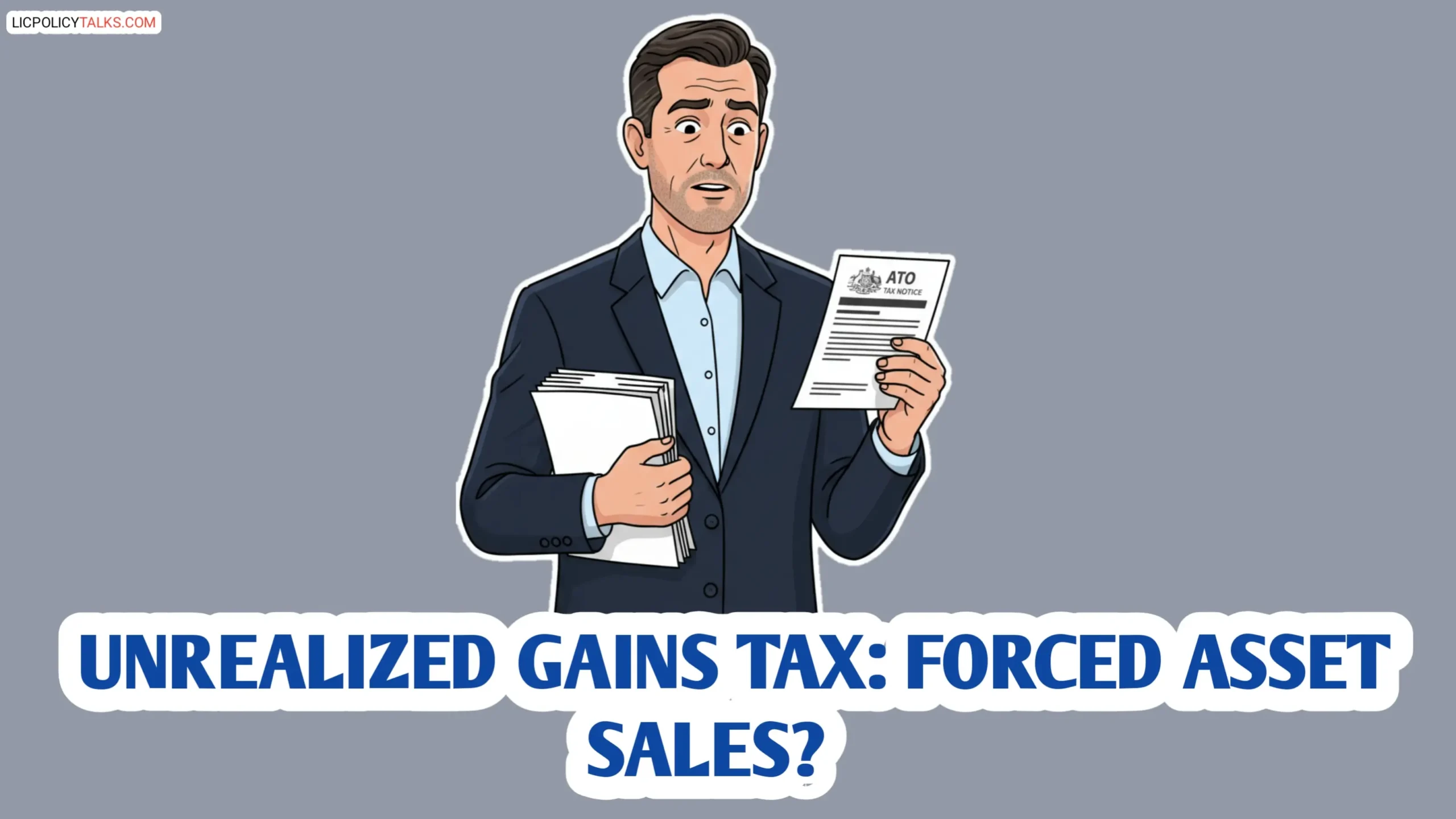



Hi friends! Picture this: It’s 2027. You haven’t sold a single investment in your Self-Managed Super Fund (SMSF). But you’ve just opened your mailbox to find a huge tax bill from the ATO. Your fund’s property and shares have gone up in value—a great “paper profit”—but now you need to find tens of thousands in real cash to pay for it. This isn’t a dystopian fantasy. It’s the reality for high-balance super funds starting July 1, 2026.
The core of this looming crisis is a new law called Division 296. From mid-2026, it imposes an extra 15% tax on the earnings for the part of your super balance that exceeds $3 million. And here’s the kicker: the definition of “earnings” includes unrealized gains. That means you’re taxed on market growth even if you don’t sell a thing. This creates what I’m calling the “Super Cap Crisis“—where paper profits demand real cash, potentially forcing the sale of the very assets that created the gain. Thankfully, the government’s decision to push this start date to 2026 (Revamped Division 296 tax pushed back to 1 July 2026) is a critical window to prepare.
The goal of this article is simple: to cut through the complexity. We’ll explain exactly how this unrealized tax 2026 works, illustrate with real numbers how it can trap you in a liquidity crisis, and outline clear, strategic defences you can start building now.
What is the Unrealized Gains Tax (Division 296) and How Does it Work in 2026?
Let’s break down Division 296 without the jargon. It’s an additional 15% tax, but only on the “earnings” attributed to the part of your Total Super Balance that’s over the $3 million cap at the end of a financial year. Think of it as a special extra levy for the portion of your super that’s in the “over $3M club.”
The truly shocking part is how “earnings” are calculated. For your entire investing life, you’ve likely only paid tax on realized gains—money you actually made from a sale, rent, or dividends. Division 296 changes the game entirely. Its formula for earnings is: (Closing Balance – Opening Balance + Withdrawals – Contributions). This means if the share market booms and your portfolio’s value jumps, that growth is counted as “earnings” for this tax—even though it’s just a number on a statement. It’s a tax on paper profits.
This is fundamentally different from the Capital Gains Tax (CGT) we all know. The confusion is so common that even experts are publishing guides to clear it up (like this one on the $3m super tax – your top 10 questions answered). To make the contrast crystal clear, let’s look at them side-by-side.
| Feature | Traditional Capital Gains Tax (CGT) | Division 296 Tax (From 2026) |
|---|---|---|
| Tax Trigger | Sale or disposal of an asset (Realized Gain) | Increase in total super balance > $3M (Includes Unrealized Gain) |
| Liquidity Need | You have sale proceeds to pay the tax | You need separate cash to pay the tax on paper gains |
| Timing | Upon selling the asset | Annual, based on yearly balance movements |
| Impact on Portfolio | You decide when to sell and crystallize gain | ATO’s tax bill may force a sale at an inopportune time |
Finally, remember this cap is per person, not per fund. For a couple with a joint SMSF worth $6.5 million, if it’s split evenly, both members individually have balances above the $3M threshold and would both be subject to Division 296 on their respective shares. The core problem isn’t just the extra tax, it’s that this tax on unrealized gains creates an annual cash demand that might not match your fund’s actual cash flow.
The Forced Sale Trap: Why a ‘Paper Profit’ Can Trigger a Real Liquidity Crisis
Understanding the rule is one thing. Feeling its pinch is another. The real danger of Division 296 isn’t just a higher tax rate—it’s the severe liquidity trap it creates. Let’s visualize the problem. In a typical high-growth SMSF, most of the annual increase in value comes from the appreciation of long-term holdings like property or blue-chip shares. The actual cash income from dividends and rent is often a much smaller slice. Yet the ATO’s tax bill demands cash.
The Liquidity Trap: Super Growth vs. Tax Cash Demand
A visual breakdown of where an SMSF’s value growth comes from versus the cash needed to pay the new tax.
See the mismatch? This isn’t a theoretical chart. Let’s walk through a case study. Meet John and Sarah. They have a well-managed SMSF valued at $6.5 million, heavily invested in a commercial property and a portfolio of long-term Australian shares. In the 2026-27 financial year, a strong property and share market pushes their fund’s value to $7.2 million—a healthy $700,000 paper gain.
Here’s their Division 296 calculation:
- Proportion over $3M per member: Assuming a 50/50 split, each has an end balance of $3.6M. The proportion over the cap for each is ($3.6M – $3M) / $3.6M = 16.67%.
- Taxable Earnings per member: Their individual share of the $700k fund growth is $350k. The taxable amount is 16.67% of $350k = $58,345.
- Extra Tax per member: 15% of $58,345 = $8,752.
Together, John and Sarah owe the ATO $17,504 in extra tax. Their SMSF might only generate $30,000 in actual cash dividends and rent that year. After paying this new tax, their cash flow is squeezed by over half. If they don’t have a cash buffer, they are staring at a classic forced asset liquidation scenario to pay the bill. This gets worse in volatile markets where a temporary price spike can generate a tax bill, or if the compounding effect hits year after year. Some analyses suggest the policy’s impact is more severe than first thought (Why the new super tax is worse than we thought).
The assets most at risk of these forced ATO asset sales are the illiquid ones: direct property (which can take months to sell), unlisted assets, and large, concentrated parcels of shares in a single company that you wouldn’t normally sell.
This crisis coincides with other major changes. Understand the full landscape with our guide to Payday Super.
Strategic Defences: How to Prepare Your Portfolio Before July 2026
1. Restructuring Asset Holdings for Liquidity
The most direct defence is to ensure your SMSF has sufficient liquid assets to cover anticipated Division 296 bills. This might mean strategically holding more cash, term deposits, or highly liquid listed ETFs within the fund. For some, it may involve exploring whether to shift some long-term growth assets (like property) out of the SMSF and into a family trust or other structure. This is a major decision with significant trade-offs—you’d likely crystallize a CGT event now and lose the super fund’s favourable tax environment on future earnings—so it requires detailed modelling with a pro.
2. Strategic Withdrawals and Contribution Planning
If you’re in the pension phase, consider whether strategic withdrawals could help manage your closing balance each year. A withdrawal reduces your end-of-year balance, which directly reduces the “earnings” calculated under Division 296. Conversely, if you’re nearing the $3M super balance cap, you may need to rethink making large non-concessional contributions, as these will push your balance higher and increase future tax exposure.
3. The Insurance Question: Can it Help?
It’s worth checking if insurance policies held inside your super are counted in your Total Super Balance (they generally are). For some, the high cash value of certain policies could be a factor pushing them over the threshold. This doesn’t mean you should cancel necessary cover, but it’s another element to discuss with your advisor.
4. Seeking Professional Advice: Your Essential First Step
Let’s be honest: this is complex. The super tax system is so intricate that there’s a genuine knowledge gap (Most people (and the ATO) do not know their super tax). Your first and most important move is to consult a specialist SMSF financial advisor and accountant. They can model your specific position, calculate potential liabilities, and help you build a tailored plan. It’s also fair to acknowledge the government’s perspective that this measure promotes equity in the system (The case for the $3 million super tax). Our job isn’t to debate politics, but to ensure you’re prepared for the practical, financial reality of the law as it stands.
The Division 296 trap is just one part of the puzzle. Dive deeper into how it specifically targets retirement liquidity here.

FAQs: ‘wealth tax Australia’
Q: Is this a ‘wealth tax’ on my total super balance?
Q: What happens if my balance falls below $3M in a future year?
Q: Can I simply move assets out of my SMSF before 2026?
Q: Are defined benefit schemes affected differently?
Q: Where can I find my official Total Super Balance?
Conclusion
So, friends, here’s the bottom line. The unrealized tax 2026 under Division 296 creates a perfect storm: it taxes paper gains, but the ATO demands real cash. If your wealth is tied up in illiquid assets, this mismatch can lead directly to ATO asset sales you never planned for—selling a property or shares at a time not of your choosing, just to pay a tax bill.
The delay until July 2026 is a gift of time, not a reprieve. It’s your window to act. The core message for every SMSF trustee or high-net-worth individual is proactive liquidity management. Don’t wait for the first bill to arrive.
Your clear call to action is this: Schedule a meeting with your financial advisor and SMSF specialist before the end of 2025 to model your position and build your defence. This isn’t about panic; it’s about smart, forward-looking preparation.