Secure Act 2.0 Roth Catch-Up Mandate 2026: 7 Critical Rules for High Earners Over $145k

×
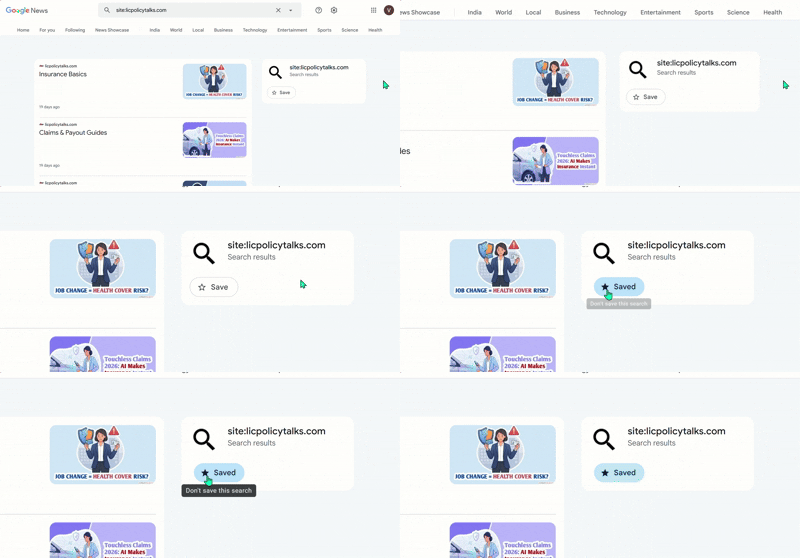
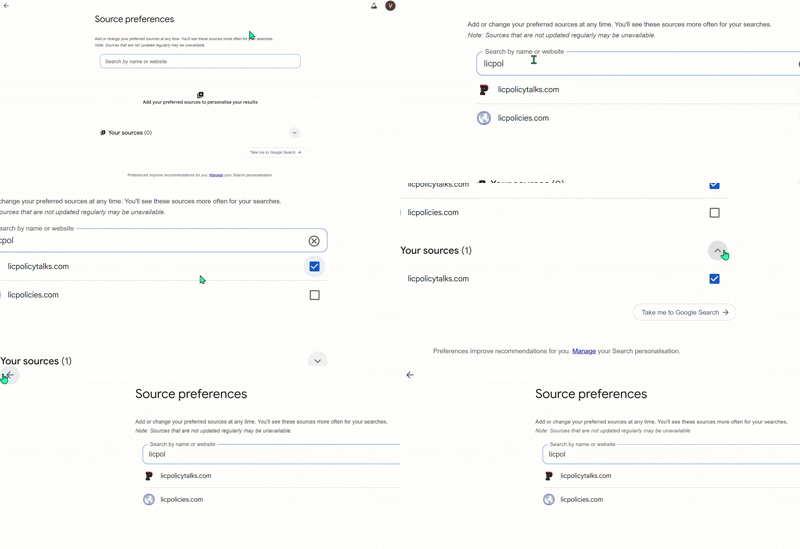
Follow Us on Google News
Follow Guide
Please click the "Star" ⭐ icon/button to save us and get updates!
Open Google News
Secure Act 2.0 Roth Catch-Up Mandate 2026: 7 Critical Rules for High Earners Over $145k

Hi friends! Let’s be honest, retirement planning can feel like a moving target, especially with new laws popping up. You know what? Right now, there’s a huge change on the horizon that could directly impact your 401(k) strategy if you’re a high earner. It’s time to talk about the Secure Act 2.0 Roth catch-up mandate. If the thought of navigating another tax code update makes your head spin, don’t worry. This guide is your friendly map through the new rules. We’ll break down exactly what’s happening, who it affects, and most importantly, give you a clear, step-by-step plan to handle it like a pro.

Starting in 2026, a pivotal rule from the Secure Act 2.0 kicks in, fundamentally changing how savers over 50 with high incomes make their catch-up contributions. This isn’t just a minor tweak; it’s a mandatory shift for a specific group of high-income earners retirement planning. Let’s dive into what this means for you.

Decoding the Mandate: What Secure Act 2.0 Actually Says

The SECURE 2.0 Act was signed into law to enhance Americans’ retirement security, packed with dozens of provisions aimed at helping people save more. One of its most talked-about—and complex—rules is Section 603. This section introduces a new requirement for “Applicable Employer Plans” like your 401(k), 403(b), and governmental 457(b) plans. The core mandate is simple: if you’re age 50 or older and your prior-year W-2 wages from that employer exceeded $145,000, any catch-up contributions you make must go into a Roth account. This rule applies to the Thrift Savings Plan (TSP) for federal employees as well. Originally slated for 2024, the IRS granted a two-year administrative delay, pushing the effective date to 2026. This delay is a gift of time for both employees and employers to prepare for these significant Secure 2.0 changes. To understand the broader landscape of choices introduced by this law, you can read about how Savers Face New Choices Under SECURE 2.0 Act.

The 7 Critical Rules Every High Earner Must Know (2026 Onward)

Rule 1: The $145,000 Threshold Isn’t What You Think

This is the most crucial detail to get right. The $145,000 threshold isn’t about your current salary or total household income. It’s specifically based on your W-2 wages from the prior year from the employer sponsoring your retirement plan. What counts is the figure in Box 1 of your W-2, which is your income after pre-tax deductions like health insurance or traditional 401(k) contributions. It does not include your spouse’s income, investment earnings, or side hustle 1099 income. After 2026, this $145,000 figure will be adjusted for inflation, so it will creep up over time. Understanding this “look-back” rule is key to planning your contributions a year in advance.

Do the 2026 Roth Rules Apply to You?

Prior Year W-2 < $145k
Choice: Pre-tax or Roth Catch-up
Prior Year W-2 ≥ $145k
Mandatory: Roth Catch-up Only

*Based on W-2 Box 1 wages from the prior year.

Rule 2: “Catch-Up” Contribution Limits Remain (Mostly) Unchanged

Here’s some good news: the dollar amount you’re allowed to contribute isn’t being slashed. For 2025, the standard catch-up contribution limits for those 50+ is $7,500, and it’s projected to be around $7,750 for 2026 (pending official IRS inflation adjustments). The seismic shift is in the tax treatment, not the limit itself. Your ability to save that extra money remains intact. A separate Secure 2.0 provision also introduces a higher catch-up limit of $10,000 (or 150% of the standard catch-up) for participants aged 60, 61, 62, and 63 starting in 2025. If you’re in that age bracket and a high earner, that larger amount would also be subject to the mandatory Roth rule.

Rule 3: Your Plan Must Offer a Roth Option

This rule places a direct obligation on your employer’s retirement plan. For a high-earning employee to make any catch-up contribution at all in 2026, the plan itself must have a “designated Roth account” feature. If the plan does not offer a Roth option, it is prohibited from accepting any catch-up contributions from participants who trigger the high-earner rule. This isn’t just a suggestion; it’s a compliance requirement. This creates immediate urgency for employees to verify their plan’s features and for plan sponsors to amend their plans if necessary.

Rules 4 & 5: The Tax Impact – Pay Now vs. Pay Later

This is the heart of the change. Under the old rules, you could choose: contribute pre-tax (lowering your current taxable income, paying taxes later) or Roth (using after-tax dollars for tax-free growth). The new mandatory Roth contributions eliminate that choice for high earners. Let’s use an example: You’re in the 32% federal tax bracket and want to make a $7,500 catch-up contribution.

Old Way (Pre-tax): You contribute $7,500. Your taxable income for the year is reduced by $7,500, saving you $2,400 in taxes now (32% of $7,500). The full $7,500 grows, but you pay income tax on every dollar you withdraw in retirement.

New Way (Roth): You contribute $7,500. This comes from your take-home pay, so you’ve already paid roughly $2,400 in taxes on that money. The trade-off? Every single dollar of growth is tax-free, and qualified withdrawals in retirement are completely tax-free.

The strategic question becomes: Is it better to pay taxes now at your peak career tax rate, or defer them to retirement? We’ll explore that next.

Rule 6: Not All High Earners Are Affected (Key Exceptions)

Breathe a sigh of relief if you’re self-employed or a business owner. This rule has clear exceptions. It specifically targets W-2 employees. If you’re a sole proprietor with a Solo 401(k) or a partner in a partnership where your income is reported on a K-1, this mandate does not apply to you. Your catch-up contributions can still be made on a pre-tax or Roth basis as your plan allows. The law is aimed at traditional company retirement plans.

Rule 7: This is a Plan-Level Rule, Not Just Yours

Finally, it’s vital to see the bigger picture. This isn’t just an individual burden; it’s a massive administrative change for your company’s HR and finance teams. Plan sponsors must amend plan documents, update payroll systems to track prior-year W-2 wages, reprogram contribution logic, and communicate all of this clearly to participants. The entire infrastructure of the plan needs to adapt. This underscores why the two-year delay was crucial. For a look at how other federal retirement systems are adjusting for 2026, you can see the related updates for the New 2026 TSP and IRA Contribution Limits.

FeaturePre-2026 Rules2026 Secure Act 2.0 Rules
Tax TreatmentChoice: Pre-tax or RothMandatory Roth (after-tax)
Income TriggerNone for choicePrior-year W-2 > $145,000
Plan RequirementRoth option not needed for pre-tax catch-upRoth feature MUST be offered
Contribution LimitStandard catch-up amount ($7,500+)Limit unchanged, but tax treatment is fixed

Strategic Implications: Is This a Setback or a Stealth Opportunity?

It’s easy to view this as a pure loss, especially framed as High Earners Over Age 50 Will Lose a 401(k) Tax Break. You’re giving up an immediate tax deduction at what’s likely your highest marginal rate. But let’s reframe. A Roth account offers powerful, permanent benefits: tax-free growth, no Required Minimum Distributions (RMDs) during your lifetime, and priceless tax diversification in retirement. The real question isn’t your marginal tax rate now, but your effective tax rate in retirement. If you expect to be in a similar or higher bracket later, paying taxes upfront can be a smart move. Furthermore, this mandate might prompt you to optimize elsewhere: max out your HSA (triple tax-advantaged!), explore a deferred compensation plan, or see if your plan allows a “mega backdoor Roth.” For many, this is a strategic shift rather than a setback.

Read Also
Biden’s 2025 Medical Debt Relief: How New Policy Slashes Hospital Bills by 40%
LIC TALKS! • Analysis

Your 2024-2026 Action Plan: A Step-by-Step Guide

For Employees & Individuals (Steps 1-4)

Don’t wait until 2026. Take control with this phased approach:

Step 1 (Now): Pull your 2024 W-2. Project your 2025 income. Will your Box 1 wages cross the $145k threshold? This determines your 2026 contribution status.

Step 2 (2025): Have a conversation with HR or your plan administrator. Ask: “Will our retirement plan have a Roth option by 2026?” and “When will you communicate the implementation details?”

Step 3 (2025 Tax Planning): Consult your financial advisor or CPA. Model the tax impact of losing the pre-tax deduction. Discuss strategies to offset it, like maximizing HSA or IRA contributions.

Step 4 (2026 Onward): When enrolling, ensure your catch-up contribution is directed to the Roth source. Re-evaluate your overall savings rate to meet your retirement goals.

For Employers, HR & Plan Administrators

The burden of compliance falls here. A smooth rollout is critical:

Action 1: Plan Amendment. Work with your third-party administrator (TPA) or legal counsel to update plan documents for Section 603 compliance.

Action 2: Systems & Payroll Check. Coordinate with your payroll provider. Ensure their system can identify eligible employees based on prior-year W-2 wages and default their catch-ups to Roth.

Action 3: Participant Communication. Start educating employees in mid-2025. Use clear language to explain the rule, the income threshold, and what they need to do.

Action 4: Offer Support. Consider providing financial wellness resources or advisor access to help employees navigate this significant change to their retirement plan updates.

Read Also
TCJA Tax Sunset 2026: 3 Urgent Moves for High-Net-Worth Expats to Dodge the $14M Estate Tax Cliff
LIC TALKS! • Analysis

FAQs: ‘catch-up contribution limits’

Q: If my income is just barely over $145,000, can I reduce my W-2 wages via pre-tax deductions to get below the threshold?
A: Yes, potentially. The $145k is based on Box 1 wages, which come after pre-tax deductions. Maximizing contributions to a traditional 401(k), HSA, or FSA can lower your Box 1 income below the limit.
Q: Does this rule apply to IRA catch-up contributions?
A: No, this mandate only applies to employer plans like 401(k)s and 403(b)s. Your IRA contributions and catch-ups follow separate, unchanged rules and are not affected by this Secure 2.0 provision.
Q: I have multiple jobs. Is the $145,000 threshold per employer or total W-2 income?
A: It’s per employer. If you earn $100k at Job A and $90k at Job B, neither individual W-2 exceeds $145k, so the rule doesn’t trigger at either plan. Keep records of all your W-2s.
Q: What happens if my plan doesn’t add a Roth option by 2026?
A: The plan cannot accept any catch-up contributions from high-earning participants over 50. This is a major consequence that should motivate your employer to add the Roth feature promptly.
Q: Can I still make pre-tax catch-up contributions if I’m under 50 but otherwise a high earner?
A: Yes. This rule only applies to catch-up contributions, which are exclusively for those aged 50 and over. Your regular contributions are unaffected and can be pre-tax or Roth as your plan allows.

Conclusion

The 2026 Secure Act 2.0 Roth catch-up mandate is a significant change, but forewarned is forearmed. By understanding these seven rules, you can move from anxiety to action. Remember, this isn’t necessarily a loss—it’s a forced step into tax diversification that could benefit you in the long run. The key is proactive planning. Start the conversation with your HR department and your financial advisor now. Use the next two years to model scenarios, adjust your strategy, and ensure your plan is ready. By taking these steps, you can confidently navigate this new rule and keep your high-income earners retirement goals firmly on track.

How useful was this post?

Click on a star to rate it!

Average rating 0 / 5. Vote count: 0

No votes so far! Be the first to rate this post.

Leave a Comment

Your email address will not be published. Required fields are marked *

Reviews
×
Scroll to Top