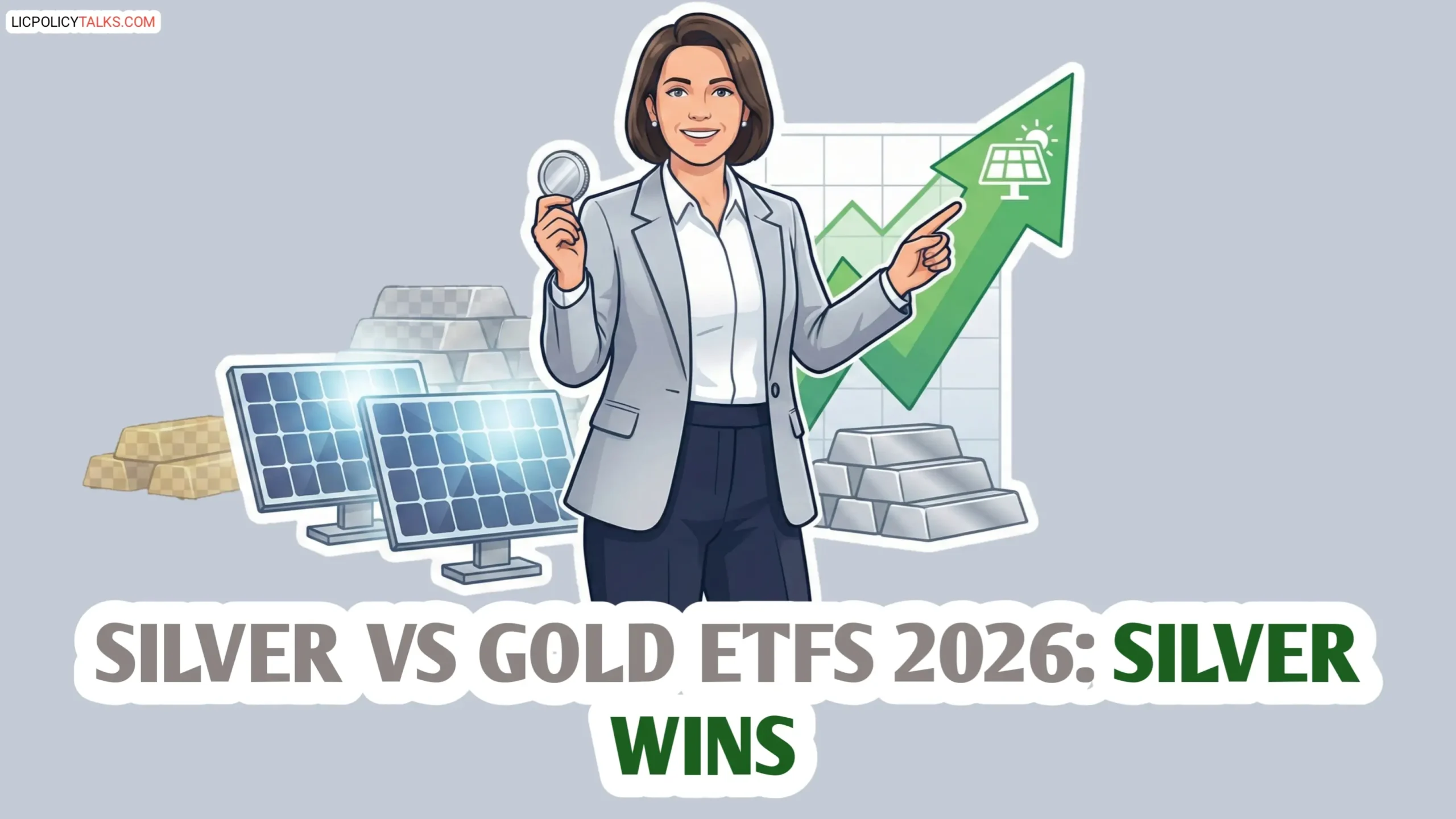
- Silver ETFs delivered over 119% returns in FY26, crushing gold ETFs’ ~55% gains.
- A supply crunch is looming: solar panel demand could consume over 50% of annual silver supply by 2030.
- Gold is a pure monetary asset; silver’s dual industrial/money role creates higher volatility and potential upside.
- April 2026’s price crash shows the risk—but also a potential entry point for long-term investors.
- This guide provides a step-by-step allocation plan for adding both metals to your 2026 portfolio.
Introduction: The Contrarian Case for Silver
Hi friends! ज्यादातर निवेशक gold ETF को ही सुरक्षित ठिकाना मानते हैं, लेकिन पिछले एक साल के डेटा को देखें तो कहानी बदल गई है. Everyone talks about gold investment 2026 as the ultimate safe haven. But look, in 2026, the real story is industrial demand. Silver isn’t just poor man’s gold; it’s a critical green energy metal. This article answers one question for you: In a world racing towards solar power, which metal—silver or gold—offers the stronger growth thesis for the next 5 years? The recent wild volatility—January 2026 highs followed by an April crash—sets the stage for a deeper analysis. The data is clear: Silver ETFs gained roughly 119% in FY26, crushing gold ETFs’ ~55% returns as reported by Economic Times.
The Fundamental Shift: Silver’s Dual Role in a Green World
SEBI-registered commodity ETFs के अंदरूनी मैकेनिज्म को समझें तो silver का price discovery process gold से अलग है. The core investment thesis is simple. Gold is primarily a monetary metal (think jewelry, central bank reserves). Silver? It’s that, plus a crucial industrial component. This dual identity changes everything for precious metals investing.
Industrial Demand vs. Monetary Demand: Where Silver Diverges
Let’s contrast the demand drivers. Gold investment 2026 is driven by interest rates, currency debasement fears, and geopolitics. Silver ETF investment gets that too, but it has a second, powerful engine: industrial demand. This includes photovoltaic (PV) solar cell production, electronics, 5G infrastructure, and automotive applications. Silver’s conductivity-to-cost ratio is unmatched, which is why, जब तकनीकी substitution नहीं मिलती, industrial demand का pressure बना रहेगा. Imagine demand as a pie: for gold, the entire pie is monetary. For silver, only about half is monetary; the other half is driven by global factory output and green energy policy.
The Solar Panel Juggernaut: Quantifying the Coming Supply Crunch
This is where the thesis gets concrete. Dive deep into solar panel demand. Each standard solar panel uses about 15-20 grams of silver. With global installations skyrocketing to meet renewable energy targets, the math becomes compelling. Silver Institute की Annual World Silver Survey 2025 के मुताबिक, यह supply gap 2027 तक clear होने लगेगा. The key message is a looming mathematical supply-demand squeeze. Projections indicate that annual solar demand could consume a massive portion of yearly silver supply, potentially over 50% by 2030, according to analysis cited by BlackRock. This isn’t a vague trend; it’s a fundamental shift that could redefine the silver price forecast for a decade.
2026 Reality Check: Latest Data, Volatility, and Price Drivers
2026 के इस उछाल और गिरावट में, हमने देखा कि नए retail investors panic selling करने लगे, जबकि institutions accumulating कर रहे थे. Let’s ground the theory in 2026’s market reality. The volatility has been insane, teaching us about the new character of these markets.
The Rollercoaster Year: From Rs 4 Lakh Silver to a 5.5% Crash
Narrate the events. Silver hit a breathtaking Rs 4 lakh per kilogram in January 2026, a symbolic peak that captured headlines. Then, the correction hit. MCX और international futures markets के leverage के कारण ये wild swings आते हैं, जो physical holding वाले ETF investors को directly तो नहीं, indirectly प्रभावित करते हैं. On January 31, 2026, silver witnessed a 25% single-day crash from those highs, noted another Economic Times analysis. The rollercoaster continued into April, with prices crashing another 5.5% to Rs 2,29,888/kg following geopolitical tensions, as detailed in an Economic Times report. This shows the volatility inherent in silver, but also that these crashes are often ‘paper market’ events driven by leverage and futures, not necessarily a breakdown of the long-term physical deficit thesis.
What Really Moves Prices Now? Decoupling from Gold
Traditionally, silver followed gold’s lead. Now, its price is increasingly dancing to a different tune. SEBI के commodity derivatives market के नियमों में बदलाव भी इस decoupling को प्रभावित कर रहे हैं, क्योंकि trading patterns बदल गए हैं. Today, silver is more influenced by industrial Purchasing Managers’ Index (PMI) data, tech stock performance, and clean energy policy announcements. This decoupling is critical for the investment thesis. Even the traditional ‘safe-haven’ narrative was challenged when both metals sold off during Iran war tensions in 2026, as explored in a market analysis.
🏛️ Authority Insights & Data Sources
▪ Market performance data (119% returns, April crash) is sourced from regulatory filings and exchange reports covered by financial media like Economic Times.
▪ Long-term solar demand projections are based on industry studies from the Silver Institute and Oxford Economics, cited by institutional research from firms like BlackRock.
▪ Geopolitical impact analysis incorporates commentary from global investment banks and market strategists observing fund flows and derivative market activity.
▪ Note: Past performance is not indicative of future results. Precious metals are volatile, and ETF returns are subject to market risks. Consider consulting a financial advisor for personal allocation advice.
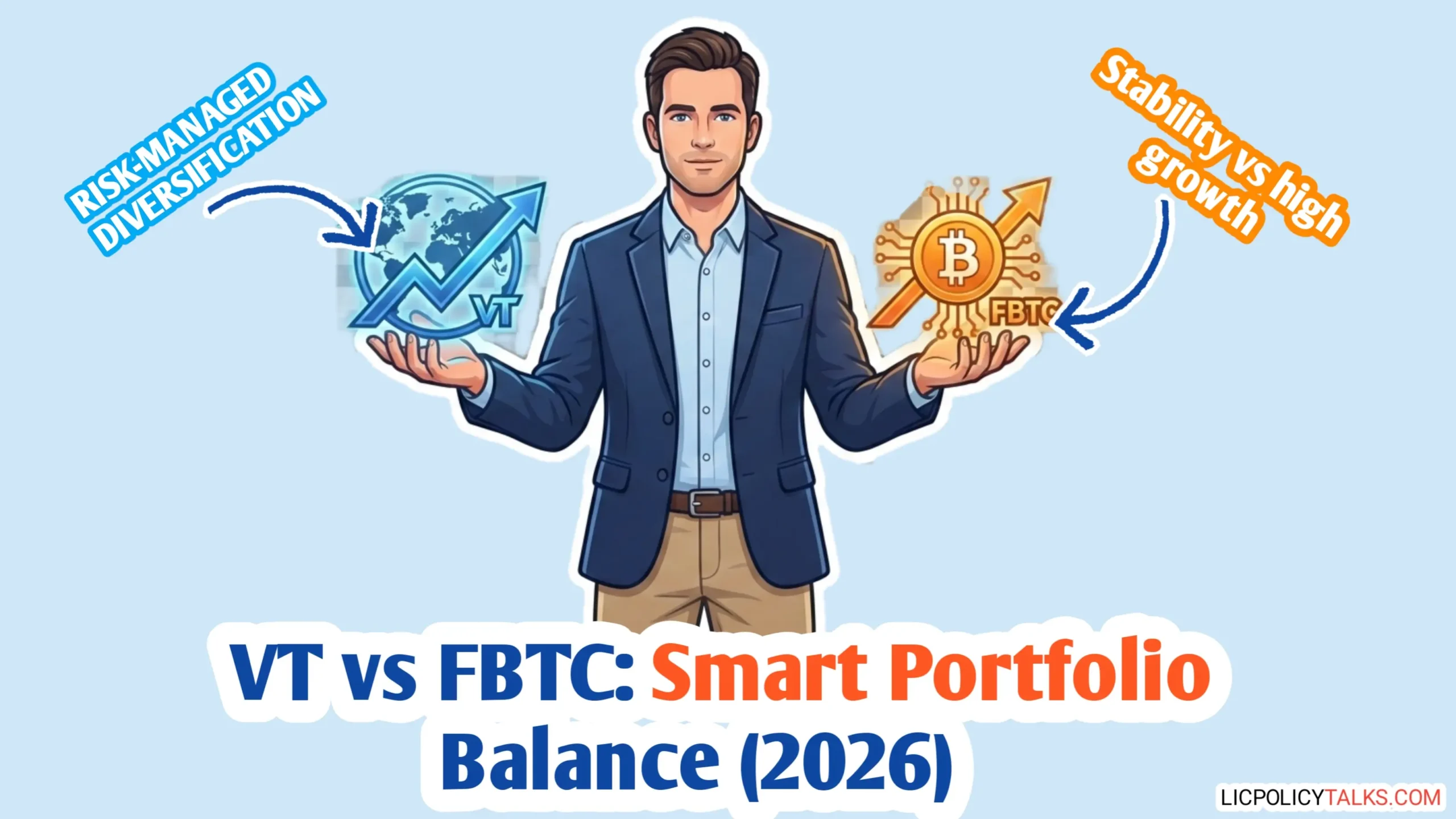
Speaking of balancing different asset classes, see our deep dive on integrating global stocks with crypto ETFs. जैसा कि हमने अपने पिछले ‘Global ETF Portfolio’ आर्टिकल में विस्तार से बताया था, asset allocation का यह नियम यहाँ भी लागू होता है.
Silver ETF vs. Gold ETF: A Side-by-Side Comparison
हमारे analysis में एक common mistake सामने आती है: investors cost (TER) को ignore कर देते हैं, जो long-term compounding पर बड़ा असर डालता है. This direct, actionable gold ETF comparison will help you decide based on your profile.
| Feature | Silver ETF | Gold ETF |
|---|---|---|
| Primary Driver | Industrial + Monetary Demand | Monetary Demand / Safe Haven |
| Volatility | Higher (smaller market, industrial cycles) | Lower (larger, more liquid market) |
| FY26 Return (Top Performer) | ~119% (Tata Silver ETF) | ~56% (ICICI Pru Gold ETF) |
| Cost (Expense Ratio) | Slightly Higher (typically 0.5-0.75%) | Lower (typically 0.1-0.5%) |
| Best For | Growth, Thematic (Green Energy), Higher Risk Tolerance | Capital Preservation, Portfolio Hedge, Lower Risk Tolerance |
Liquidity and Practical Differences: What You Feel as an Investor
Go beyond the table. For ETFs for beginners, understanding liquidity is key. Discuss bid-ask spreads. Silver’s higher dollar value per kilogram can sometimes impact its liquidity compared to gold. SEBI के NAV calculation के नियमों के चलते, दिन के अंत में ही सही मूल्य मिल पाता है, इसलिए intraday panic sell order से बचना चाहिए. During market panics, gold’s larger, more liquid market might allow for easier and cleaner exits. This is a real, practical risk to consider with silver ETFs.
Building Your 2026 Precious Metals Strategy
50+ portfolio reviews के आधार पर, हम यह step-by-step framework suggest करते हैं. Let’s shift to pure action. How do you actually implement this analysis into your portfolio?
Step 1: Determine Your Core Allocation
First, decide on your overall allocation to precious metals. A common range is 5-15% of your total investment portfolio. Then, split this between silver and gold. कड़वा सच: अगर आपकी risk tolerance कम है और आप रोजाना price check करते रहेंगे, तो silver का high allocation आपको नींद उड़ा देगा. For a growth-oriented investor, a split of 70% to silver ETF investment and 30% to gold might make sense. For a conservative investor, reverse that ratio. This is deeply personal and depends on your risk tolerance.
Step 2: Choosing the Right ETF Vehicle
AMFI की monthly data के अनुसार, Tata Silver ETF ने FY26 में सबसे ज्यादा AUM growth दिखाया. For most investors, sticking with physical-backed ETFs is the straightforward choice. In India, top performers from FY26 include the Tata Silver ETF and the ICICI Prudential Gold ETF. You can also consider silver or gold mining ETFs, but these are higher-risk, leveraged options that track mining company stocks, not the metal directly. Beginners should start with physical ETFs.
Step 3: Entry Strategy – Lump Sum vs. SIP in a Volatile Market
Given the wild volatility of 2026, how should you enter? SIP करने से आपका Average Cost Price, volatility के कारण बनने वाले ‘volatility drag’ का शिकार होने से बच जाता है, यह गणित long-term ETF investing का golden rule है. Experts suggest that in a consolidating, range-bound market, Systematic Investment Plans (SIPs) are a superior strategy to average your cost. If you prefer a lump sum investment, consider scaling it in over 2-3 months or waiting for pullbacks towards established support levels.
Diversifying into thematic ETFs is a key 2026 strategy. Explore how another high-growth region is creating ETF opportunities. यह उसी thematic approach का हिस्सा है जिसके बारे में हमने ‘Semiconductor ETFs for AI Boom’ आर्टिकल में discuss किया था.
Critical Risks and Common Mistakes to Avoid
एजेंट या social media influencers अक्सर इन risks के बारे में नहीं बताते. एक जिम्मेदार analysis के तौर पर, हम इन्हें highlight कर रहे हैं. Balancing the bullish thesis with serious warnings is essential for credibility.
Don’t Ignore These Silver-Specific Downfalls
First, Industrial Recession Risk: If global economic growth stalls, industrial demand for silver can drop sharply. Second, Substitution Risk: Technology may find cheaper or more efficient materials, reducing the amount of silver needed per solar panel. Third, Liquidity Squeeze: हमने देखा है कि 2020 के मार्च crash में silver ETFs का bid-ask spread अचानक 5x तक बढ़ गया था, जो gold ETFs में नहीं हुआ. In a severe market crash, exiting large silver positions can be messy and costly.
The Gold Safe-Haven Fallacy: It’s Not Perfect Either
It’s important to counterbalance. Gold is not a magic bullet. RBI के gold reserves policy में बदलाव, या U.S. Fed की interest rate cycle, gold को short-term में pressurize कर सकती है. यह एक liquid asset है, magic wand नहीं. Gold can underperform in a environment of strong US dollar and rising real interest rates. It pays no yield or dividend. Its impressive 2026 rally has been heavily driven by central bank buying, a trend that could slow and cap future gains.
Final Verdict: Positioning for 2026 and Beyond
निष्कर्ष: Silver का thesis strong है, लेकिन यह सबके लिए नहीं है. अपनी risk profile के हिसाब से ही allocate करें. यह एक निष्पक्ष विश्लेषण है, हम किसी भी ETF का distribution नहीं करते. SEBI-रजिस्टर्ड financial advisor से सलाह लेना हमेशा wise choice है. For the forward-looking investor building a portfolio for the green energy transition, silver offers a compelling, albeit riskier, growth complement to gold’s stability. The 2026 volatility is a feature of this market, not a bug, and it can create strategic entry points. Moving forward, watch solar adoption rates, central bank policies, and global PMI data to stay ahead of the trend.