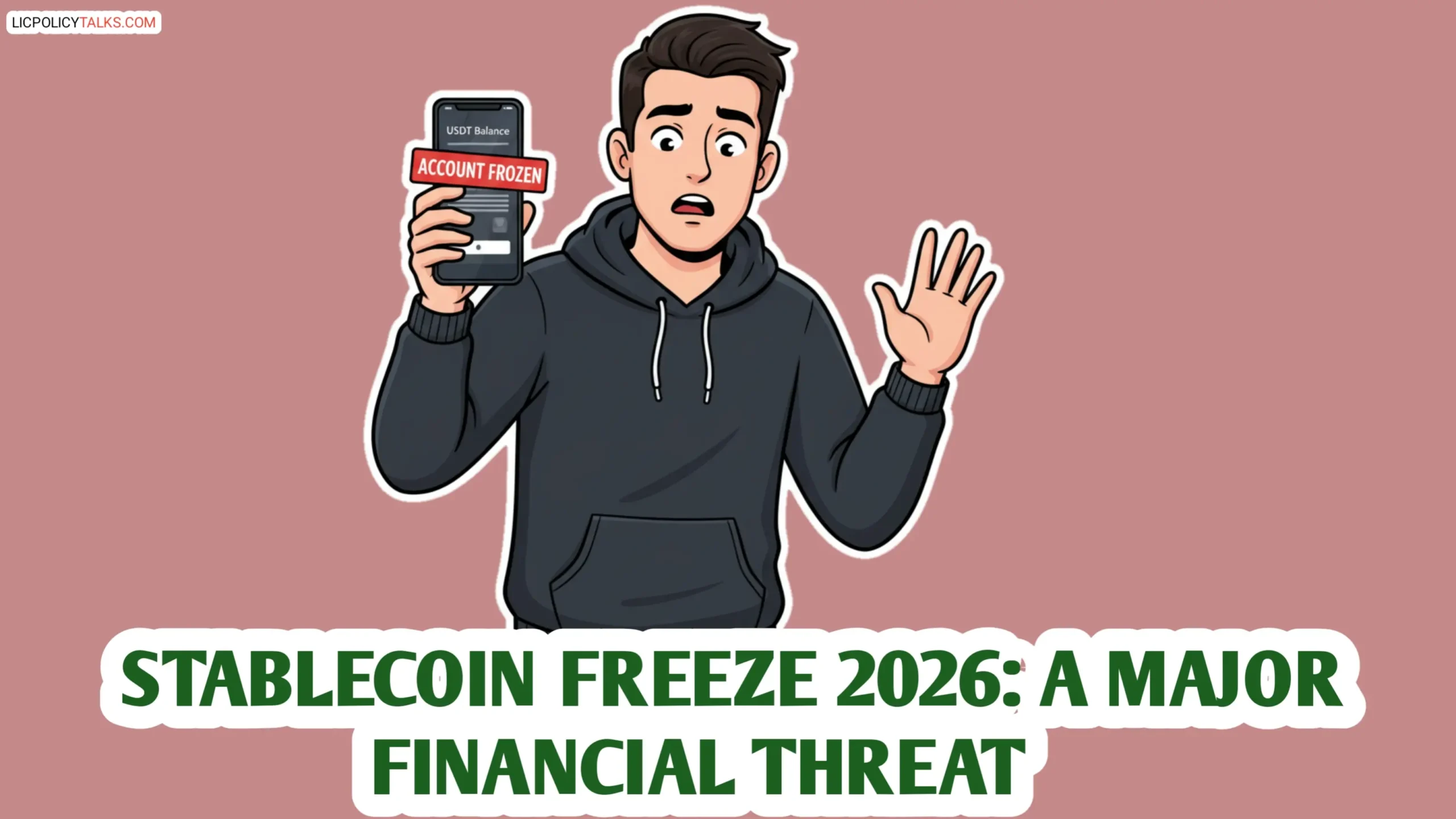
Hi friends! Picture a classic bank run for a second. You see the black-and-white footage: long, anxious lines of people outside a bank, desperate to get their cash before it’s gone. Now, imagine that same panic—but in complete silence. No queues, no shouting, just you, staring at your screen as your digital savings, your USDT, suddenly becomes untouchable. That’s the eerie reality of a stablecoin freeze. If you’re using USDT as a savings account or for DeFi yields, you’re right to be researching its risks. This article’s mission is to dissect the specific conditions that could lead to a ‘2026 Stablecoin Freeze’, why it’s a unique threat, and how it compares to—and could be worse than—a bank run. We’ll use real data analysis and regulatory forecasts to map out what’s coming.
Understanding this potential Stablecoin Freeze 2026 scenario is no longer just speculative—it’s a critical part of protecting your cryptocurrency savings in the evolving digital landscape.
What Exactly is a ‘Stablecoin Freeze’? Beyond the Buzzword
Let’s cut through the hype. In the crypto world, a “freeze” isn’t a hack where your funds are stolen. It’s a sanctioned, legal stoppage of transactions executed by the stablecoin’s issuing company or demanded by a regulator. Think of it as a digital “stop” button being pressed on your wallet address.
It’s crucial to separate a freeze from a depeg. A stablecoin depegging means the token’s value drops below (or rises above) its $1 peg—your asset is worth less, but you can still trade it. A Tether freeze is different: your USDT is theoretically still worth $1, but you cannot move, spend, or sell it. The mechanics are straightforward: Tether Holdings, the company behind USDT, maintains a blacklist. Under regulatory pressure or to investigate suspected illicit activity, they can add addresses to this list, halting all transfers from them instantly.
Imagine trying to send USDT to pay an invoice, only to see the transaction stuck forever in ‘pending’ because your wallet address got flagged. This isn’t science fiction; it’s a built-in feature of centralized stablecoins, posing a direct threat to your digital asset security. Unlike a bank error, you may never get a clear explanation why.
Bank Run vs. Digital Freeze: A Side-by-Side Survival Horror
A traditional bank run is a crisis of confidence. It builds over hours or days, fueled by rumors, leading to physical queues, media frenzies, and a desperate rush to withdraw before the bank’s reserves run out. In many countries, agencies like the FDIC provide insurance (up to $250k per account) as a critical safety net, calming panic and protecting everyday savers.
Now, contrast that with a stablecoin freeze. It’s instantaneous, global, and silent. One moment, the network is fine; the next, a regulatory order or an internal compliance flag halts transactions across entire protocols. There are no physical lines—just error messages on blockchain explorers. Crucially, there is zero deposit insurance. No FDIC, no SIPC. You are utterly exposed.
This digital version is arguably more insidious for three reasons. First is speed: it can happen globally in minutes, not days. Second is opaqueness: users may have no idea why their funds are frozen. Third, and most dangerously, is contagion. A major freeze on USDT wouldn’t just hurt Tether holders; it could trigger panic selling and liquidity crises across the entire crypto ecosystem, freezing the lifeblood of DeFi. This bank run comparison shows a modern financial panic that’s faster, quieter, and without a safety net.
Understanding systemic financial risk is crucial. For another deep dive into how 2026 monetary policy shifts could create unexpected volatility, explore our analysis below.
The Fault Lines in USDT: Why Tether is Ground Zero for 2026 Risk
To understand the 2026 risk, you must look at Tether itself. USDT isn’t just any stablecoin; with a market cap often exceeding $100 billion, it’s the primary liquidity layer for the entire crypto economy. Its dominance makes any systemic failure catastrophic. Let’s examine its three core fault lines.
First, reserve transparency. While Tether has improved, moving from commercial paper to US Treasuries and issuing attestations, questions about the depth of audits and the liquidity of all assets in a crisis persist. Second, Tether is a giant regulatory target. Its 2021 settlement with the NYDFS for $18.5 million confirmed regulators are watching closely. As central banks explore CBDCs, like those analyzed in the Galaxy report on Digital Dollars, regulatory scrutiny on private stablecoins that compete with monetary policy will intensify.
The third and most direct fault line is centralized control. The power to freeze addresses is a feature baked into USDT’s code. This “kill switch,” while useful for combating crime, is a single point of failure that could be activated en masse under extreme regulatory pressure. These USDT risks are compounded by depegging events, like the brief drop to $0.995 in June 2023. While minor, such wobbles reveal underlying stress and can be a precursor to, or occur alongside, a broader Tether freeze.
You know what? The stablecoin depegging we’ve seen is a warning shot. It shows how quickly confidence can erode. When you combine opacity, a target on its back, and centralized control, Tether sits directly at the epicenter of potential digital asset security disasters.
2026: The Perfect Regulatory Storm for Stablecoins
Why 2026? It’s not a random guess; it’s where current regulatory timelines converge. By mid-2024, the EU’s Markets in Crypto-Assets (MiCA) regulation is live, with full provisions for stablecoin issuers applying by 2026. In the US, the political dust from the 2024 elections will have settled, potentially leading to long-awaited, definitive stablecoin legislation. The regulatory fog will have lifted, and the rules of the game will be crystal clear—and strict.
Now, imagine a triggering event. Perhaps a major sanctions evasion or terrorist financing scandal is publicly linked to a decentralized protocol heavily using USDT. The political pressure would be immense. A forceful, coordinated global regulatory response could demand Tether freeze entire swathes of addresses connected to the protocol, potentially catching innocent users in a vast digital dragnet. This scenario turns the theoretical into a terrifying reality.
This push will be supercharged by the rise of Central Bank Digital Currencies (CBDCs). Governments rolling out Digital Euros or Digital Dollar pilots have a vested interest in asserting sovereignty over the digital money space. Private stablecoins that threaten monetary policy control or financial stability won’t just be regulated; they could be actively sidelined to make way for state-backed alternatives. This perfect storm of mature stablecoin regulation and CBDC ambition makes 2026 a pivotal year for these 2026 crypto predictions.
Navigating the future of money requires separating hype from reality. Just as stablecoin risks are often underestimated, the narrative of rapid dedollarization deserves a data-driven reality check.
Your Survival Guide: How to Fortify Your Crypto Savings
Okay, enough about the problem. Let’s talk solutions. You don’t need to panic-sell; you need a smart risk mitigation strategy. Think of this as essential “portfolio hygiene.”
Principle 1: Diversification is Key. Never hold 100% of your stablecoin value in USDT. Allocate across different stablecoins with varying risk profiles. Consider USDC (more transparent and US-regulated) and decentralized options like DAI. Each has its own trade-offs between regulation and censorship-resistance.
Principle 2: Understand Self-Custody Nuances. Holding your own keys in a hardware wallet protects you from an exchange collapse like FTX. But it does NOT protect you from a network-level freeze by the stablecoin issuer. This is a critical distinction many miss. Self-custody solves one risk but not the systemic one we’re discussing.
Principle 3: Assess DeFi Protocol Risk. If you’re yield farming, investigate. Is the protocol you’re using overwhelmingly reliant on a single stablecoin like USDT? What is its contingency plan if that asset is frozen? Diversify your protocols just like you diversify your assets.
Principle 4: The ‘Dry Powder’ Rule. Always keep a portion of your emergency funds or core savings in truly off-ramped, traditional currency in a regulated bank. This is your financial airbag. The goal isn’t to abandon cryptocurrency savings, but to ensure you’re not 100% exposed to its unique digital asset security risks.
Honestly, taking these steps isn’t about fear; it’s about wisdom. It’s the difference between being a passive holder and an informed, resilient participant in the digital asset space.
Beyond the Freeze: The Long-Term Future of Digital Money
Let’s zoom out. Despite the risks, we must acknowledge the incredible utility stablecoins have unlocked: near-instant cross-border payments, the foundation of DeFi, and financial access for millions. The innovation is real and valuable.
A major freeze event, while painful, could act as a catalyst. It might accelerate the development of more robust, truly decentralized, and auditable stablecoin models. Alternatively, it could lead to a heavy-handed regulatory clampdown that pushes innovation into the shadows. The likely outcome is a hybrid future: regulated, transparent stablecoins for mainstream finance, and more resilient decentralized options for those willing to accept different trade-offs.
The core message is this: The goal isn’t to avoid digital assets. It’s to understand their unique risks with clear eyes, just as a smart investor understands stock market volatility or bond interest rate risk. By acknowledging the potential for a Stablecoin Freeze 2026, you empower yourself to build a portfolio that can withstand shocks and thrive in the long-term evolution of money.
FAQs: ‘bank run comparison’
Q: If Tether freezes my USDT, is my money gone forever?
Q: Is USDC a safer alternative to USDT?
Q: How likely is a major stablecoin freeze actually in 2026?
Q: Can decentralized stablecoins like DAI be frozen?
Q: What should I do right now if I have significant USDT savings?
So, let’s tie it all together. A stablecoin freeze is the 21st-century equivalent of a bank run—but it’s faster, quieter, and operates without a government safety net. The “2026” timeline is simply a projection based on the clear trajectory of global stablecoin regulation and the rise of CBDCs. The exact year is less important than the undeniable trend: the regulatory noose is tightening.
This knowledge isn’t meant to scare you away from crypto. Quite the opposite. It’s meant to empower you. By understanding these unique risks—the USDT risks, the potential for stablecoin depegging, and the silent threat of a freeze—you can move beyond being a passive holder. You can become a sophisticated, resilient participant in the digital asset ecosystem. Make informed choices, diversify wisely, and always keep a clear-eyed view of both the incredible potential and the real pitfalls. The future of money is digital, and with the right preparation, you can be ready for it.

Sanya Deshmukh leads the Global Desk at Policy Pulse. She covers macroeconomic shifts across the
USA, UK, Canada, and Germany—translating global policy changes, central bank decisions, and
cross-border taxation into clear and practical insights. Her writing helps readers understand how
world events and global markets shape their personal financial decisions.