G’day! Ever peeked at your payslip, spotted the super line, and thought “Hang on, is that right? What’s the go this year?” You’re definitely not alone. With the superannuation changes Australia is rolling out in 2025 and prepping for 2026, it feels like the goalposts are shifting again! Whether you’re just starting out, eyeing the finish line (retirement!), or somewhere in between, this stuff directly hits your hip pocket. Think of it like upgrading your financial safety net – we all want it thicker and comfier, yeah? So, grab a brew, let’s cut through the waffle and talk plainly about what’s actually new, what’s coming, and how to stay ahead of the game. Let’s get into it!
1. Why’s 2025 Such a Big Deal for Super?
Alright, picture this: Aussie super is basically your boss topping up a massive savings pot alongside your wages. It’s your cash, invested for years, aiming for a comfy retirement cruise. Governments fiddle with the rules regularly – sometimes little nudges, sometimes big shoves. 2025 is a “milestone” year. Why? Because the long-awaited SG rate peak finally hits, and we see huge equity shifts like Super on Parental Leave. It’s not just about one number; it’s about the system maturing. Imagine roadworks on your main road to retirement – the heavy digging is done, and now they’re paving the smooth lanes. These are significant superannuation changes Australia is implementing right now.
2. The Main Event: 12% SG Rate (We Made It!)
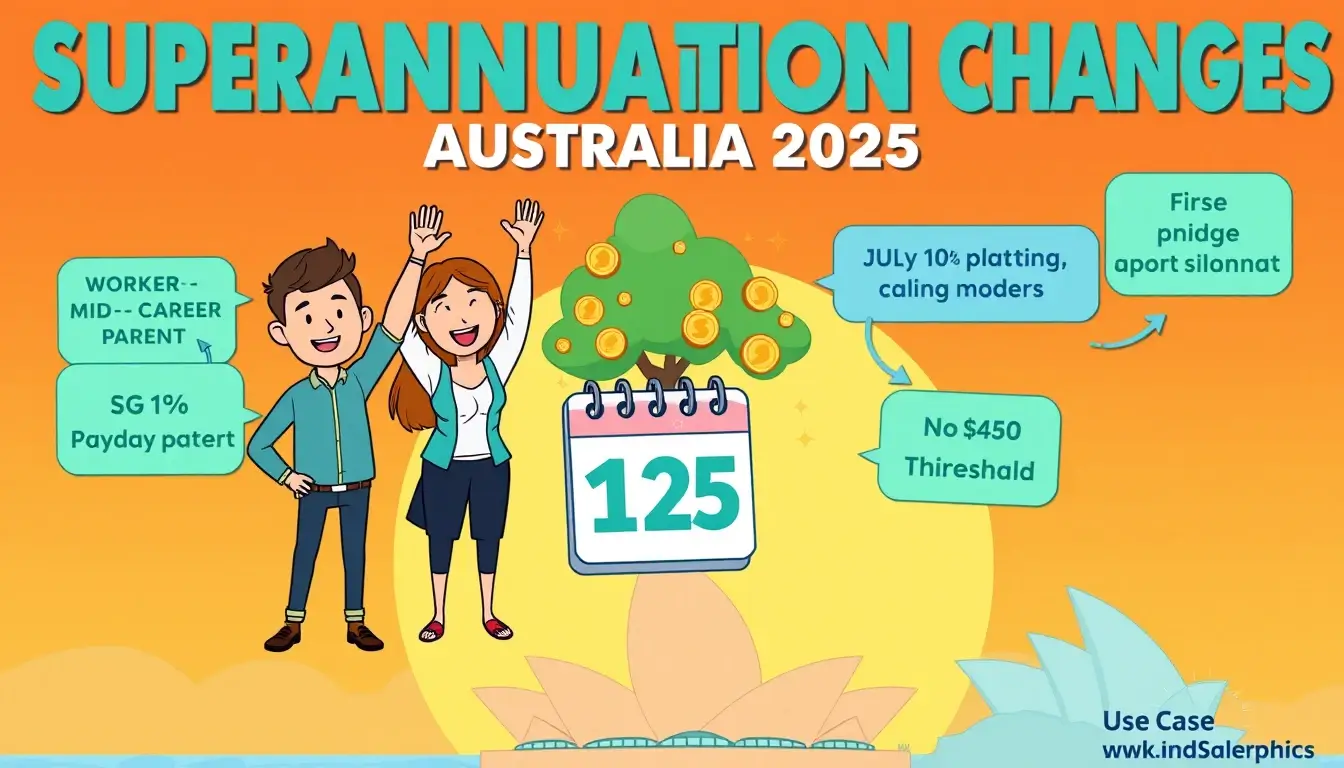
Remember that climb to 12% they’ve been promising for over a decade? Well, 1 July 2025 is the finish line! The Super Guarantee (SG) rate bumps up from 11.5% to a flat 12%. This is the final scheduled increase in the current legislation – a massive core part of the superannuation changes Australia.
- Your Pay Packet: Let’s be upfront, if your salary package is “inclusive of super,” your take-home pay might feel a tiny pinch (0.5%). Earning $100k? That shift is roughly $500 a year moving from cash-in-hand to your super pot. But here’s the flip side: That money isn’t gone. It’s zooming straight into your future investment account, taxed at only 15% instead of your marginal rate.
- The Magic of Compounding: This is where it gets spicy. That extra 0.5% sounds small, but over 20 years? Thanks to compound interest, it can mean tens of thousands more in your final balance. It’s like planting an extra tree in your retirement forest – watch it grow! 🌳
- Official Source:
ATO Confirmation: As of 1 July 2025, the statutory Super Guarantee rate is 12%. Employers must calculate this on Ordinary Time Earnings (OTE).
3. Not Just the Rate: New Rules for 2025/26
The SG rate increase is the headline act, but the supporting players (these legislation updates) are crucial too. They make sure the system works smoothly with the extra cash as part of the broader superannuation changes Australia:
- Super on Paid Parental Leave (FINALLY): Huge win for fairness, especially for mums. From 1 July 2025, the government will pay Superannuation on Commonwealth Paid Parental Leave (PPL). Before this, taking time off to raise a bub meant your super paused. Now, you get that 12% contribution on your government payments. This helps close the “gender super gap” significantly.
- Transfer Balance Cap Jumps to $2 Million: For those close to retirement, listen up. On 1 July 2025, the Transfer Balance Cap (the limit on how much super you can move into the tax-free pension phase) indexed from $1.9m to $2 million. If you haven’t started a pension yet, you now have a higher cap.
⚠️ Strategy Tip: If you were planning to retire in June 2025, waiting until July might have unlocked this higher cap. Worth checking with your advisor!
- Payday Super – The 2026 Giant: This is the next massive shift. While not live *today*, legislation has been pushing for a 1 July 2026 start. This will require bosses to pay super on payday rather than quarterly.
- Why this matters now: Bosses are already upgrading software.
- Why you’ll love it: No more waiting 3 months to see if your super was paid. It hits your account with your wages. Much safer!
4. What Your Boss Needs to Do (New To-Do List)
With big superannuation changes Australia comes… yep, more admin for the bosses. Knowing their job helps you know what to expect (and what to chase up if needed!). These are the key employer obligations:
- Hitting the 12% Target: Sounds obvious, but payroll software glitches happen. Bosses must update systems to ensure the new 12% rate applies to all payments made on or after 1 July 2025. Check your first payslip of the financial year!
- Stapling is Business as Usual: We’ve had “Stapling” for a few years now (since late 2021), so there’s no excuse. Bosses must check if you have an existing fund before creating a new one. If you see a new “default” fund account open up when you already had one, your boss might have missed a step.
- Prepping for Payday Super (2026): Smart businesses are already moving to monthly or fortnightly super payments to get ready for the 2026 mandate. If your boss is still paying quarterly, they are technically compliant for now, but they’re cutting it fine for the future shift.
- Warning on Missed Payments:
Hidden Risk: The ATO is cracking down hard on unpaid super. With Single Touch Payroll (STP) data, they know if a payment is late. If your fund statement shows “late” or “interest” payments, your employer might be under ATO watch.
5. Defined Benefit Funds: Will They Feel It?
Defined benefit funds (DBFs – think older government or big public sector schemes) are different. Instead of your balance depending on investments, they promise a specific retirement income. So, how do the 2025 superannuation changes Australia hit them?
- The 12% Impact: It’s tricky. Many DBF members don’t get the standard SG contribution; they get a formula based on service. However, employers still have to ensure the “value” of what they provide equals the statutory 12%. Some generous schemes are already well above this, so you might see no change on your payslip. That’s normal!
- Bigger Reform Picture: DBFs are complex beasts. While the headline changes (Payday Super) are mechanically different for DBFs, the transparency rules still apply. Trustees need to keep members informed. If you’re in a DBF, don’t panic if you don’t see “12%” listed explicitly—your defined formula is likely worth more than that anyway.
6. Bigger Picture: Treasury Reforms & The $3m Cap
The Treasury reforms go beyond just the SG rate. There’s a lot of chatter about taxes on big balances. Here is the lowdown on the 2025/2026 outlook:
- Division 296 Tax (The $3m Cap): You’ve probably seen scary headlines about a new tax on super balances over $3 million. Proposed to start 1 July 2026 (delayed from original talks), this will double the tax rate (from 15% to 30%) on earnings for balances above $3m.
Reality Check: This impacts less than 0.5% of Australians. If you have $200k in super, relax. This doesn’t touch you. - Performance Tests Continue: The “Your Future, Your Super” performance test is still running. Funds that flunk this test must write to you.
Check This: Did you get a letter/email from your fund saying they “failed the test”? Don’t ignore it. It means they are underperforming benchmarks. Compare and consider switching.
- Retirement Income Covenant: Funds are now legally required to have a plan to help you spend your money, not just save it. Expect your fund to contact you with better options for turning that lump sum into a fortnightly “paycheck” in retirement.
7. What This Means For You (Like, Right Now!)
Okay, enough policy yack! What should you actually do because of all these superannuation changes Australia?
- Scrutinise That July Payslip: Seriously, circle the date! When that first payslip after 1 July 2025 lands, look hard. Does the super line show 12% of your Ordinary Time Earnings (OTE)? A small slip-up now costs you big later.
- Check Your Concessional Caps: For the 2025/26 financial year, the concessional contribution cap sits at $30,000. If you want to salary sacrifice to lower your tax, make sure you don’t blow over this limit, or you’ll get a tax bill from the ATO.
- Mums & Dads on Leave: If you are expecting a baby in late 2025, check your eligibility for the new Commonwealth PPL Super. Ensure your details are up to date with Centrelink so that super payment flows to your fund correctly.
- Think About Topping Up (If Possible): 12% is better, but many experts say 15% is the “sweet spot” for a comfortable retirement. Look into salary sacrifice. Even putting in an extra $20 a week makes a massive difference over 20 years.
- Get Your Head Around Payday Super: While mandatory from mid-2026, many good employers are starting early. If your super hits your account monthly, give your boss a high-five. It means your money is compounding faster!
8. Quick Tips: Smashing the 2025 Super Game
Feeling swamped? Here’s your cheat sheet for navigating the superannuation changes Australia:
✅ July 1, 2025 = 12% SG: CHECK. THAT. PAYSLIP!
✅ Parental Leave Boost: Govt PPL now includes Super.
✅ Transfer Balance Cap: Now $2 Million (for new pensions).
✅ Payday Super: Coming 2026 – watch this space.
🔍 Performance Test: If your fund fails, move your money.
💰 Caps: $30k Concessional Cap applies for 25/26.
🧩 Consolidate: Still have multiple accounts? You’re paying multiple fees. Fix it via myGov.
💡 Salary Sac: Can you spare $50/week to save tax?
📱 Monitor Regularly: Check the ATO app to see if payments are actually landing.
❓ Ask Questions: Bug your fund, boss, or the ATO if unsure.
9. Wrapping Up: Your Super, Your Future
Phew! That was a chunk, but hopefully, it feels less like a rulebook and more like a solid heads-up about your cash. These 2025 superannuation changes Australia – the 12% SG rate, PPL updates, and the upcoming Payday Super shift – are aiming for a fairer, stronger system. Yeah, bosses have work to do, and taxes might get tricky for the ultra-wealthy (>$3m). But for the average punter, the news is good: more money going into your pot, sooner.
Think of your super as your future self’s pay packet. These changes are stuffing more notes into that envelope. Stay switched on, be proactive (check that payslip!), and maybe review your fund’s fees while you’re at it. Small steps now mean a way comfier later on.
Found this useful? Share it with your crew or your partner – everyone needs this info! And if you’ve got specific questions about your situation (especially with that $2m Transfer Balance Cap), having a yarn with a licensed financial advisor is always a smart play. Here’s to building a ripper financial future! 👍
10. Superannuation Changes Australia 2025 FAQs
Q: Will my take-home pay shrink because of the SG increase?
A: Yep, slightly. Because more money’s going into super (taxed at 15% in the fund), less hits your bank each pay. On $100k, expect roughly $19 less per fortnight. But remember: That cash is still yours, just working for future-you!
Q: I work two part-time jobs. Do I get super on both?
A: You bet! That’s the beauty of the $450 threshold being history. You earn super on every single dollar from every boss, no matter how small each pay is. No more missing out!
Q: What’s “stapling” and how does it affect me in 2025?
A: Stapling means your existing super fund ‘sticks’ when you start a new job. Your new boss has to pay into that existing fund unless you pick their default or another one. In 2025, this rule is firmly locked in. It stops you accidentally getting heaps of accounts and paying extra fees. Tell your new boss your chosen fund details.
Q: When does Payday Super start, and why should I care now?
A: Payday Super kicks off 1 July 2026. Care now because bosses are flat out getting ready! It means super must be paid at least monthly, lined up with your pay cycle (so often weekly/fortnightly). Benefit for you? Your money lands in your super fund faster, starts growing sooner, and it’s dead easy to spot if a payment’s missing. Listen out for updates from your boss.
Q: How can I tell if my super fund is any good?
A: Top question! Use the ATO’s “Your Super Comparison” tool (in your myGov account). It shows your fund’s fees and performance against others. Also, check the APRA website for the yearly performance test results – if your fund fails, seriously think about switching. High fees or poor performance are silently stealing your retirement cash. Don’t let ’em!