
Hi friends! Picture this: it’s early 2026, and after years of hard work, your small business is finally ready to expand. You walk into your bank, business plan in hand, feeling confident. But instead of a handshake, you’re met with a surprising amount of hesitation, new questions, and maybe even a “no” on a loan you were sure you’d get. Why would a bank say no to a healthy, growing business? The answer might be a complex set of global banking rules you’ve never heard of, quietly reshaping the lending landscape. That silent rule-changer is the Basel III Endgame.
The Basel III Endgame small business lending shift is the final, stricter phase of global bank capital rules. While it sounds like distant financial jargon, its real-world effects are barreling toward Main Street. By the 2026 deadline, how banks view your loan application will fundamentally change. This guide will decode the regulation and outline the five specific, unavoidable impacts on your access to capital, its cost, and its terms.
Decoding the “Endgame”: It’s About the Bank’s Safety Cushion, Not Your Business
Let’s cut through the complexity. At its heart, Basel III Endgame is about a bank’s “safety cushion.” Imagine a bank’s own money (its capital) as a financial airbag. Basel III forces banks to stuff more money into that airbag to protect against potential losses from loans that go bad. The bigger the perceived risk of the loan, the more of their own money the bank has to set aside.
This is where Risk-Weighted Assets (RWA) come in. It’s how banks measure loan risk. An unsecured loan to a new restaurant gets a higher “risk weight” than a mortgage backed by prime real estate. Higher risk weight = more capital the bank must hold = that loan becomes more expensive for the bank to make.
The timeline targets global implementation around 2026, with major economies like the US (following its own US capital rules path) and the EU (with its EU banking regulations) moving on similar, though not identical, schedules. The technical standards are deep, as outlined in authorities like the Bank of England’s near-final policy statement [PS9/24].
The push for stability is creating real tension, with significant industry pushback arguing it could stifle credit. This friction is clear in reports like “The Bad Blood In Basel III”. So, if the rule is about the bank’s cushion, how does it pinch your loan? Let’s connect the dots.

The 5 Critical Impacts: How Basel III Will Reshape Your Loan Journey
Here’s the core of what you need to know. The regulatory pressure from the top creates a chain reaction that ends at your loan officer’s desk. This simple funnel visualizes how the rule change filters down to you.
Impact #1: The Credit Squeeze – Why ‘Good’ Might No Longer Be Good Enough
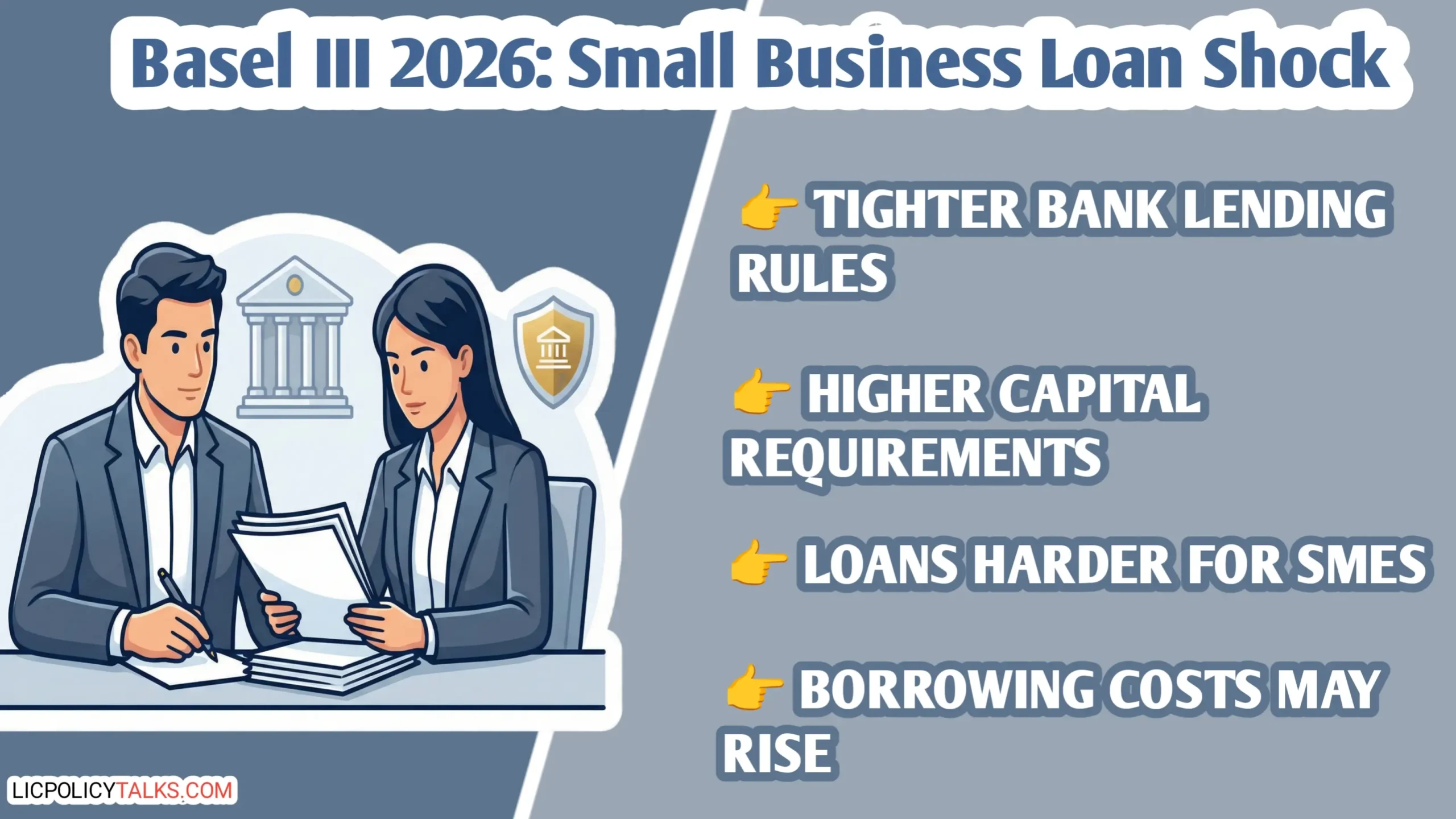
The new rules assign higher risk weights to loan portfolios like commercial lending for real estate or unsecured business loans. This makes them less attractive and profitable for banks. The logical outcome? Banks will become incredibly selective.
They will focus their energy and capital on only the most pristine borrowers: those with near-perfect credit scores, ironclad collateral, and long, stable financial histories. This creates a genuine credit availability crunch for the broad middle market.
What This Means for You: Even profitable businesses with what was once considered ‘decent’ credit may find traditional bank doors closing. The bar for being “bankable” is being raised significantly.
Impact #2: The Price Tag – Why Your Small Business Loans Will Cost More
Here’s the direct financial hit. Higher bank capital requirements mean a higher cost of capital for the bank. Banks are not charities; they will pass this cost on. Expect this to materialize as higher interest rates, especially for borrowers deemed riskier under the new models.
We may also see new, non-interest fees designed to maintain bank profitability on these now-more-expensive-to-hold loans. Your cost of growth is officially going up.
What This Means for You: Start budgeting for higher financing costs now. That expansion loan or new equipment financing will carry a heavier price tag.
Impact #3: The Collateral Crunch – Your Assets Under the Microscope
Basel III also refines how collateral is valued, applying higher “haircuts” (discounts). This means the bank will value your property or equipment more conservatively. The result? The loan-to-value (LTV) ratio you’re used to may shrink.
You might need 30% more collateral to secure the same loan amount. This hits asset-heavy businesses (like manufacturers) particularly hard, even if their cash flow is strong.
What This Means for You: That warehouse or machinery you planned to use as collateral might not stretch as far. It’s time to explore diversifying the types of assets you can pledge.
Impact #4: The Paperwork Avalanche – Data Becomes Your New Currency
To accurately model risk under the new rules, banks will demand deeper, more granular data. Think real-time cash flow dashboards, detailed P&L breakdowns, and multi-year projections. For smaller banks, the complexity may push them to use simpler, one-size-fits-all models that are paradoxically stricter.
What This Means for You: Impeccable, digitized financial records are non-negotiable. Be prepared for deeper, more frequent due diligence as part of your 2026 compliance journey with lenders.
Impact #5: The Great Diversion – Big Banks May Retreat, Creating a Fragmented Market
This is a strategic shift. Large global banks may de-prioritize small business segments in favor of more capital-efficient activities. This is reflected in long-term 2026 banking and capital markets outlook analyses.
This creates an opening for non-bank lenders—fintechs, private credit funds—and community banks. However, this alternative funding often comes at a higher cost and with different, sometimes less predictable, terms.
This fragmentation is a major regulatory impact on the commercial lending ecosystem. Your trusted banking relationship might change, and you’ll need to be a more savvy shopper.
What This Means for You: Don’t put all your eggs in one basket. Start researching and building relationships with community banks and reputable alternative lenders now.
The Political Wildcard: Could Deregulation Change the Game?
Just when you thought the path was set, here’s the plot twist. Significant political uncertainty, particularly around a potential second Trump administration in the US, could alter the trajectory. The expected policy direction is a strong push for financial deregulation. This is a live topic, as seen in reports on How Trump’s deregulation drive could impact banks.
This could mean revisiting the implementation of Basel III Endgame in the US, easing stress tests, and revising US capital rules. Analysts are already speculating what will deregulation look like under the second Trump administration?
The potential outcomes are a delayed or diluted US implementation (creating a transatlantic gap), short-term credit easing, but also long-term planning uncertainty for businesses.
The prudent advice is to monitor political developments closely, but not to bank your 2026 financing strategy on a regulatory reversal. Plan for the stricter scenario; any relief will be a bonus.
| Aspect | Old World (Pre-Basel III Endgame) | New World (Post-2026) |
|---|---|---|
| Bank’s Capital Cushion | Lower reserves for many business loans. | Higher reserves required, especially for riskier/commercial loans. |
| Risk Assessment | Broader categories, more bank discretion. | More granular, standardized models. Your specific industry & financials matter more. |
| Collateral Value | Higher assumed value (lower ‘haircuts’). | More conservative valuation. Assets may secure less money. |
| Ideal Borrower Profile | Good credit, stable history. | Excellent credit, strong cash flow, ample collateral. The ‘super-prime’ of business. |
Your 2024-2025 Action Plan: How to Get “Basel-Ready”
Okay, enough analysis. Let’s get practical. The time to act is now, in 2024 and 2025. Banking and payments experts share sector forecasts for 2025 that emphasize adaptation. Here’s your coach’s playbook to get ahead of the curve.
Action 1: Fortify Your Financials. This is priority number one. Work on improving both business and personal credit scores. Strengthen your balance sheet by reducing unnecessary debt. Most importantly, produce pristine, professional financial statements and realistic 3-year projections. Your numbers need to tell a compelling story of stability and growth.
Action 2: Rethink Your Collateral. Don’t wait for the bank’s appraisal. Get professional valuations done on key assets (property, equipment, inventory) now. Explore diversifying your collateral pool—can you pledge receivables, intellectual property, or cash savings?
Action 3: Expand Your Lender Rolodex. Start researching community banks, credit unions, and reputable fintech lenders in your area or sector. Attend local business banking events. Build relationships before you need the money.
Action 4: Start the Conversation Early. Schedule a meeting with your current bank or loan officer. Ask them directly: “How is our bank preparing for the 2026 Basel III Endgame changes, and what will you need from borrowers like me to get approval?” Their answer will be incredibly revealing.
Action 5: Scenario Plan. Update your business plan with two new scenarios: one that accounts for a 1-3% increase in financing costs, and another that plans for a 3-6 month longer capital-raising timeline. This isn’t pessimism; it’s strategic preparedness.
FAQs: ‘Basel III Endgame & Your Business Loan’
Q: Will Basel III Endgame make small business loans disappear?
Q: As a very small business (under 10 employees), will I be affected?
Q: If the rules start in 2026, why should I worry now?
Q: Can a new US president in 2025 stop Basel III?
Q: What’s the single most important thing I can do to prepare?
Navigating the New Rules of the Game
Let’s wrap this up. The Basel III Endgame small business lending shift isn’t just a technical banking problem. It’s a fundamental change in the financing landscape that will touch every business owner seeking capital. The regulatory impact is real and unavoidable.
But here’s the good news: forewarned is forearmed. Proactive preparation is your most powerful response. By taking the steps outlined here—fortifying your financials, expanding your options, and starting conversations early—you take back control. While the rules of the game are changing, informed and prepared business owners can and will still find the capital they need to grow. Start your preparation today.