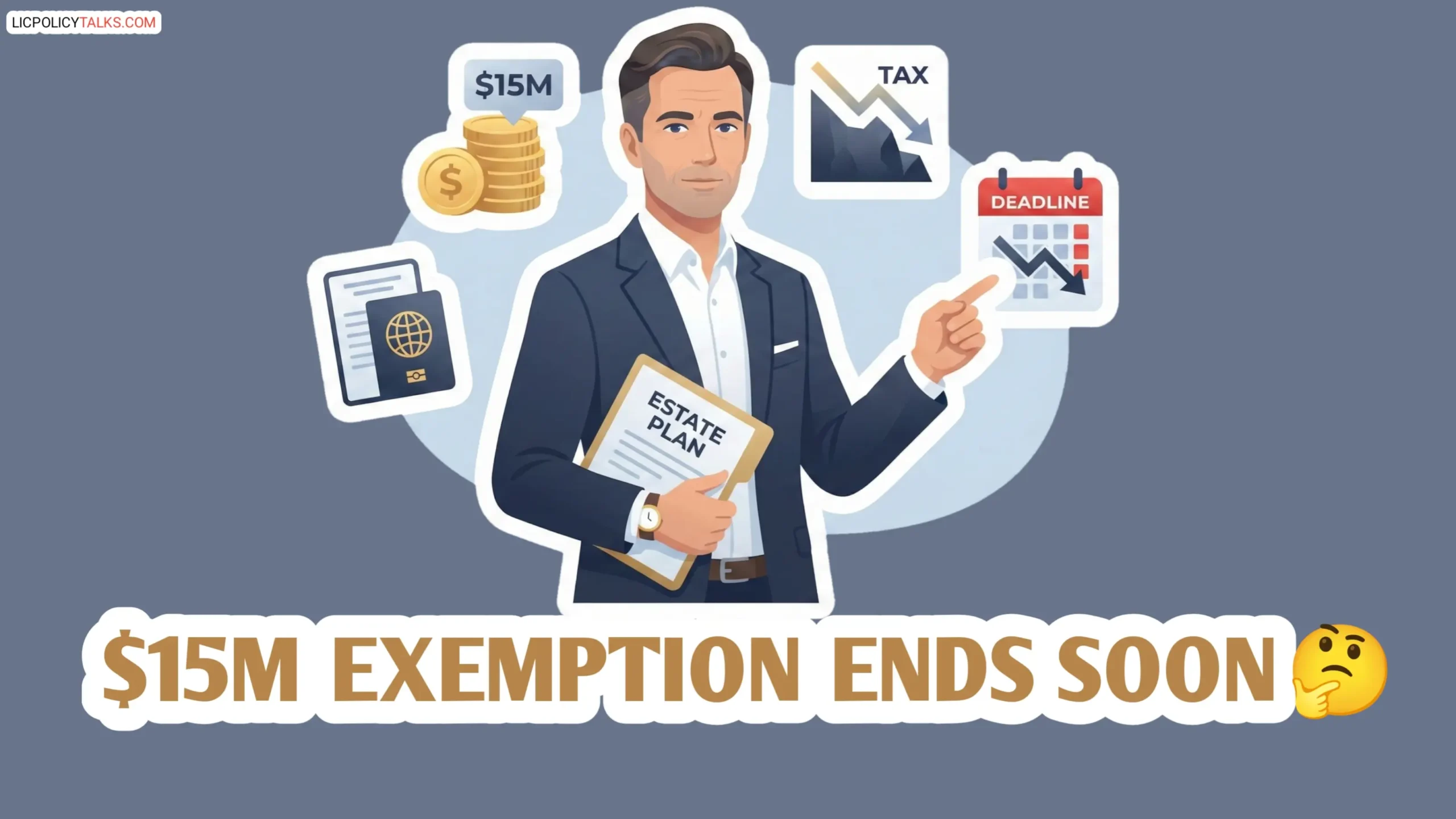

Hi friends! Picture this for a second. A successful American entrepreneur, living in Singapore for 20 years, thinks their global wealth is buttoned up. Then they pass, and their family gets hit with a completely unexpected $8 million US tax bill. Why? Because of a single, obscure deadline they missed related to the looming Estate Tax Cliff 2026. This isn’t a scare story; it’s a real, imminent financial event. This guide is your roadmap to understand why it’s especially tricky for us living abroad and, most importantly, the exact steps you can take before May 2026 to protect your family’s wealth.
The core issue is the scheduled sunset of the historic estate tax exemption. For expats, the real strategic deadline isn’t just January 2026—it’s several months sooner. Let’s break it down.
The 2026 Cliff Isn’t a Theory—It’s a $6M+ Tax Bill Waiting to Happen
Back in 2017, the Tax Cuts and Jobs Act (TCJA) gave us a huge, temporary gift: a massively increased lifetime estate tax exemption. Think of it as a “get-out-of-tax-free” card for passing on wealth. But here’s the catch—this law is set to revert or “sunset.” On January 1, 2026, that exemption is scheduled to be cut roughly in half. You can read the TCJA sunset provision text here to see the law itself.
This isn’t just about estate tax. It’s a unified credit that applies to both gifts you make while alive and assets you leave at death. The single most important thing to understand is that once the exemption drops, you cannot get the higher amount back.
The 2026 Estate Tax Exemption Cliff
Visualizing the ~$6M Drop Per Person
The Impact: Without planning, over $6M per person (or $12M per couple) that is currently tax-free could become subject to a 40% federal estate tax overnight on Jan 1, 2026.
*Projection based on pre-TCJA $5M base adjusted for inflation. Actual amounts to be finalized in 2026.
Let’s make it concrete. Say your estate is worth $20 million. Under today’s rules, you could shield $13.61 million and pay tax on $6.39 million. After the cliff, with an exemption of around $7.2 million, you’d pay tax on $12.8 million. The difference in tax owed? Over $6 million more. This same cliff applies to the generation-skipping transfer tax exemption, crucial for dynasty trust planning (the IRS has a guide on GST tax here).
Why This Cliff Is Especially Dangerous for Americans Abroad
For expats, this isn’t a simple US tax problem. It’s a cross-border puzzle where mistakes are magnified.
Issue 1: Portability Pitfalls. Married couples can “port” a deceased spouse’s unused exemption via a portability election on IRS Form 706. For expats with a non-citizen spouse, this gets messy fast. The unlimited marital deduction doesn’t apply, often requiring a Qualified Domestic Trust (QDOT) to defer tax. You need to know the IRS instructions for Form 706 inside and out.
Issue 2: The Foreign Asset Tangle. That villa in Italy or brokerage account in Hong Kong? It’s part of your worldwide US taxable estate. Valuation becomes a nightmare, and selling foreign assets to pay a US tax bill is notoriously difficult and slow.
Issue 3: Domicile vs. Residency Confusion. This is a big one. Simply having a residence permit abroad doesn’t mean you’ve changed your “domicile”—your permanent home for legal purposes. The US taxes based on domicile, and proving you’ve lost it is a high bar, as seen in cases like Estate of Kwang Sun Kim (Tax Court summaries are available here). Most expats are still US domiciliaries.
Issue 4: Conflicting Foreign Laws. If you live in a civil law country (like most of Europe), “forced heirship” rules may dictate who gets your assets, completely blowing up your carefully crafted US trust plan.

Your Pre-May 2026 Action Plan: 4 Strategic Levers for Expats
Knowledge is good, but action is everything. Here’s your playbook. Remember, for major gifting strategies, your true deadline is May 2026 due to the 5-year look-back rule for certain trusts. Don’t wait until December.
| Strategy | Action Before May 2026 | Potential Benefit | Expat-Specific Risk/Note |
|---|---|---|---|
| Lifetime Gifting | File Form 709 for gifts >$18k to use current high exemption. | Locks in exemption; removes asset + future growth from estate. | Gifts to non-citizen spouse limited; foreign asset valuation challenges. |
| Portability Election | Ensure wills/plans mandate filing Form 706 upon first death. | Preserves unused exemption of first-to-die for survivor. | Non-citizen spouse may require QDOT; strict 15-month filing deadline. |
| IDGT Funding | Establish and fund trust with high-exemption assets. | Freezes estate value; future growth occurs outside taxable estate. | Severe PFIC & foreign trust reporting complexities; requires expert counsel. |
| Domicile Shift | Begin documenting severance of US ties; establish new domicile. | Potential escape from US estate tax system entirely. | Triggers ‘expatriation tax’ on unrealized gains; irreversible. |
Strategy 1: Strategic Gifting to Lock in Today’s Exemption.
Think of your lifetime exemption as a “use-it-or-lose-it” coupon before it shrinks. This is different from the annual gift tax exclusion ($18,000 in 2025). The steps are clear: 1) Get professional valuations of assets you want to gift. 2) File IRS Form 709 (IRS page for Form 709) to report the gift and allocate your exemption. This filing is non-negotiable, even if you owe zero tax. 3) Keep impeccable records. Crucial expat note: Gifts to a non-citizen spouse have very low annual limits, so the unlimited marital deduction doesn’t help here.
Strategy 2: The Essential Portability Election (Form 706) Review.
For married expat couples, this is critical. When the first spouse dies, the surviving spouse must file an estate tax return (Form 706) to elect “portability” and capture the deceased’s unused exemption. The deadline is 15 months from the date of death. Failing to file this form on time, even when no tax is due, means permanently losing millions in exemption. For expats with non-citizen spouses, this almost always requires setting up a QDOT, a complex trust with strict rules. Professional review is mandatory.
Strategy 3: Leveraging Trusts in a Cross-Border Context.
Trusts like Intentionally Defective Grantor Trusts (IDGTs) are powerful for removing future asset growth from your estate. But for expats, foreign trusts and foreign assets add layers of complexity. Funding a trust with shares of a foreign corporation can create PFIC (Passive Foreign Investment Company) reporting nightmares. Foreign grantor trust rules are another minefield. Domestic Asset Protection Trusts (DAPTs) are an option, but their effectiveness abroad is questionable.
Strategy 4: Comprehensive Domicile Analysis & Documentation.
For long-term expats truly settled overseas, the ultimate move is to formally sever US domicile. This means relinquishing US ties (property, club memberships, voter registration) and definitively establishing a new domicile elsewhere, following the IRS’s own domicile determination factors. Warning: This is a nuclear option. It triggers the “expatriation tax” (Section 877A) on all your unrealized capital gains and is irreversible. It demands a full team of cross-border tax and legal advisors.
The Cross-Border Advisor Checklist: Who You Need on Your Team
You cannot DIY this. Your team must include: 1) A US estate planning attorney who actively works with expats. 2) A cross-border tax advisor (CPA or Enrolled Agent). 3) Local legal counsel in your country of residence. 4) An international financial planner familiar with reporting (FBAR, FATCA) and liquidity planning.
Ask potential advisors: “How many expat estate planning clients have you filed a Form 706-NA for?” and “Will you coordinate directly with my foreign lawyer?” Their answers will tell you everything. Coordination is the single biggest factor for success.

FAQ: The 2026 Estate Tax Cliff for Expats
FAQs: The 2026 Estate Tax Cliff for Expats
Q: I’m married to a non-US citizen. Can I still leave them everything tax-free?
Q: My primary home and investments are all in [Foreign Country]. Does the US still tax my estate?
Q: What happens if I make a large gift now and the exemption doesn’t drop as much as expected?
Q: Is there any chance Congress will extend the higher exemption?
Q: I’ve already filed Form 706 for portability. Is my work done?
Conclusion: The Clock is Ticking—Your Next Move
So, friends, here’s the one-two punch: the exemption value plummets in January 2026, but the door for the most impactful gifting strategies starts closing in May 2026. This isn’t just about tax avoidance; it’s about proactive, intelligent wealth preservation for your global family.
The call to action is clear and urgent. Schedule a coordinated consultation with your US and foreign advisors before the end of this quarter. The goal of that first conversation is simple: map all your worldwide assets and identify the single most impactful strategy you can execute before May 2026.
Remember, inaction is a decision—and for high-net-worth expats facing the Estate Tax Cliff 2026, it could be the most expensive financial decision of your life.