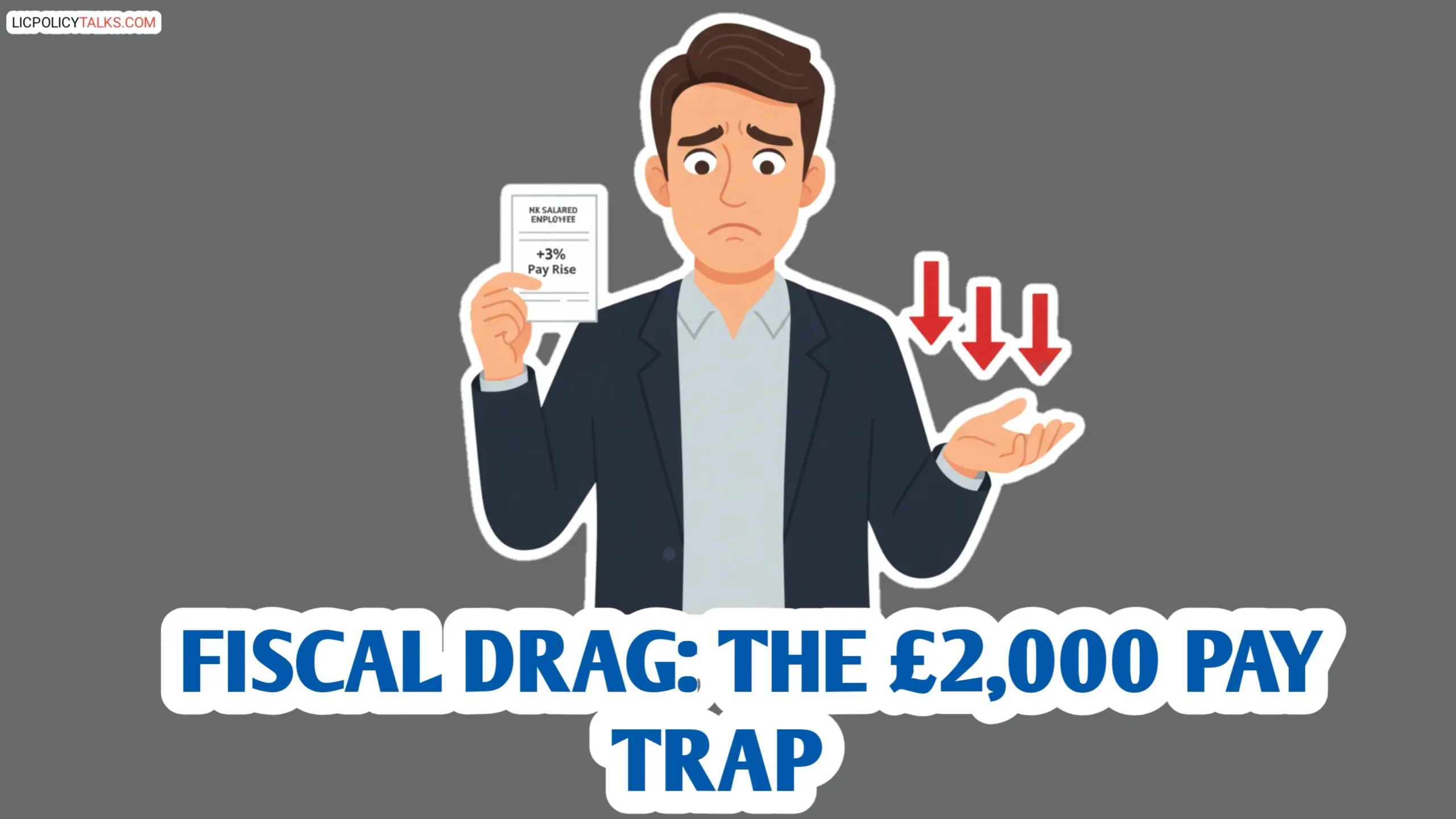

Hi friends! Let me ask you something. Have you ever gotten a modest pay rise—say, that promised 3% “inflation-matching” bump—only to look at your bank account a few months later and feel… nothing? Or even worse, feel like your money isn’t stretching as far as it used to? You’re not imagining it, and you’re definitely not alone. That gnawing feeling of working harder but getting poorer has a name, and it’s a silent force working against millions of payslips right now.
Today, we’re pulling back the curtain on the biggest financial trick being played on working people. We’re going to explain this “fiscal drag” phenomenon—the ultimate “stealth tax“—in plain English. I’ll show you exactly how it’s projected to pinch an average of £2,000 from your pocket by 2026, expose the brutal 60% trap where pay rises vanish, and most importantly, give you a clear action plan to fight back. This isn’t just theory; it’s the reason your “real income” is shrinking. Recent analysis reveals this phenomenon is poised to significantly erode household disposable income by 2026.
What is Fiscal Drag? The Invisible Hand in Your Payslip
Let’s break down the jargon. “Fiscal drag” sounds complex, but its other name—”tax bracket creep“—gives the game away. Picture this: Imagine the income tax system is a road with toll gates. Each gate marks a new tax threshold (like £12,570 for the personal allowance, then £50,270 for the higher rate). Normally, these gates move forward each year with inflation, so your car (your income) can grow without hitting the next, more expensive toll.
Now, imagine those gates are frozen solid. But your car keeps getting longer (your salary gets a pay rise with inflation). What happens? More and more of your car gets caught in the next, higher-toll gate. You’re paying more tax, not because the toll rate changed, but because the gate didn’t move. The central engine of this drag is the government’s freeze on the personal allowance and basic rate threshold until 2028, silently pulling more income into higher tax brackets.
This is the core of fiscal drag. It’s not a new law you voted on; it’s a sneaky consequence of inaction. Your nominal wage goes up, but a bigger slice is taxed at a higher marginal tax rate. It’s an “inflation tax” that erodes your spending power quietly, without the political drama of announcing a “tax hike.”
The £2,000 Hit: How Fiscal Drag Bites by 2026
Let’s get concrete. That abstract “creep” translates into a very real number hitting your wallet. This ongoing tax threshold freeze is projected to cost the average taxpayer an additional £2,000 by the 2026-27 tax year, directly slashing their real income.
Think about that. £2,000 isn’t a one-off bill; it’s the cumulative erosion of your disposable income over the years of the freeze. That’s money that could have been a family holiday, extra pension savings, or simply peace of mind at the end of the month. Broken down, it’s roughly £40 less in your pocket every single month. The visual below shows how this “extra cost” stacks on top of your normal tax bill.
The Rising Cost of Frozen Thresholds
Visualising the £2,000 ‘Fiscal Drag’ cost for an average earner.
Tax Paid
With Fiscal Drag
Insight: The red block shows the additional tax you pay simply because thresholds didn’t rise with inflation.
The 60% ‘Tax Trap’: Where Your Pay Rise Disappears
For many middle and higher earners, fiscal drag creates a particularly painful pinch point known as the “60% tax trap.” This isn’t a formal rate, but an effective marginal tax rate that kicks in between £100,000 and £125,140 of income. Here’s the brutal math: for every £1 you earn over £100,000, you start losing your £12,570 personal allowance at a rate of £1 for every £2 earned.
So, on that portion of income, you pay 40% income tax PLUS the 20% effective tax from losing the allowance. That’s a 60% hit. For a £1,000 bonus in this zone, you keep less than £400. This freeze creates a potent 60% tax trap for many middle-income earners, where a significant portion of any pay rise is lost to the treasury. Suddenly, that hard-earned promotion or annual raise feels gutted before it even reaches your account.
Protecting your income isn’t just about your salary. Using tax-efficient wrappers like ISAs is a critical first line of defence against this stealthy erosion of your wealth.
A Simple Example: See Your Money Vanish (The 3% Illusion)
Let’s make it real with a story. Meet Alex. In 2024, Alex earns £55,000. They’re a solid performer, so in 2025 and 2026, they get a 3% “inflation-matching” raise each year. On paper, great! Their salary grows to £56,650 in 2025 and £58,350 in 2026. But here’s the fiscal drag twist.
While Alex’s salary grows, the tax thresholds are frozen. In a normal world, they’d move up with inflation, protecting more of Alex’s raise. In our frozen reality, more of each raise gets taxed at 40% instead of 20%. The table below shows the stark reality. This is the essence of bracket creep—nominal wage growth fails to translate into improved financial well-being, acting as an effective inflation tax on earnings.
| Metric | 2024 (Thresholds Indexed) | 2026 (Thresholds Frozen) | Change |
|---|---|---|---|
| Salary | £55,000 | £58,350 | + £3,350 |
| Tax Paid | ~ £9,086 | ~ £10,632 | + £1,546 |
| Net Income | ~ £45,914 | ~ £47,718 | + £1,804 |
| Real Income (inflation-adjusted) | £45,914 | ~ £44,970 | – £944 |
The Illusion: Alex’s nominal net pay rises by £1,804. But after adjusting for just 3% annual inflation, their actual spending power (real income) has FALLEN by nearly £1,000. The stealth tax in action.
Fighting Back: Your Action Plan Against the Stealth Tax
You don’t have to sit back and accept this. Because fiscal drag works silently, you need to act deliberately. Here’s your defence plan, starting with the easiest wins.
1. The Power of Pension Contributions: This is your number one weapon. Payments into your pension come from pre-tax income. If you earn £55,000 and pay £5,000 into your pension, you’re only taxed on £50,000. This can literally pull you back into a lower tax bracket, saving you hundreds instantly. It’s not lost money—it’s your future self getting a raise.
2. Maximise Your ISA Allowance: Unlike pension money, ISA savings are accessible. Every pound of interest, dividends, or growth inside an ISA is tax-free forever. By sheltering your savings and investments here, you protect your future disposable income from further erosion.
3. Explore Salary Sacrifice: Could you swap some taxable salary for non-cash benefits? Things like a cycle-to-work scheme, additional pension contributions, or tech schemes reduce your taxable pay, thus reducing the drag. It’s a smart way to get what you need while keeping more of what you earn.

While protecting your income is crucial, don’t forget about protecting what you build. Upcoming changes to inheritance tax could pose another threat to your family’s wealth, making holistic planning essential.
4. Know Your Numbers & Plan Ahead: The most important step is awareness. Use an online tax calculator. Know your marginal tax rate. If you’re nearing £50,270 or £100,000, plan your bonuses or side-income with these cliff-edges in mind. Sometimes spreading income across tax years or between spouses (if possible and legal) can make a big difference.
Beyond Your Payslip: The Bigger Picture of Fiscal Drag
This isn’t just a personal finance headache; it’s a macroeconomic one. When millions of people have their real income squeezed by this stealth tax, they spend less. That dampens economic growth. It also creates perverse work incentives—why chase a promotion or work extra hours if 60% of the reward vanishes? This mechanism represents a profound shift in the tax burden, reducing disposable income through bracket creep rather than explicit legislative changes.
Politically, it’s a “stealth” method because it’s less visible than raising headline tax rates. But the effect on your wallet is just as real. Understanding this is the first step to not being a passive victim of policy. It empowers you to make informed choices, both at the ballot box and in your financial planning.
FAQs: ‘Fiscal Drag & Stealth Tax’
Q: Is fiscal drag the same as the government raising my taxes?
Q: I earn less than £50,000. Does fiscal drag still affect me?
Q: What’s the single most effective thing I can do to reduce the impact of fiscal drag?
Q: Will tax thresholds ever be unfrozen? What happens if they are?
Q: How does fiscal drag interact with other allowances, like the Savings Allowance or Dividend Allowance?
Don’t Let the Stealth Tax Win: Take Control
So, here’s the truth. Fiscal drag is a powerful, silent force actively eroding your standard of living. That £2,000 figure by 2026 and the 60% trap aren’t scare stories—they’re the mathematical reality of frozen thresholds. But knowledge is your armour. Don’t just be a passenger in your financial life. Review your payslip, understand your marginal tax rate, and implement at least one strategy from the action plan today. Your real income and financial health require active defence. Start now.