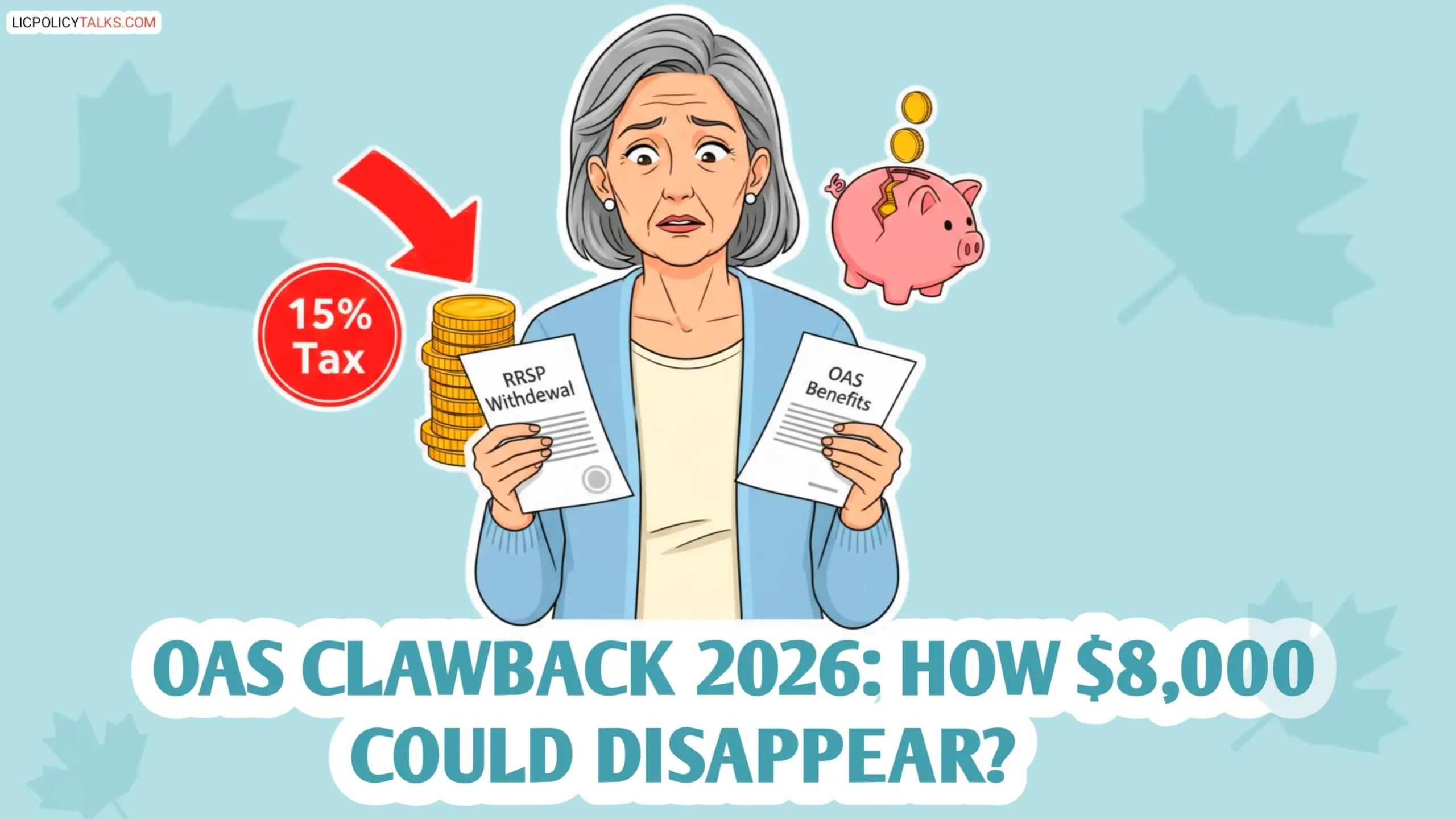
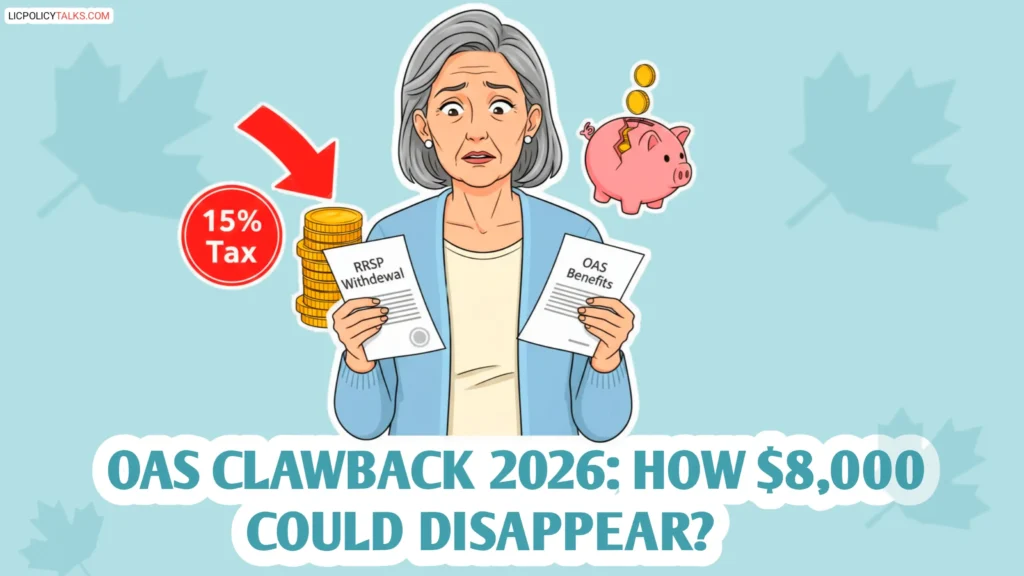
Hi friends! Picture this: Susan, a vibrant 72-year-old, decided to take a dream European cruise. To fund it, she withdrew $40,000 from her RRSP. The vacation was perfect, but months later, a letter from the government left her stunned. Her Old Age Security payment had been reduced. She had just met the OAS clawback—a silent stealth tax that chips away at your benefits if your income is too high. Her RRSP withdrawal, meant for joy, had quietly triggered a costly penalty.
If you’re relying on RRSPs for your golden years, this is a critical story to understand. A large withdrawal can push your income over a hidden line, activating a 15% “recovery tax” on your OAS. The good news? A rule change in 2026 gives us a new planning opportunity. This guide will demystify the OAS clawback, show you exactly how RRSPs trigger it, and give you a clear action plan to keep every dollar of your hard-earned benefits.
The $8,000 Retirement Mistake You Might Not See Coming
Susan’s story isn’t rare. Many retirees discover the OAS clawback only after their benefit is reduced. It happens because RRSP and RRIF withdrawals are fully taxable income. This income directly boosts the number the government uses to calculate your OAS eligibility. Go over a specific threshold, and you enter the “clawback zone.”
Starting in July 2026, that threshold is getting a welcome boost to $95,000, giving you more breathing room. But this isn’t just a news item—it’s a critical checkpoint for your retirement income strategy. Whether you’re a pre-retiree mapping things out or already taking withdrawals, understanding this mechanism is the key to avoiding a nasty, expensive surprise. Let’s break it down into simple, actionable steps.
OAS Clawback Demystified: It’s Not a Tax, It’s a Benefit Recovery
First, let’s clear up the jargon. The OAS clawback is officially called the Old Age Security pension recovery tax. It’s a 15% reduction on your OAS benefits for every dollar your net income exceeds a set threshold. Think of it not as an extra tax you pay, but as the government taking back part of your benefit because your other income is deemed high enough.
That “net income” is the key. For retirees, this is primarily Line 23400 on your tax return. It includes almost all your cash flow: RRSP/RRIF withdrawals, CPP, company pension payments, rental income, and investment income (even from non-registered accounts). According to definitions from RetireHappy, the threshold for the 2024 tax year is $90,997. If your net income is below this, you keep 100% of your OAS. Go over it, and the clawback begins.
This creates a “clawback zone.” Your OAS isn’t cut off all at once; it’s gradually reduced by 15 cents for every dollar you’re over the threshold. This phase-out continues until your OAS is fully recovered, which happens at a net income of about $148,000 for 2024. The visual below shows exactly how this works.
The OAS Income Thresholds
Why Your RRSP is the #1 Trigger for the OAS Clawback
Now, why is your RRSP (or its successor, the RRIF) public enemy number one here? It’s simple: every dollar you pull out is counted as 100% taxable income. Unlike other income sources you can’t easily control, like CPP, you decide when and how much to withdraw from your RRSP. A large, one-time withdrawal can blast your annual net income from a safe zone right into the heart of the benefit reduction territory.
Contrast this with a TFSA withdrawal. Money from your Tax-Free Savings Account is exactly that—tax-free. It doesn’t appear on your tax return, doesn’t boost your net income, and has zero effect on your OAS clawback. This difference is the cornerstone of smart retirement income planning. The real danger is the “effective marginal tax rate.” When you add your regular income tax bracket (say, 30-35%) to the 15% clawback, a single RRSP withdrawal could face a combined tax hit of 50% or more. That’s a brutal bite out of your savings.

The 2026 Game Changer: What the New $95,000 Clawback Threshold Means for You
Here’s some excellent news to factor into your plans. The federal government has confirmed a significant change: starting in July 2026, the OAS recovery tax threshold will increase to $95,000. You can find the official confirmation and analysis of this 2026 threshold change on RetireHappy. This is a positive move, giving retirees more headroom before the clawback engages.
But don’t just file this away as good news—use it as a strategic planning date. If you’re anticipating a large expense in 2026 or beyond, like helping a family member or renovating your home, this is your new income benchmark to keep in mind. Delaying a withdrawal until after the threshold increase could save you thousands in recovered benefits. Let’s compare the landscape before and after this change.
| Scenario | Threshold Amount | Clawback Start Point | Impact of a $50,000 RRSP Withdrawal* |
|---|---|---|---|
| Pre-2026 (e.g., 2024) | $90,997 | Lower, easier to trigger | Higher potential benefit reduction |
| Post-July 2026 | $95,000 | Higher, more protection | Reduced potential clawback, more retirement income safe |
*Assuming a base income close to the threshold.
Case Study: How a $50,000 RRSP Withdrawal Could Cost $8,000 in OAS
Let’s make this real with numbers. Meet Robert. He’s 68, receives CPP and a small pension, and his annual net income from these sources is $85,000. He’s safely below the current clawback threshold. He decides to gift his granddaughter $50,000 for a down payment and takes it from his RRSP. This is where the stealth tax strikes.
That $50,000 withdrawal is added directly to his net income. Now his total net income for the year is $135,000 ($85,000 + $50,000). The OAS clawback calculation kicks in: ($135,000 – $90,997 threshold) = $44,003 of income over the limit. Multiply that by 15%: $44,003 * 0.15 = $6,600. Just like that, Robert owes an extra $6,600 as an OAS recovery tax. When you add his provincial income tax on that $50,000 withdrawal, the total tax bill easily approaches the $8,000 figure from our title. And remember, this isn’t a one-time fee—if his income stays high, the clawback happens every single year.
Your Action Plan: 5 Smart Strategies to Avoid the OAS Clawback
Knowledge is power, but action is what protects your money. Here are five concrete strategies to add to your tax planning toolkit. Think of these as ways to smooth out your income and keep you below the radar of the clawback.
Strategy 1: Income Smoothing & Timing. Instead of one massive RRSP withdrawal, spread it out over several years. Need a lump sum? Use your TFSA as a “bridge” to provide the cash now, then replenish it with smaller, controlled RRSP withdrawals over the next few years to stay under the threshold.
Strategy 2: The RRSP to RRIF Transition Plan. By age 71, you must convert your RRSP to a RRIF and start taking mandatory minimum withdrawals. Plan the start date and amount of these withdrawals in conjunction with when you start CPP and OAS. Sometimes starting CPP later can help balance income. General advice on RRIF strategy emphasizes this coordination.
Strategy 3: TFSA-First Withdrawal Order. This is a golden rule for early retirement. If you retire before taking CPP/OAS, draw living expenses from your TFSA first. This preserves your RRSP, allowing it to grow tax-deferred longer, and keeps your taxable income artificially low until mandatory withdrawals begin.
Strategy 4: Split Pension Income. If you have eligible pension income (like from a RRIF or company pension), you can split up to 50% of it with your spouse or common-law partner. This can significantly lower the higher earner’s net income, potentially pulling them back under the clawback threshold.
Strategy 5: Charitable Donations & Tax-Loss Harvesting. More advanced, but strategic. Making a sizable charitable donation in the same year as a large withdrawal can create a deduction that lowers your net income. Similarly, realizing investment losses in a non-registered account can offset other income.

FAQs: ‘benefit reduction’
Q: Is the OAS clawback based on my income before or after taxes?
Q: If my income is $20,000 over the threshold, do I lose all my OAS?
Q: Should I avoid RRSPs altogether because of the clawback?
Q: How does the clawback work for a couple? Is it individual or combined?
Q: Can I repay the OAS clawback if I accidentally trigger it one year?
The Bottom Line: Knowledge is Your Best Defense
Let’s recap the triple threat: 1) RRSP withdrawals are fully taxable, 2) that taxable income is what triggers the OAS clawback, and 3) the clawback is a steep 15% benefit reduction on every dollar over the line. It’s a recipe for a stealthy, significant wealth erosion.
But you’re not powerless. Use the 2026 threshold increase as a catalyst for your retirement planning. Sit down and project your future income streams—CPP, OAS, pensions, and eventual RRIF withdrawals. Model different scenarios. The single best step you can take is to consult a fee-only financial planner who specializes in retirement income. They can help you build a personalized, tax-efficient withdrawal strategy so you can enjoy your savings without any costly surprises. Your future self will thank you.