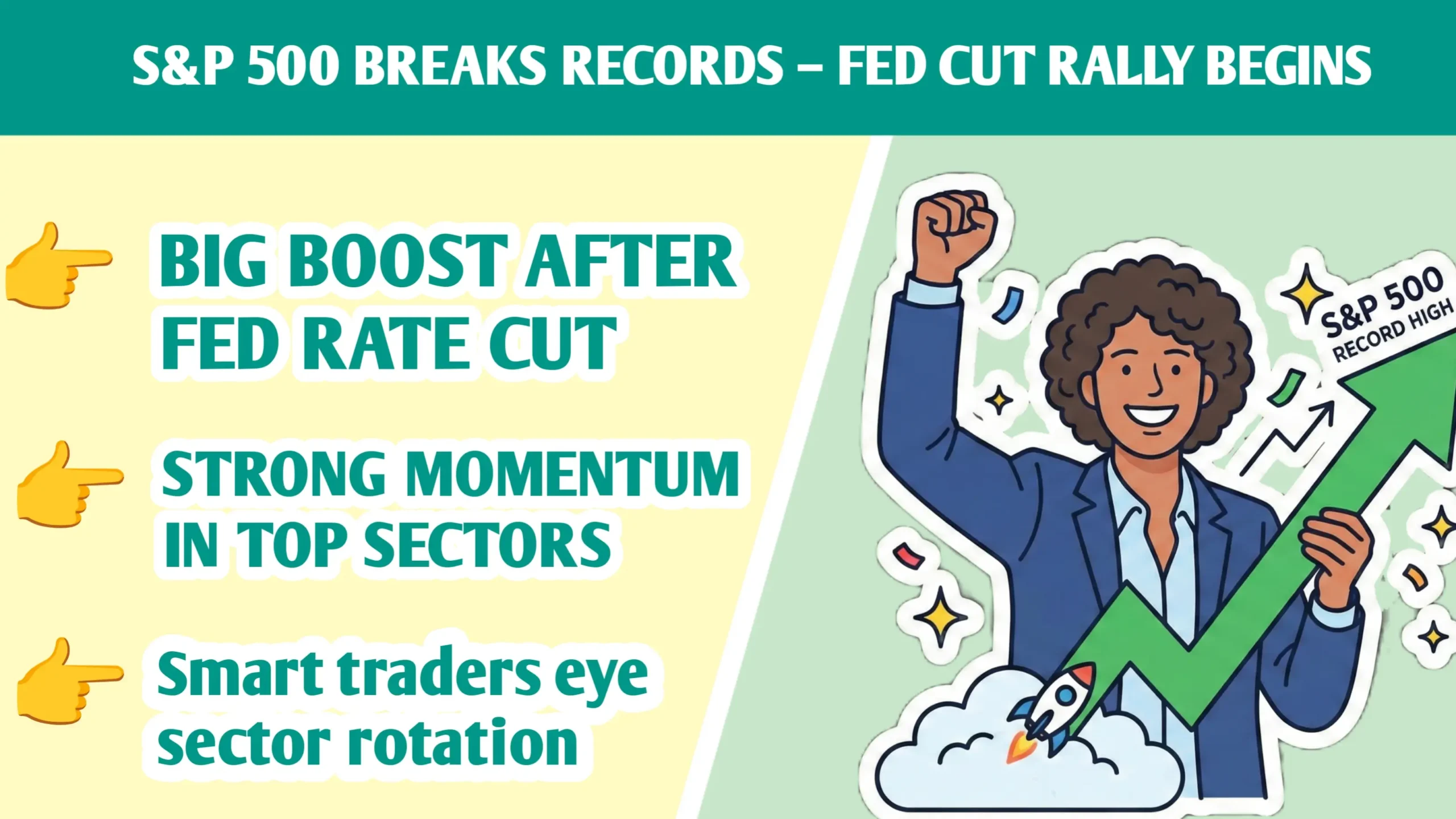

Hi friends! Scanning the tape in early 2026 reveals a classic conflict. The S&P 500 has touched record highs, yet the market’s engine—the Fed rate cut narrative—is sputtering. The immediate pitfall, as seen in February’s hotter PPI data, is directly challenging the central bank’s timeline. This conflict is documented in Federal Reserve meeting minutes and Bureau of Labor Statistics data releases. The market is anxious, with the S&P pulling back to around 6,506 and the VIX fear index spiking roughly 34% in February. So, here’s the reality check… This isn’t about bullish hype; it’s a risk-aware framework for what comes next. Our purpose is to cut through the noise and provide a clear-eyed strategy for navigating the potential stock market rally and inevitable sector shifts driven by Fed policy, inflation, and geopolitical risks.
The current landscape of S&P 500 record highs is a story of two markets: one celebrating new peaks, the other bracing for a fundamental shift. Success in 2026 won’t come from buying the index, but from mastering the rotation beneath it.
Quick Highlights
- Market State: S&P 500 at record highs (~6506), but Fed “higher-for-longer” stance is firming.
- Core Opportunity: The real play is the ongoing sector rotation into energy, materials, and industrials.
- Immediate Risk: Hotter inflation data (PPI) threatens the already-delayed rate cut timeline.
- For Whom: Investors and traders positioning portfolios for the 2026 policy shift and volatility.
Executive Summary: Key Takeaways for Navigating the 2026 Market Rally
The Core Thesis: Why Record Highs Can Still Present Opportunity
New highs in a late-cycle environment aren’t automatically a sell signal. Historical cycle analysis, combined with current fund flow data from platforms like Kavout, shows that the most significant alpha is generated not from buying the index, but from anticipating the rotation within it. The opportunity lies in the rotation beneath the surface—out of mega-cap tech and into other sectors. Recent data shows money moving into ‘real economy’ sectors like energy and industrials.
Your Immediate Action Plan: Prioritizing Steps in a Frothy Market
The most frequent error we see is an unbalanced portfolio. Here’s the corrective sequence for a clear action plan:
- Audit your portfolio for overexposure to high-multiple tech stocks.
- Rebalance to include defensive and cyclical hedges.
- Set strict stop-losses for volatile positions.
- Plan new entries on market pullbacks, not by chasing breakouts.
Critical Risk Factors to Monitor in the Coming Quarters
Your primary macro risk indicator will be Federal Open Market Committee (FOMC) statements. Monitor the SEC filings of major banks for credit risk clues. The top risks are: 1) Inflation re-acceleration (PPI/CPI prints). 2) The Fed staying ‘higher-for-longer’. 3) Geopolitical shocks propping up oil prices (WTI crude is around $98). 4) Narrowing market breadth where only a few stocks lead.
Decoding the Rally: The Fed Rate Cut Engine and Market Psychology
How Anticipated Fed Policy Shifts Directly Fuel Equity Valuations
This isn’t speculation; it’s discounting 101. The Fed Funds Rate is the risk-free rate in your discounted cash flow model. When the market expects rate cuts, future company earnings are worth more today. However, the 2026 shift is crucial: the market is moving from expecting multiple cuts to perhaps just one. This ‘delay’ in the monetary policy easing cycle is causing the current re-pricing and volatility across equity markets.
Beyond the Headlines: Analyzing the Underlying Economic Indicators
Don’t just watch the headline S&P number. The real story is in the Census Bureau’s monthly retail sales report and the BEA’s Personal Consumption Expenditures (PCE) data—the Fed’s preferred inflation gauge. We see a mix: strong past earnings (Q4 2025 was up 14.2%) against forward-looking worries like cooling retail sales and sticky inflation. This combo supports a cautious Federal Reserve that may limit itself to a single rate cut.
Market Sentiment vs. Fundamentals: Gauging the Rally’s Sustainability
In periods like this, we consistently see a divergence between the ‘story’ (AI, rate cuts) and the ‘money flow’. That divergence, measured by the VIX, is your sustainability meter. The fear is evident in the elevated VIX. More telling is the shift from growth to value, with the Russell 1000 Value index outperforming its Growth counterpart. The question for your market analysis is whether this is a healthy correction or the start of a deeper downturn.
Your Strategic Playbook: Trading and Investing Approaches for 2026
Core Portfolio Positioning for Long-Term Investors
This aligns with the SEC’s long-standing advice on diversification to mitigate unsystematic risk. Focus on quality over speculation: companies with strong balance sheets and reliable cash flows. A portfolio heavy only in US mega-caps violates basic Modern Portfolio Theory, especially when international valuations are more attractive. Highlight the merit of international diversification given the S&P 500’s flatness compared to gains in the MSCI World ex-US index.
Active Trading Strategies to Capitalize on Short-Term Volatility
Cover strategies suited for a choppy, news-driven market: 1) Trading sector ETFs like XLE (Energy) or XLI (Industrials) based on rotation signals. 2) Using VIX spikes (like the one to ~20) for hedging via options. 3) The potential of covered call strategies to generate income in elevated volatility environments. Trading these requires understanding their prospectus and holdings. Using VIX products for hedging? Know the FINRA rules on options approval levels and the tax implications.
For a deeper look at how global index rebalancing is affecting sector leadership, see this analysis.
The Essential Role of Risk Management and Position Sizing
The most common blow-up we analyze isn’t from a wrong call, but from oversized positions. In uncertain macro times, managing downside is more important than maximizing upside. The 1-2% risk-per-trade rule isn’t a suggestion; it’s the arithmetic of survival, especially under volatile Fed policy regimes. Use stop-losses based on key technical support levels, like the 200-day moving average whose recent breach triggered automated selling.
The Sector Rotation Imperative: Identifying Winners and Losers
Ignoring sector rotation now is the single biggest strategic error an investor can make. The tape is screaming the change. This is the most critical action item for 2026. The rally’s character is changing from a tech-led surge to a broader, more selective advance.
Historical & Projected Sector Performance in a Rate Cut Cycle
Studies from the Federal Reserve Bank of St. Louis on past cycles show that ‘delay’ phases uniquely benefit tangible asset sectors. We’re in a ‘rate cut delay’ cycle, which historically sees early rotation into defensives and cyclicals that benefit from lingering inflation. This isn’t guesswork; it’s patterned market behavior.
Prime Candidates for Outperformance: Energy, Materials, Industrials
Energy’s case is bolstered by SEC 10-K filings showing capital discipline and by EIA inventory data. These sectors are leading for concrete reasons: Energy (geopolitical risk, oil prices ~$98). Materials & Industrials (inflation hedge, ‘real economy’ assets). These aren’t speculative moves; they’re flows into sectors with transparent, inflation-linked cash flows. Data confirms these were top performers in February.
Sectors to Approach with Caution or Use as Hedges
Honest Truth: Chasing last year’s tech winners now is likely a value trap. Their lofty valuations require perfect execution and lower rates—neither is guaranteed in 2026. Be cautious of Technology & Growth (under pressure from higher rates and rotation) and Financials (sensitive to higher-for-longer rates). Utilities (XLU) and Consumer Staples (XLP) are defensive hedges already seeing inflows. Utilities, while ‘boring’, serve a specific IRS-qualified dividend and capital preservation role.
| Sector | 2026 Outlook & Catalyst | Consideration for Portfolio |
|---|---|---|
| Energy | Geopolitical risk, high oil prices (~$98). Top performer in Feb. Inflation hedge. | Strong candidate for overweight. Monitor DOE weekly crude reports. |
| Materials | Beneficiary of inflation, ‘real economy’ rotation. Less vulnerable to AI disruption. | Add for cyclical exposure and inflation protection. |
| Industrials | Infrastructure spending, economic cycle play. Seeing fund inflows. | Core holding for balanced growth exposure. |
| Technology | Pressure from higher rates, AI fatigue, and sector rotation. Growth slowing. | Underweight or selective. Valuation sensitivity to Fed tone is high. |
| Financials | Down YTD. Net interest margins squeezed if Fed stays high. | Approach cautiously. Monitor credit quality in bank earnings. |
| Utilities | Defensive hedge. Stable dividends in demand during volatility. | Use for stability and income, not high growth. |
Sector Rotation Snapshot: Early 2026 Market Dynamics
Sector rotations are a global phenomenon. Here’s how it’s playing out in one of the world’s fastest-growing major markets.
Advanced Analysis: Technicals, Valuations, and Market Breadth
Interpreting Key Chart Levels and Momentum Indicators on the S&P 500
The 200-day moving average isn’t just a line; for many quantitative funds and institutional risk models, a sustained break triggers automated selling programs. That’s why this level matters. Note the key levels: Record highs, the recent pullback to ~6506, and the critical breach of the 200-day MA. A reclaim above it suggests resilience, while a failure signals deeper correction risk.
Assessing Market Breadth: Is the Rally Narrow or Broad-Based?
Healthy rallies are broad. Breadth data from exchanges and providers like Bloomberg shows participation is weakening. Cite the underperformance of the equal-weighted S&P 500 and small caps (Russell 2000 down) as signs of narrowing, concentrated leadership—a key risk factor. A rally on the backs of 5-7 stocks, while the Russell 2000 languishes, is historically fragile.
Valuation Metrics in a High-Price Environment: Finding Fair Value
Shiller CAPE for the S&P is elevated, but that’s a backward-looking aggregate. In a rotation, sector-level valuation is more important than index-level. Forward P/E for the energy sector, based on analyst consensus from Refinitiv, tells a completely different and more relevant story for 2026 allocation. Value sectors may look cheaper relative to their improving outlook.
Authority Insights & Data Sources
- Economic Data: Market data on PPI, CPI, and retail sales sourced from Federal Reserve Economic Data (FRED) and Bureau of Labor Statistics reports, as analyzed by institutional commentary.
- Market Performance: Sector performance and index-level statistics are derived from real-time market data feeds and aggregated by financial research platforms.
- Policy Analysis: Fed policy analysis incorporates statements from FOMC meetings, projections, and Chair Powell’s press conferences.
- Important Disclosure: The author and publisher are not registered financial advisors with the SEC or CFTC. This material is for educational and informational purposes only. Conduct your own due diligence and consider consulting a qualified professional for personalized advice tailored to your financial situation and risk tolerance. Past performance and historical patterns are not guarantees of future results. This is analytical commentary, not personalized financial advice.
Common Pitfalls and How to Avoid Them in a Bull Market Frenzy
Emotional Trading Mistakes: FOMO, Greed, and Recency Bias
Client portfolio reviews consistently reveal this pattern: over-allocating to what just worked. It’s a documented cognitive bias, not a strategy. In a bull market frenzy, warn against chasing yesterday’s winners (tech) and fearing missing out on breakouts. The recent past (AI rally) is not the 2026 playbook.
Strategic Errors: Overconcentration, Chasing Yield, Ignoring Hedges
SEC regulations emphasize diversification for a reason. A non-diversified portfolio is a speculative bet. Critique the ‘all-in on Magnificent Seven’ portfolio. Discuss the danger of reaching for yield in rate-sensitive sectors like REITs without understanding their interest rate sensitivity, detailed in their SEC 10-Q filings. Stress the non-negotiable need for hedges (defensives, cash, options).
The Portfolio ‘Health Check’ Routine for 2026
Top portfolio managers run this check quarterly, aligning with earnings season and FOMC meetings. It forces action based on data, not emotion. Your 5-minute checklist: 1) Sector exposure vs. the recommended rotation above. 2) Percentage of your portfolio in stocks below their 200-day MA. 3) Cash position level (dry powder). 4) Date of your last rebalance.
Looking Beyond 2026: Building a Resilient Portfolio for All Cycles
Asset Allocation Principles That Withstand Market Shifts
This isn’t our opinion; it’s the conclusion of Nobel-winning Modern Portfolio Theory and a cornerstone of the SEC’s investor education materials. Asset allocation is the primary determinant of long-term returns. Reiterate timeless principles: diversification across sectors, asset classes (consider bonds if rates peak), and geographies.
The Non-Negotiable Elements: Diversification, Rebalancing, and Patience
Rebalancing is how you systematically ‘sell high and buy low.’ It’s a tax-efficient process (understand IRS wash-sale rules) that enforces the discipline most investors lack. Emphasize that sector rotation strategies require periodic rebalancing. Patience is needed as these macro rotations play out over months, not days.
Continual Education: Resources for Staying Ahead of Market Trends
For authoritative primary sources, bookmark the Federal Reserve’s website for FOMC statements, the BEA for GDP data, and the SEC’s EDGAR database for company filings. These are the unfiltered sources. Suggest following key economic calendars (CPI, PPI, Fed meetings) and reading credible market commentary to understand macro drivers.
FAQs: ‘bull market’
Q: Is it too late to buy the S&P 500 after it hits record highs?
Q: How many Fed rate cuts are priced into the market for 2026?
Q: Which single sector ETF is the best hedge if the rally fails?
Q: Should I sell all my technology stocks because of this rotation?
Q: What’s the biggest mistake investors are making right now regarding sector rotation?
The market is always evolving. The strategy that won in 2023 won’t win in 2026. The dual narrative of 2026 is clear: S&P 500 record highs are masking a significant internal shift. Success hinges on adapting to the new regime of cautious Fed policy, sector rotation, and heightened volatility. By focusing on the rotation, respecting risk, and adhering to time-tested principles of diversification within your investment portfolio, you’re not just following trading strategies for a rally—you’re building durable financial resilience. Strategic positioning is the key differentiator.