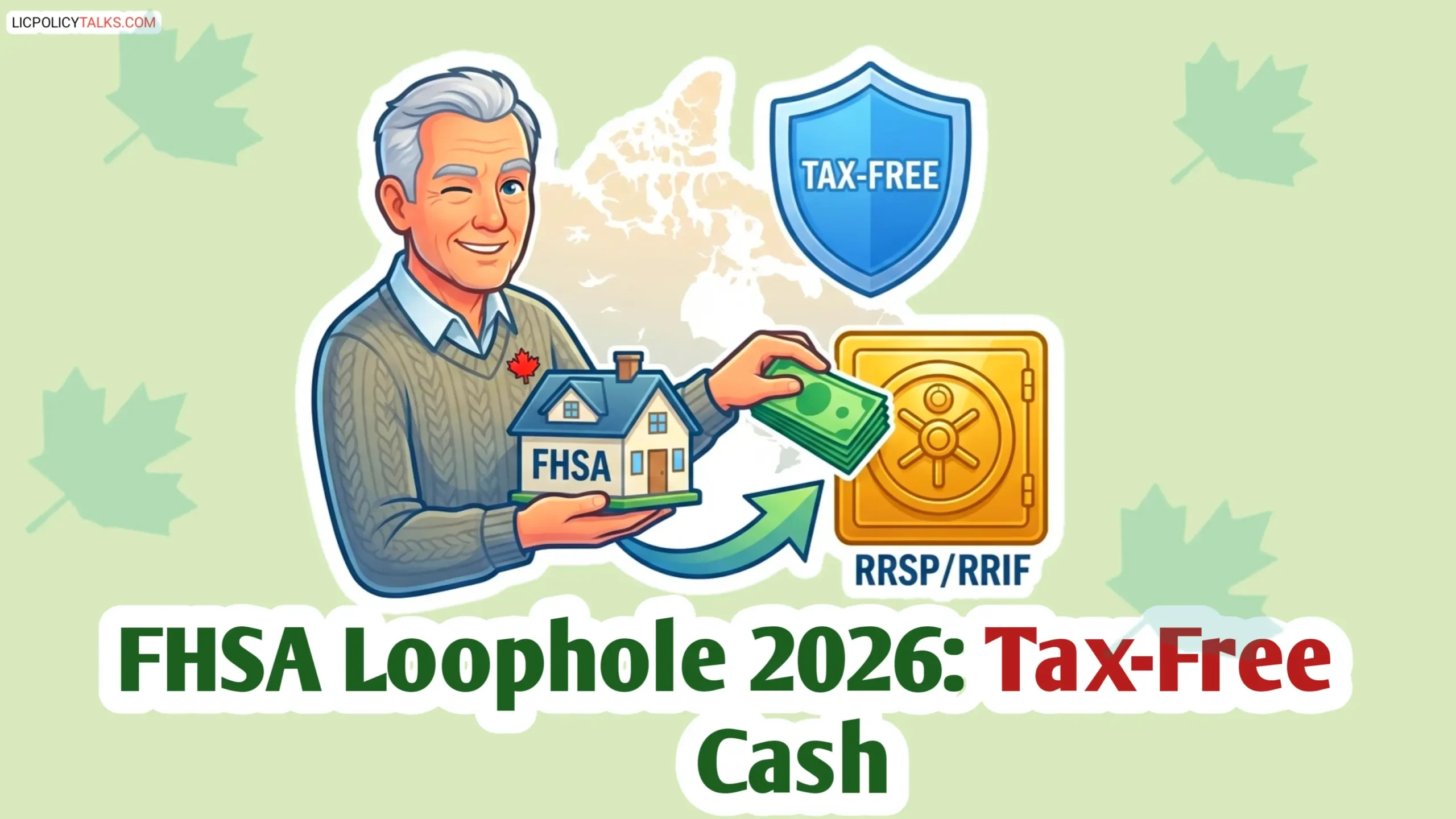
Hi friends! If you’re a Canadian over 50, you’ve probably heard about the new First Home Savings Account. You might have thought, “That’s for first-time buyers, not for me.” What if I told you there’s a perfectly legal, CRA-approved way for retirees to use this account to build a stash of completely tax-free cash for later life? It’s not a sneaky trick; it’s a strategic, long-term provision in the rules. And with a key 2026 deadline on the horizon, now is the perfect time to understand this powerful retirement planning tool. Let’s dive in.
This guide will demystify the so-called FHSA Loophole, framing it as a legitimate strategy for savvy Canadian retirees. We’ll walk through the rules, the timeline, and a clear action plan to help you decide if this fits into your financial future.
Beyond the Down Payment: Redefining the FHSA for Retirement
Everyone knows the FHSA is designed to help first-time buyers save for a down payment. But honestly, its long-term benefit is the real game-changer for retirement planning. Here’s the core, perfectly legal rule that changes everything: the CRA states that withdrawals for *any purpose* are 100% tax-free if your account is at least 15 years old OR you have reached age 71. This isn’t a glitch; it’s a designed feature. As noted in recent analyses, “its rules permit withdrawals for non-housing purposes after the account has been open for at least 15 years, creating a valuable long-term tax shelter.” This transforms the FHSA from a short-term home-buying tool into one of the most powerful tax shelter vehicles available for building future tax-free cash.
The 2026 Countdown: Why This Year is a Pivotal Deadline
The FHSA program launched in April 2023. For the earliest adopters who opened accounts that year, the 15-year clock runs out in 2038. So why is 2026 such a big deal for financial planning? It’s all about maximizing your contribution runway. You have a $40,000 lifetime limit, and you can carry forward unused contribution room. Starting your contributions now, or at least solidifying your plan before 2026, gives you more time to hit that $40k max and, most importantly, gives your investments the longest possible time to grow completely tax-free. The earlier you start, the larger your future tax-free nest egg becomes. Proactive planning before 2026 is essential for those seeking to leverage this opportunity for enhanced financial security.
The Mechanics of the Strategy: A Step-by-Step Blueprint
Let’s break this down into simple, actionable steps for someone aged 55 to 65. Think of it as a three-part recipe for generating future tax-free cash.
Step 1: Eligibility Check – Are You a ‘First-Time Home Buyer’?
This is the most surprising part for many retirees. The CRA’s definition is specific: you are a “first-time home buyer” if you have not owned a home that you lived in at any time during the current calendar year and the previous four calendar years. Many retirees qualify! If you sold your family home five or more years ago to downsize, rent, or travel, you might be eligible. Even if you own a recreational property like a cottage, it’s your primary residence that counts.
Step 2: Contribution & Deduction Strategy
You can contribute up to $8,000 per year, with a $40,000 lifetime max. Here’s the magic: every dollar you contribute gives you an immediate tax deduction, just like an RRSP. This is a huge upfront benefit. A smart move for those with existing savings? Contribute to your FHSA first to get the tax refund, then use that refund money to fund your TFSA. This way, you get the deduction *and* create more flexible, tax-free savings.

Step 3: The 15-Year ‘Sleeping Period’ & Investment Choice
Once the money is in, you let it grow untouched for at least 15 years. This is the “sleeping period.” Because your time horizon is still long-term (15+ years), you should invest this money for growth. A balanced portfolio of low-cost ETFs or stocks is appropriate here. This contrasts with the more conservative investments you might hold in a RRIF. The goal is to let the power of tax-free compounding do the heavy lifting.
Visual Guide: FHSA vs. RRSP vs. TFSA for a Retiree’s Tax-Free Cash
The Tax Efficiency Showdown (Comparison Table)
| Feature | FHSA (Retirement Strategy) | RRSP/RRIF | TFSA |
|---|---|---|---|
| Contribution Tax Deduction | YES | YES | NO |
| Growth Tax Status | Tax-Free | Tax-Deferred | Tax-Free |
| Withdrawal Tax Status (Qualified) | 100% Tax-Free | Fully Taxable as Income | 100% Tax-Free |
| Mandatory Withdrawal Age | None (But must close at 71) | Yes (RRIF at 71) | None |
| Best For This Strategy | Long-term, lump-sum tax-free cash post-15 yrs | Steady retirement income, tax deferral | Flexible, anytime tax-free access |
Scenario Analysis: How Much Tax-Free Cash Can You Really Shelter?
Let’s look at some realistic numbers. The charts below show two hypothetical scenarios for a retiree using the FHSA as a long-term tax shelter. Remember, these figures represent money you can withdraw without paying a cent of tax to the CRA.
Scenario A: Max Contributor (Starts at 55)
Contributes $8k/yr for 5 years ($40k total). Assumes 6% return.
Scenario B: Moderate Contributor (Starts at 60)
Contributes $4k/yr for 8 years ($32k total). Assumes 5% return.
Navigating the Pitfalls: CRA Rules You Must Not Break
Now, let’s get serious. This strategy only works if you follow the rules to the letter. Adherence to CRA guidelines is paramount, as improper withdrawals can trigger taxes and penalties, undermining the account’s advantages. Here are the critical pitfalls to avoid.
The Non-Qualified Withdrawal Trap
If you need to pull money out for a non-qualifying purpose before the 15-year mark (or age 71), it’s considered a “non-qualified withdrawal.” The amount is fully added to your taxable income for the year, and you permanently lose that contribution room. This can create a significant tax bill and derail your long-term plan.
The 15-Year Clock & Age 71 Rule
Remember the two gates to tax-free access: 15 years OR age 71, whichever comes first. If you open the account at 60, you can withdraw tax-free at 71, even though it’s only been 11 years. Also, you must close your FHSA by the end of the year you turn 71. Any funds must be withdrawn (tax-free if qualified) or transferred to an RRSP/RRIF.
Coordination with RRSPs: Avoiding Overlap
Your FHSA contributions give you a separate $8,000 deduction limit on top of your RRSP limit. This is a bonus! However, you need to plan your deductions wisely, especially if you have a pension. Consulting a financial planner can help you optimize which deductions to claim and when, to avoid pushing yourself into a lower tax bracket unintentionally.
Your Action Plan: Checklist to Start Before 2026

The Pre-2026 Checklist
- Confirm FHSA eligibility using the CRA’s 4-year rule for first-time home buyers.
- Review your contribution room and plan how to use carry-forward amounts.
- Set up an account with a provider that offers low-fee growth funds or ETFs.
- Plan your 2024 and 2025 contributions to maximize your runway before the 2026 deadline.
- Schedule a review with a fee-only financial advisor to integrate this into your overall retirement planning.
- Mark your 15-year horizon date on your calendar. Patience is key!
FAQs: ‘FHSA Retirement Strategy’
Q: I’m 68 and own a cottage but not a primary home. Do I qualify as a first-time home buyer for an FHSA?
Q: Can I transfer funds from my RRSP to my FHSA to kickstart this strategy?
Q: What happens to my FHSA if I die before the 15 years are up?
Q: Is this strategy better than just using my TFSA?
Q: Where can I open an FHSA, and what should I look for in a provider?
Final Word: A Powerful Tool, Not a Secret Loophole
Let’s be clear: this FHSA Loophole for Canadian retirees isn’t about gaming the system. It’s about understanding and strategically using a powerful, CRA-designed tax shelter for a purpose beyond its initial marketing. It requires patience, discipline, and a solid 15-year plan. If you’re between 50 and 70, this could be a brilliant way to add a significant chunk of tax-free cash to your retirement blueprint. Use this guide as your starting point, then take that next, most important step: have a detailed conversation with a qualified financial planner. Your future, more secure retirement self will thank you for taking control today.