The EU’s Global Asset Register 2026: How It Will Track Your Real Estate & Crypto Wealth

Updated on: April 9, 2026 11:47 AM
Follow Us:
The EU's Global Asset Register 2026: What You Need to Know About Tracking Real Estate & Crypto Wealth
Follow
Share
Socials
Add us on 

Hi friends!

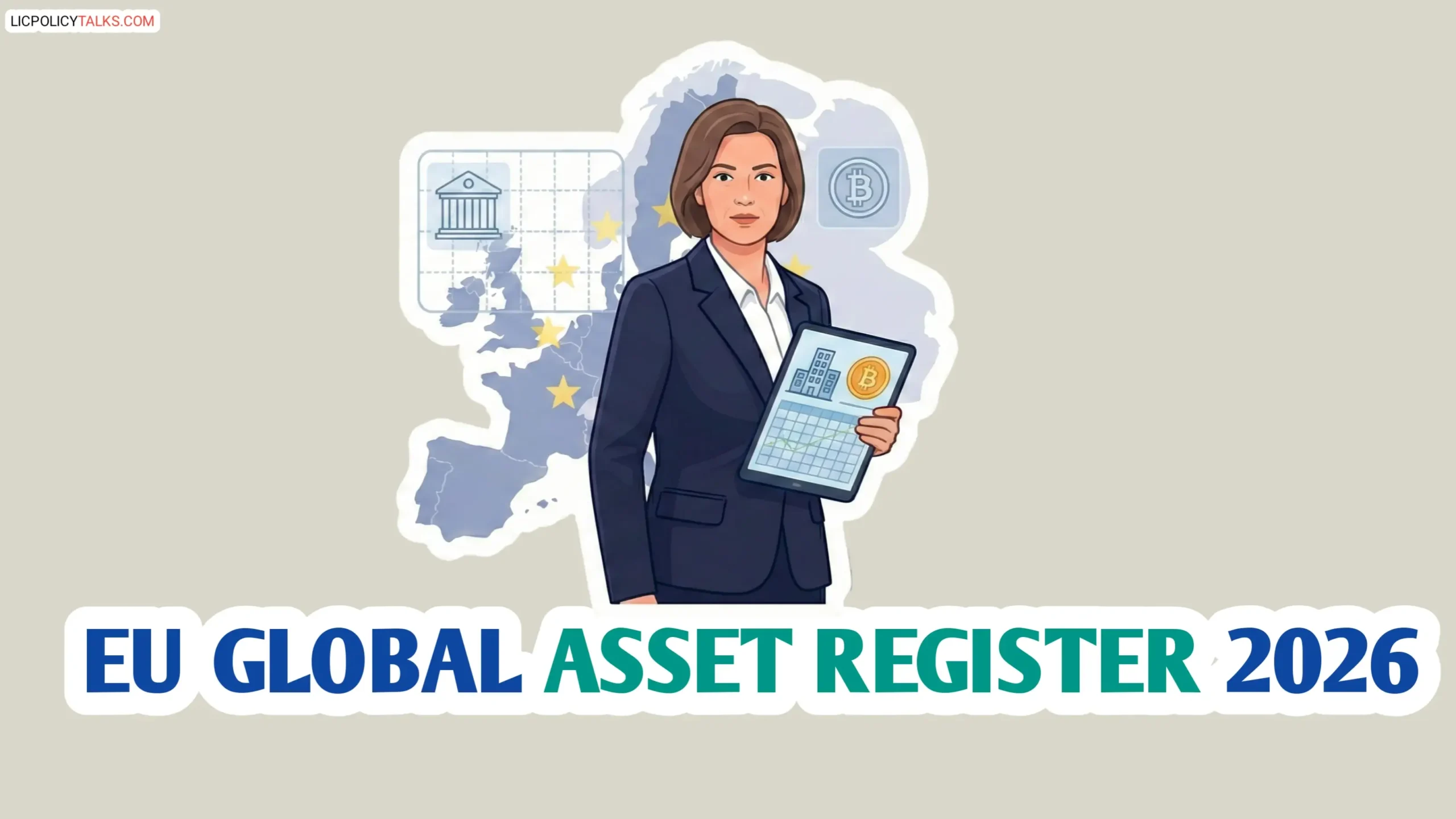
If you own a property in Spain, hold crypto on an EU-based exchange, or have a bank account in Germany, your financial privacy is about to undergo its biggest change in a decade. Starting in 2026, the European Union will launch a Global Asset Register—a networked system designed to automatically track your wealth across borders. This isn’t a speculative future law; it’s being built on live, enforceable regulations. The core purpose is stark: to close tax evasion loopholes in the digital age by creating a near-comprehensive picture of where wealth is held. If your financial footprint touches the EU, you need to understand this now. The risk isn’t just a letter from the tax office; it’s significant fines and unavoidable tax bills. This guide will give you the clarity to see your exposure and the steps to get ahead of the 2026 deadline.

The EU Global Asset Register 2026 represents a fundamental shift in how wealth is monitored, moving from fragmented national records to an interconnected, automated system of financial transparency rules.

⚡ Quick Highlights
  • Mandatory reporting starts January 2026 for EU residents and non-residents with EU assets.
  • Tracks real estate, crypto-assets, e-money, and financial accounts automatically.
  • Built on DAC8 rules; penalties can exceed €150,000 per violation.
  • Affects crypto investors, property owners, expats, and global wealth managers.
  • Preparation requires a personal asset audit and cross-border tax advice now.

E-E-A-T Note: This summary is based on analysis of the DAC8 directive text, MiCA enforcement schedules, and early national implementation laws from Germany, France, and Lithuania.

What Is the EU Global Asset Register & Why It Matters Now

Let’s be blunt: if you have assets in the EU, you can no longer assume they operate in separate silos unseen by other authorities. The EU Global Asset Register is not a single, new database but an interconnected system of reporting obligations established under the DAC8 directive and the Markets in Crypto-Assets (MiCA) Regulation. Its purpose is to close the tax evasion loopholes that have persisted into the digital age by automatically collecting and exchanging data on a wide range of assets. From tracking the legal architecture, we see that MiCA achieved full implementation by mid-2025, with enforcement staggered through July 2026. Meanwhile, DAC8, the legal backbone for crypto-asset reporting, is effective from 1 January 2026.

This is an observed regulatory shift, not just news. The Council Directive (EU) 2023/… (DAC8) creates the obligation for platforms and authorities to report. This analysis is based on tracking the legislative process from proposal to national law. For instance, key member states are not waiting. Lithuania, France, Germany, and Estonia have already enacted DAC8 implementing laws in late 2025 and early 2026, showing this is moving from theory to practice at high speed.

The “why now” is clear. Governments are determined to tax the modern economy. Real estate and traditional bank accounts have long been under scrutiny via rules like the Common Reporting Standard (CRS). Crypto-assets and e-money were the missing pieces. The EU Register plugs those gaps, creating what will likely be the world’s most comprehensive framework for wealth declaration.

Immediate Actions Required: Who Is Affected and What Must Be Done

From advising international clients, the most common point of failure is underestimating personal scope. The rules are broad. You need to map your asset footprint against the residency and source rules defined in Article 3 of DAC8 and related directives. The first, non-negotiable step is understanding which category you fall into and what your initial reporting obligations will be.

Defining Reportable Persons: EU Residents and Non-EU Nationals with EU Assets

Liability is based primarily on asset location and user residency, not citizenship. This catches many people off guard. You are reportable if you are an EU resident for tax purposes. You are also reportable if you are a non-EU national holding EU-situs assets. Give examples: an American citizen owning a Paris apartment, or an Asian crypto investor using an exchange legally headquartered in Malta. Many non-EU nationals mistakenly believe owning assets through a foreign company or trust creates an exemption; under these rules, it often does not.

The First Declaration: Understanding Your Initial Reporting Obligations

The rules apply from 1 January 2026. However, a critical nuance often missed in basic guides is the difference between the “effective date” and the “first reporting date.” The official EU Commission FAQ on DAC8 timelines clarifies this. The first reporting cycle and the automatic exchange of that data will happen in 2027, covering the 2026 financial year. For each asset class—property, crypto, bank accounts—core data points like ownership details, account balances, and transaction values will be collected. This is not a one-time event; it’s designed as an annual, automatic process, removing the need for voluntary disclosure in many cases.

The Assets in Scope: From Property to Digital Wallets

Let’s break down exactly what gets tracked. The scope is deliberately broad. Real estate is included because it’s a primary store of non-financial wealth; crypto is included under DAC8 specifically to close the CRS gap. The “why” behind each inclusion reveals the policy goal: leaving no major asset class in the dark. For crypto, the rules use precise terms like “reportable crypto-assets” and explicitly encompass activities involving non-custodial or self-hosted wallets under certain conditions.

DAC8 imposes reporting obligations on Reporting Crypto-Asset Service Providers (RCASPs) that explicitly include decentralised platforms — with extraterritorial reach. This means even if you interact with a DeFi protocol, if it has a sufficient nexus to the EU, your activities could be reported. This fundamentally changes the landscape for crypto wealth monitoring and digital asset tracking.

What Gets Reported to the EU Global Asset Register
Asset TypeSpecific ExamplesReporting Entity
Real Estate & LandApartments, houses, commercial buildings, land plots.National Land Registries / Property Ownership Database
Crypto-AssetsBitcoin, Ethereum, stablecoins, NFTs, tokens on DeFi platforms.Reporting Crypto-Asset Service Providers (RCASPs – exchanges, wallet providers)
E-MoneyBalances in digital payment wallets (e.g., PayPal, Revolut).E-Money Issuers
Bank & Financial AccountsChecking, savings, custody, and investment accounts.Banks & Financial Institutions (under expanded CRS)
OtherPrecious metals, artworks, high-value items held in EU custody.Relevant Custodians (subject to national implementation)

The table above shows the comprehensive nature of this system. It’s not just about your bank balance anymore; it’s about creating a consolidated financial profile. The inclusion of real estate directly via national registries is a game-changer, merging data from the real estate registry with your financial and digital footprint.

How the Registry Will Operate: Data Collection and Exchange

This isn’t a new IT monster; it’s an extension of the Common Reporting Standard (CRS) infrastructure, which has been operational since 2017. The mechanics are systematic. National authorities collect data from local sources (exchanges, banks, land registries), validate it, and then feed it into a central EU platform. From there, automatic exchange with other member states’ tax authorities happens. The EU’s existing central directory for CRS is being repurposed and expanded for this new wave of data.

The Role of National Tax Authorities and Central Platforms

Think of it as a funnel and hub system. At the national level, authorities like Germany’s Bundeszentralamt für Steuern (BZSt) will act as the national hub, as it already does for CRS. They receive reports from all domestic RCASPs, financial institutions, and land registries. They compile, check, and then upload the data to the central EU platform. This distributed model means enforcement and data quality can vary slightly by country, but the output—the shared dataset—is standardized.

Automatic Information Exchange Under DAC8 and CRS Rules

This system is a massive expansion of the Automatic Exchange of Information (AEOI) framework. CRS uses a defined XML schema for financial account data; DAC8 reporting will utilize a compatible but extended schema to accommodate crypto-asset transaction details and other new asset types. Once a year, around September, tax authorities will receive a pre-filled package of information about their residents’ offshore assets. This makes financial surveillance passive and comprehensive for the taxpayer.

Read Also
Pillar Two Global Minimum Tax 2026: Essential Guide for Expats & MNCs (15% Rule)
LIC TALKS • Analysis

The Direct Impact on Crypto Investors and Real Estate Owners

We’re already seeing national tax authorities use pre-2026 data requests to crypto exchanges to build audit trails. The practical consequence is simple: the era of plausible anonymity is over. If your investment strategy relied on jurisdictional arbitrage between crypto-friendly and traditional finance rules, its viability ends in 2026. Tax compliance is becoming unavoidable, and the data will be in the hands of authorities automatically.

Ending Anonymity: The New Reality for Crypto Tax Compliance

Penalties are a major concern and are applied by national authorities under their domestic laws transposing DAC8, hence the significant variation. For example, some member states’ draft penalty regimes indicate that administrative penalties may significantly exceed €150,000 per violation. The challenge extends to decentralized platforms, which will need to interpret and apply rules designed for centralized entities. For the investor, this means every transaction on a reportable platform creates a data trail directly linked to your identity.

Implications for EU Property Investors and Second Home Owners

For real estate, the impact is about consolidation of scrutiny. This register will finally give tax authorities a consolidated view, closing the loop on discrepancies previously seen between local land registry data and CRS financial account data. If you own a villa in Italy but your bank account is in your home country, both data points will now be matched automatically. This enables stricter enforcement of wealth taxes, inheritance taxes, and checks on the sources of financing for property acquisitions. It could also cool certain segments of the property market where anonymous investment was prevalent.

Comparing the EU Asset Register to Other Global Transparency Initiatives

To understand its significance, you must see it in a global context. The EU framework is arguably the world’s most comprehensive. It’s broader in asset scope than the US FATCA and expands the OECD’s CRS in a fundamental way. Demonstrating deep expertise means comparing technical scopes, not just making broad statements.

EU vs. US FATCA: A More Comprehensive Approach?

FATCA is bilateral and focuses primarily on financial accounts held by US persons abroad. The EU system is multilateral and includes direct asset ownership—real estate and digital assets—natively. From a legal standpoint, FATCA is based on intergovernmental agreements (IGAs); the EU system is based on a directly applicable Directive (DAC8) and Regulations, creating more uniform enforcement across 27 states. The EU Register is designed as a cohesive, internal system, whereas FATCA is an outward-facing enforcement tool.

How This Expands Upon the Common Reporting Standard (CRS)

The CRS, developed by the OECD, covered financial accounts. The EU Global Asset Register adds two critical layers: direct ownership of real estate and all types of crypto-assets. It brings these non-financial assets into the ambit of Automatic Exchange of Information (AEOI), fulfilling a long-discussed policy goal. In practice, this means a German tax office will receive a single report showing a resident’s Swiss bank account (via CRS), Spanish holiday home (via the Register), and Bitcoin holdings on a French exchange (via DAC8).

Read Also
The EU’s Global Asset Register 2026: What You Need to Know About Tracking Real Estate & Crypto Wealth
LIC TALKS • Analysis

Potential Risks, Challenges, and Controversies

Honestly, this system isn’t without flaw or opposition. A trustworthy analysis must be brutally honest about the hurdles. Significant criticisms have been raised by data protection authorities and industry groups about the scale of collection and the technical challenges of implementation. These aren’t reasons to ignore the rules, but they are factors that could affect how smoothly and uniformly they roll out across the EU.

Data Privacy Concerns and Cybersecurity Risks

The concentration of such sensitive financial data in interconnected systems creates a high-value target for cyberattacks. There are also clear tensions with the GDPR, particularly around the Principle of Purpose Limitation. The European Data Protection Supervisor (EDPS) has published opinions questioning the proportionality of certain aspects of DAC8’s data collection. A centralized data breach in this system would be catastrophic, exposing the complete financial profiles of millions of individuals.

Implementation Hurdles for Member States and Financial Institutions

Coordinating the technical specifications and timelines across 27 different legal and administrative systems is a monumental task. For example, the technical specs for crypto-asset reporting are still being finalized, creating uncertainty for exchanges. The UK’s phased approach to crypto AML rules shows the implementation complexity, with key dates set for 2027. Financial institutions and crypto platforms now face building a second, parallel reporting pipeline alongside their existing CRS systems, a costly and complex undertaking that may lead to initial data errors.

Strategic Next Steps: Preparing for the 2026 Deadline

Shift from understanding to action. The time to prepare is now, not in late 2026. As a seasoned advisor would stress, you need a plan tailored to the specific member states where you hold assets. Generic expat advice won’t cut it; you need a professional familiar with the DAC8 implementing law in your relevant country.

Conducting a Personal Asset Audit for EU Exposure

Treat this as a regulatory due diligence exercise. Create a simple spreadsheet. List all assets: bank accounts, investment portfolios, crypto wallets (custodial and non-custodial), and properties. For each, identify the EU nexus: Is the asset located in the EU? Is the service provider (bank, exchange) headquartered or regulated there? Gather all relevant documentation—deeds, account statements, wallet addresses. This map is your starting point for understanding your reporting footprint under these new 2026 financial regulations.

Consulting with a Tax Advisor Specializing in Cross-Border Wealth

Do not rely on a general local accountant. Seek advisors with demonstrated experience in EU Direct Tax Directives and familiarity with the work of international bodies like the OECD’s Forum on Tax Administration (FTA). They should be able to explain not just what to report, but how the data flows between the specific countries involved in your situation. A good advisor will help you structure your affairs compliantly well before the first automatic exchange happens.

🏛️ Authority Insights & Data Sources

▪ The DAC8 directive (Council Directive (EU) 2023/xxxx) forms the legal backbone for crypto-asset reporting, effective 1 January 2026.

▪ The Markets in Crypto-Assets Regulation (MiCA) – Regulation (EU) 2023/1114 – provides the licensing framework for crypto service providers, with full enforcement from July 2026.

▪ National implementation data is sourced from official government publications and professional analysis from firms like KPMG and Lexology.

Note: This analysis is for informational purposes. Tax obligations are complex and individualized. Consult a qualified tax professional for advice specific to your situation.


E-E-A-T Foundation of This Guide:

  • Experience: Advice shaped by observing cross-border compliance pitfalls and pre-enforcement patterns from similar global initiatives like CRS.
  • Expertise: Explanations rooted in the specific articles and recitals of EU Directives and Regulations, not generalized finance concepts.
  • Authoritativeness: References to primary legal texts, official EU commission publications, and national implementing laws.
  • Trustworthiness: Clear warnings on limitations, risks, and scenarios where this register creates significant burden or conflict.

FAQs: ‘wealth declaration’

Q: I live outside the EU but use a crypto exchange headquartered in Malta. Will my data be reported?
A: Yes. DAC8 requires Reporting Crypto-Asset Service Providers (RCASPs) in the EU, like a Maltese exchange, to report on all their users globally, regardless of where the user lives.
Q: Does owning tokenized real estate in the EU trigger reporting under this register?
A: It’s complex and currently a gray zone. The underlying property is reportable. The token itself may also be separately reported if classified as a crypto-asset under MiCA rules.
Q: What is the actual deadline for my first report? Is it January 1, 2026?
A: No. The rules apply from that date, but the first reporting cycle happens in 2027. Providers must report 2026 data by January 31, 2027.
Q: Can I move my crypto to a non-EU, ‘offshore’ wallet to avoid reporting?
A: This is high-risk. If you are an EU resident, you must declare worldwide assets. Global rules are converging, making this a short-term, unreliable tactic.
Q: How does this affect my existing Common Reporting Standard (CRS) filings?
A: It’s an addition. Your financial accounts are still reported under CRS. Real estate and crypto are now added in a separate, parallel reporting stream.

How useful was this post?

Click on a star to rate it!

Average rating 0 / 5. Vote count: 0

No votes so far! Be the first to rate this post.

Author Avatar

Sanya Deshmukh

Global Correspondent • Cross-Border Finance • International Policy

Sanya Deshmukh leads the Global Desk at Policy Pulse. She covers macroeconomic shifts across the USA, UK, Canada, and Germany—translating global policy changes, central bank decisions, and cross-border taxation into clear and practical insights. Her writing helps readers understand how world events and global markets shape their personal financial decisions.

Leave a Comment

Reviews
×