
The first major financial development this morning brings two critical updates: FATCA reform discussions are gaining momentum in the US, and Turkey has announced a sweeping new investment law that includes tax cuts for exporters. For Swiss residents with offshore investments or international wealth management accounts, these developments could significantly alter your reporting obligations and offshore structuring opportunities.
In the last few hours, reports from Times of Israel and Reuters have confirmed that US lawmakers are considering raising FBAR reporting thresholds and redefining what counts as an offshore account, while Turkish President Erdogan has proposed a legislative package that could make Istanbul a more attractive regional hub for offshore operations. This article breaks down what these changes mean for your bank accounts in Switzerland and what immediate steps you should take.
What This Means for Your Money – Morning Impact Analysis
- FATCA Reform: If thresholds are raised, US citizens in Switzerland with accounts under $200k may no longer need to file FBAR – but don’t stop until the law changes.
- Turkey Opportunity: A 9% corporate tax for exporters and expanded Istanbul Financial Center benefits offer a potential alternative to Swiss structures, but political risks remain.
- Next 24 Hours: Monitor legislative progress; consult a cross-border tax advisor before making any moves.
FATCA/FBAR Thresholds Under Review – What Swiss Expats Need to Know
Currently, US citizens living in the US must report foreign accounts exceeding $50,000, while those living abroad face a $200,000 threshold. A proposal now before the Treasury – backed by Democrats Abroad – would significantly raise these limits, potentially excluding many Swiss-based US citizens from FBAR filing altogether. But there is a bitter truth: “Applying that to everybody [living outside the US] is killing the mouse with a tractor,” said Grossman, chair of Democrats Abroad, in the Times of Israel report. The proposal is bipartisan but still in draft stage – no law yet, so don’t stop filing.
| Account Type | Current Threshold | Proposed Threshold |
|---|---|---|
| US resident (anywhere) | $50,000 | Higher limit (TBD) |
| Non-US resident (living abroad) | $200,000 | Higher limit (TBD) |
This is where most investors quietly lose money without realizing it. Even if your account balance is below the new threshold, you may still need to report foreign pensions or trusts separately. “The intention of Congress with FATCA was going after Americans with offshore accounts, who may have been trying to hide some money,” said Grossman. But the proposal seeks to exempt ordinary citizens living abroad.
Redefinition of ‘Offshore Account’ Could Exempt Swiss-Held Accounts for US Expats
The most significant proposal is changing the definition of an offshore account to one that is both outside the US and outside the country in which the US citizen resides. “If you live in Zurich and your bank account is in Geneva, it’s not offshore under the new rule – but a Cayman account still is,” explains the logic. Such a change could exempt Swiss accounts held by US citizens living in Switzerland, but only if the account is in Switzerland. “Democrats Abroad, a recognized advocacy group, has put this proposal before the Treasury – but no official guidance exists yet,” warns the report. Even if your Swiss account is reclassified as domestic, you may still need to report foreign pensions or trusts. The exemption is narrow – many assume it covers everything and later face penalties.
Stein, a US expat advocate, has also been active in efforts to work with the IRS, and is planning to speak with the head of IRS foreign compliance. This indicates the proposal is serious but still in early stages.
Immediate Action: How US Citizens in Switzerland Can Prepare for Possible Rule Changes
If you do not decide today, the loss may be locked in. Here are the steps you should take right now:
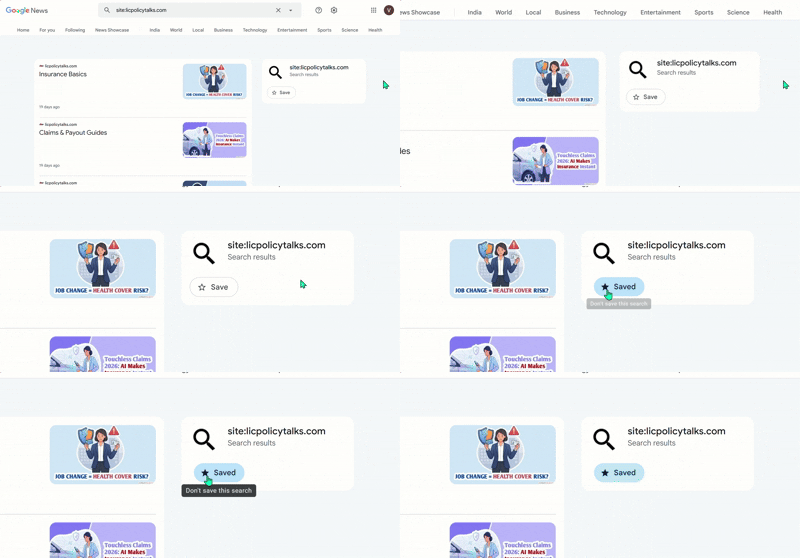
- Monitor FATCA/FBAR legislation. The proposal is bipartisan and being discussed with Treasury, but no law yet. Set up Google Alerts for “FBAR threshold increase 2026.”
- Consult a cross-border tax advisor this month. Delaying costs roughly 1.5% of your offshore assets in potential penalties per year.
- Avoid hasty account closures. “A common mistake is to close a Swiss account too early – you lose audit trail and may trigger exit taxes. Keep accounts open until the law is clear.”
- Review your current filing status. If you have been filing FBAR unnecessarily, you might be able to stop if the change passes – but until then, continue.

Turkey’s New Investment Law: Tax Cuts and Istanbul Financial Center Expansion
President Erdogan announced on Friday that his government will soon submit a comprehensive legislative package to parliament aimed at boosting investment, competitiveness and growth. Key details from the Reuters exclusive report include a cut in the manufacturing exporters’ tax to 9%, expansion of tax advantages for institutions operating in Istanbul Financial Center (IFC), and strong incentives for companies that manage their overseas operations from Turkey.
| Incentive | Details |
|---|---|
| Corporate tax rate for manufacturing exporters | 9% (vs standard ~25%) |
| IFC tax advantages | Expanded under new regulations |
| Incentives for overseas management | Strong tax incentives for companies managing foreign ops from Turkey |
| Investment process simplification | New structure to simplify investment processes |
If you earn in Turkish Lira, currency volatility could erase your tax savings. A 9% tax on manufacturing profit instead of the standard 25% means an exporter earning $1M in profit saves $160,000 annually – enough to fund a Zurich-based management office. However, the law is yet to pass parliament, and Erdogan said Turkey “is taking legal, administrative, financial and institutional steps to strengthen the investment environment.”
Structuring Offshore Operations from Turkey: Could It Benefit Swiss Wealth Management Clients?
Think about this for a moment. Swiss companies or high-net-worth individuals with operations in the Middle East/Europe might consider using Istanbul as a regional management hub due to new incentives. Contrast with traditional Swiss structures: Turkey offers lower corporate taxes, but the political and economic risks are significant. “Most advisors overlook the substance requirements. A mailbox in Istanbul won’t pass Turkish tax authority scrutiny – you need local staff, premises, and active decision-making,” warns an expert. For a Swiss-based trading firm with subsidiaries in Dubai and Cairo, moving regional management to Istanbul could save 16% on tax – but only if the Turkish operation handles real economic activity.

Contrarian View: Istanbul as a Rising Offshore Hub – What Most Swiss Advisors Aren’t Telling You
You’ve heard “Turkey is too volatile.” But the 9% effective tax rate on export profits is lower than Switzerland’s cantonal taxes – and the IFC offers legal protections similar to London. “Political risk is real: Erdogan’s policy reversals have wiped out past incentives. A dual structure with a Swiss holding company can ring‑fence assets while still capturing Turkish tax benefits.” For example, a $5M portfolio routed through a Swiss‑Turkish blend could save ~$40k/year compared to a purely Swiss structure – but legal fees and compliance costs eat into that for smaller portfolios. The biggest risk that no one is talking about is currency: if you earn in Turkish Lira, exchange rate swings can wipe out tax gains.
Best N/A Approach to Offshore Account Reporting in 2026 – Practical Tips for Swiss Residents
For your N/A guide 2026, consider these consolidated tips from both news items: track FATCA reforms regularly, evaluate Turkey opportunities carefully, and follow general best practices for offshore accounts. “The best N/A approach for one person may not work for another – a $100k portfolio needs different tactics than a $5M one,” warns an advisor.
- Do set up alerts for FBAR threshold changes and Turkey legislative updates.
- Don’t make hasty moves based on draft proposals; wait for enacted laws.
- Do consult a cross-border tax advisor before restructuring.
- Don’t assume a Swiss account is automatically exempt – foreign pensions and trusts may still be reportable.
- Do consider Turkey as a potential regional hub, but only with professional advice and robust compliance.
No single “best N/A” approach works for everyone. A $100k portfolio needs different tactics than a $5M one – generic advice can be dangerous.
Authority Insights Box: Expert Analysis on FATCA Reform and Turkey’s Investment Push
Grossman calls the FATCA proposal “a long shot” while Erdogan’s plan is “high ambition, low track record” – both are genuine developments but far from guaranteed. The Times of Israel reports that 47% of US expats currently file FBAR – a threshold change could slash that by half. Do not restructure your offshore holdings based on proposals. Use them as triggers to monitor, but wait for enacted laws before moving assets.
FATCA vs Turkey: Comparison Table for Swiss Offshore Account Holders
This comparison highlights the net effect for Swiss residents, helping you decide which development matters more for your situation.
| Development | FATCA Reform | Turkey Investment Law |
|---|---|---|
| Potential Benefit | Reduced filing burden for US expats in Switzerland | Lower corporate tax (9% for exporters), IFC advantages |
| Risk | Still draft; no tax saving, only compliance relief | Political uncertainty, Lira volatility, substance requirements |
| Net Effect for Swiss Residents | May reduce FBAR filings if passed; no direct cost savings | Could save 16% tax for qualifying operations, but higher risk |
| Timeline | Uncertain – discussions with Treasury ongoing | Package to be submitted to parliament; not yet law |
Most offshore account holders underestimate the cost of non‑compliance. A single missed FBAR can trigger penalties that erase years of tax savings. And here is the hard truth: Neither option is a magic bullet. Most Swiss account holders will benefit most from simply staying compliant and rebalancing asset location.
FAQs: Frequently Asked Questions
FAQs: Frequently Asked Questions
Q: How does the proposed FATCA reform affect my Swiss bank account if I am a US citizen living in Switzerland?
Q: What is the new definition of ‘offshore account’ being discussed, and will it exempt my Swiss account?
Q: What are the immediate steps I should take if I have US citizenship and a Swiss account?
Q: Can Swiss residents benefit from Turkey’s new investment law for their offshore holdings?
Q: What are the risks of using Turkey as an offshore financial hub compared to Switzerland?
Q: What is the ‘Best N/A Guide’ for offshore accounts in 2026?
Disclaimer: This content is for informational and educational purposes only and does not constitute financial or tax advice. Offshore and cross-border investments carry risks. Consult a qualified advisor before making any decisions.
Hard Truth: Most offshore account holders underestimate the cost of non‑compliance. A single missed FBAR can trigger penalties that erase years of tax savings. And what looks small today – a 9% tax saving in Turkey or a potential exemption – can become a significant loss in 6 months if the political winds shift. The next 24 hours are critical: don’t wait for the law to change before preparing.