The first major financial development this morning comes from an updated retirement rule that directly impacts how much you can safely withdraw from your RRSP and RRIF. The classic 4% rule has been revised to 4.7%, and for French-speaking Canadians, understanding this change in their own language is critical to avoiding costly tax traps.
RRSP in french is referred to as REER (Régime Enregistré d’Épargne-Retraite). Knowing this term and others like FERR, CELI, and REEE helps you handle CRA forms, bank documents, and retirement planning with confidence.
In the last few hours, data from USA Today confirms that the 4% rule is now the 4.7% rule. For a retiree with $500,000 in savings, this means $23,500 per year instead of $20,000 — an extra $3,500 annually. But this only works if your portfolio holds up. And for RRSP holders, withdrawals are fully taxable, so the effective benefit may shrink after tax.
Below, we break down every key French term, explain the 4.7% rule in Canadian context, and show you how to avoid the most common withdrawal mistakes.
The 4.7% Rule Is Here: What It Means for Your RRSP Withdrawals
The 4% to 4.7% rule update comes from Bill Bengen himself. According to USA Today (May 17, 2026), the new safe withdrawal rate is higher than the original 4% because of improved market conditions and longer life expectancies. But for RRSP holders, the story is different because RRSP withdrawals are taxed as income.
The impact is immediate: A retiree with $500,000 in RRSP savings withdrawing 4.7% gets $23,500 per year versus $20,000 under the old rule. Over 30 years, that extra $3,500 per year compounds significantly — but only if the portfolio does not suffer a major early loss.
Caleb Silver, editor-in-chief of Investopedia, noted in the USA Today article: ‘The 4% was a general rule of thumb, but the reality is, people really have to look at the true price of what it costs to be them in retirement.’ Rob Williams of Schwab added that retirement spending is dynamic, not static. This means the 4.7% rule is a starting point, not a guarantee.
But here is the hidden risk: If the market drops early in retirement, withdrawing 4.7% accelerates portfolio depletion. For Canadian retirees with RRSPs, this risk is magnified because withdrawals are fully taxable. A 4.7% withdrawal may actually leave you with less after-tax income than expected if you are in a high tax bracket.
Why the 4.7% Rule Matters for French-Speaking Canadians (REER & FERR)
For French-speaking Canadians, the updated withdrawal rate applies directly to REER (RRSP) and FERR (RRIF) withdrawals. Imagine a retiree with $500,000 in a REER. At 4%, they withdraw $20,000 per year. At 4.7%, they withdraw $23,500. In French terms: ‘retrait de 4,7 % de votre REER’ yields $3,500 extra each year.
That extra $3,500 translates to roughly $292 more per month. But because REER withdrawals are taxed as income, the actual net benefit depends on your tax bracket. If you are in the 30% bracket, the after-tax benefit is about $2,450 extra per year. Still significant, but less than the headline number.
Many retirees assume the 4% rule is safe, but the 4.7% rule still carries sequence-of-return risk. If markets drop early, withdrawing more accelerates portfolio depletion. Unlike US 401(k) plans, REER withdrawals are fully taxable as income, so the 4.7% rule must account for tax drag. Always factor in your marginal tax rate when planning withdrawals.
RRSP in French: REER, FERR, CELI and Other Key Terms Translated
This glossary section covers the essential French terms every Canadian investor should know. Understanding these helps you handle CRA forms, bank documents, and retirement planning in Quebec and other francophone regions. Official terms from Canada Revenue Agency and Retraite Québec are used.
REER (RRSP) – The Foundation of Your Retirement Savings in French
REER stands for Régime Enregistré d’Épargne-Retraite. It is the exact rrsp in french term. Contributions to a REER reduce your taxable income. For example, if you earn $60,000 and contribute $5,000 to a REER, your taxable income drops to $55,000. In Ontario, that saves roughly $1,250 in taxes.
The 4.7% rule applies directly to REER withdrawals. If you have $500,000 in your REER, a 4.7% withdrawal gives you $23,500 per year. But remember, this is pre-tax. You will owe income tax on every dollar withdrawn.
Most people don’t maximize REER contributions because they perceive it as inaccessible cash. Delaying contributions for even a few years can cost thousands in compound growth. Contribution limits for 2026 are 18% of earned income, up to a maximum of $31,560. The earlier you start, the more time your money has to grow tax-deferred.
FERR (RRIF) – When You Must Convert Your REER (French Term Explained)
FERR stands for Fonds Enregistré de Revenu de Retraite. It is the mandatory account you must convert your REER into by December 31 of the year you turn 71. If you don’t convert, the CRA treats your entire REER as fully taxable in that year — one of the costliest retirement mistakes.
Plan your conversion at least 6 months before age 71. Your advisor can help you choose between a FERR, an annuity, or a partial cash withdrawal. The minimum withdrawal at age 71 is 5.28% of the account value. Withdrawing more than the minimum can push you into a higher tax bracket and trigger rrsp benefits erosion through OAS clawback.
Scenario: You have $200,000 in REER at 71. Minimum FERR withdrawal is $10,560 (5.28%). If you need $20,000, the extra $9,440 may push you from the 30% to 35% bracket, costing $472 more in tax. Plan carefully.
CELI (TFSA) – The Tax-Free Account Every French-Speaking Canadian Should Use
CELI means Compte d’Épargne Libre d’Impôt — the French name for TFSA. Unlike REER, CELI withdrawals are tax-free and do not count as income. This makes it ideal for large one-off expenses without affecting OAS or GIS.
Insight: A retiree needs $20,000 for a home repair. Withdrawing from REER adds $20,000 to income, potentially causing OAS clawback. With CELI, no impact on benefits and no tax due. Only about 30% of Canadians max out their CELI. Most see it as a savings account, not an investment account. This is a missed opportunity for tax-free growth.
For 2026, the CELI contribution room is $7,000 (cumulative from 2009). If you have unused room, catch up. Even holding bond ETFs in a CELI can be more efficient than in a REER, because interest income is tax-free.
REEE (RESP) – Saving for Your Child’s Education in French
REEE stands for Régime Enregistré d’Épargne-Études. It is the French term for RESP. The government adds 20% to your first $2,500 each year (up to $500) through the Canada Education Savings Grant. ‘Cotiser à un REEE’ means contributing to an RESP.
Start early. Even $100/month from birth could grow to over $50,000 with grants and compound growth. More than half of Canadian parents don’t maximize CESG contributions, leaving hundreds of dollars per child per year unclaimed. Over 18 years, that could be $7,200 in missed grants.
RPDB (DPSP) & CELIAPP (FHSA) – Two Lesser-Known Accounts (French Terms)
RPDB (Régime de Participation Différée aux Bénéfices) is a DPSP — an employer profit-sharing plan. If your employer offers a match, always contribute enough to get the full match. That’s an instant 100% return on those contributions. Many employees miss this because the plan is called RPDB in French.
CELIAPP (Compte d’Épargne Libre d’Impôt pour l’Achat d’une Première Propriété) is the FHSA. Contributions are tax-deductible (like an RRSP), and withdrawals are tax-free if used for a first home. Few advisors explain this account; many first-time home buyers miss out because banks push the RRSP Home Buyers’ Plan instead, which requires repayment. CELIAPP has no repayment obligation.
Expert Insight: Why French Terms Matter for Your RRSP Strategy
RRSP Withdrawal Risks in a Volatile Market: Bond Yields & the 4.7% Rule
A CNBC report dated May 18, 2026 highlights that global bond yields have spiked, signaling market fragility despite a strong earnings cycle. Citi analysts warn that this could be a global bond yields warning for investors.
For RRSP investors, this matters because bond funds in your RRSP lose value when yields rise. If your portfolio drops, a 4.7% withdrawal becomes less safe. The original 4% rule assumed stable returns, but volatile markets change that calculation.
Contrarian insight: Higher yields may actually help retirees who buy bonds now. Locking in higher yields for new investments can improve long-term portfolio stability. If you are still accumulating, higher bond yields are a gift; if you are withdrawing, they are a risk. Plan accordingly.
The chart shows the 10-year Canadian bond yield rising from 3.5% to 4.2% since early 2025. This 0.7% increase means bond prices have fallen. If your RRSP holds bond ETFs, their value has dropped, potentially reducing the safe withdrawal amount.
The RRSP-to-RRIF Trap: What French-Speaking Retirees Need to Know
Risk: If you don’t convert your REER to a FERR by December 31 of the year you turn 71, CRA taxes the entire account as if you withdrew it all. This can trigger a massive tax bill and push you into the highest bracket. One of the costliest retirement mistakes.
Action: Start planning at age 70. Consider partial conversion strategies to spread out the tax hit. For example, withdraw a chunk before 71 to use lower tax brackets, then convert the remainder to a FERR. The French term is ‘conversion du REER en FERR’. For complete rules, read our guide on RRSP to RRIF conversion rules.

OAS Clawback Danger: How Large REER Withdrawals Reduce Your Benefits
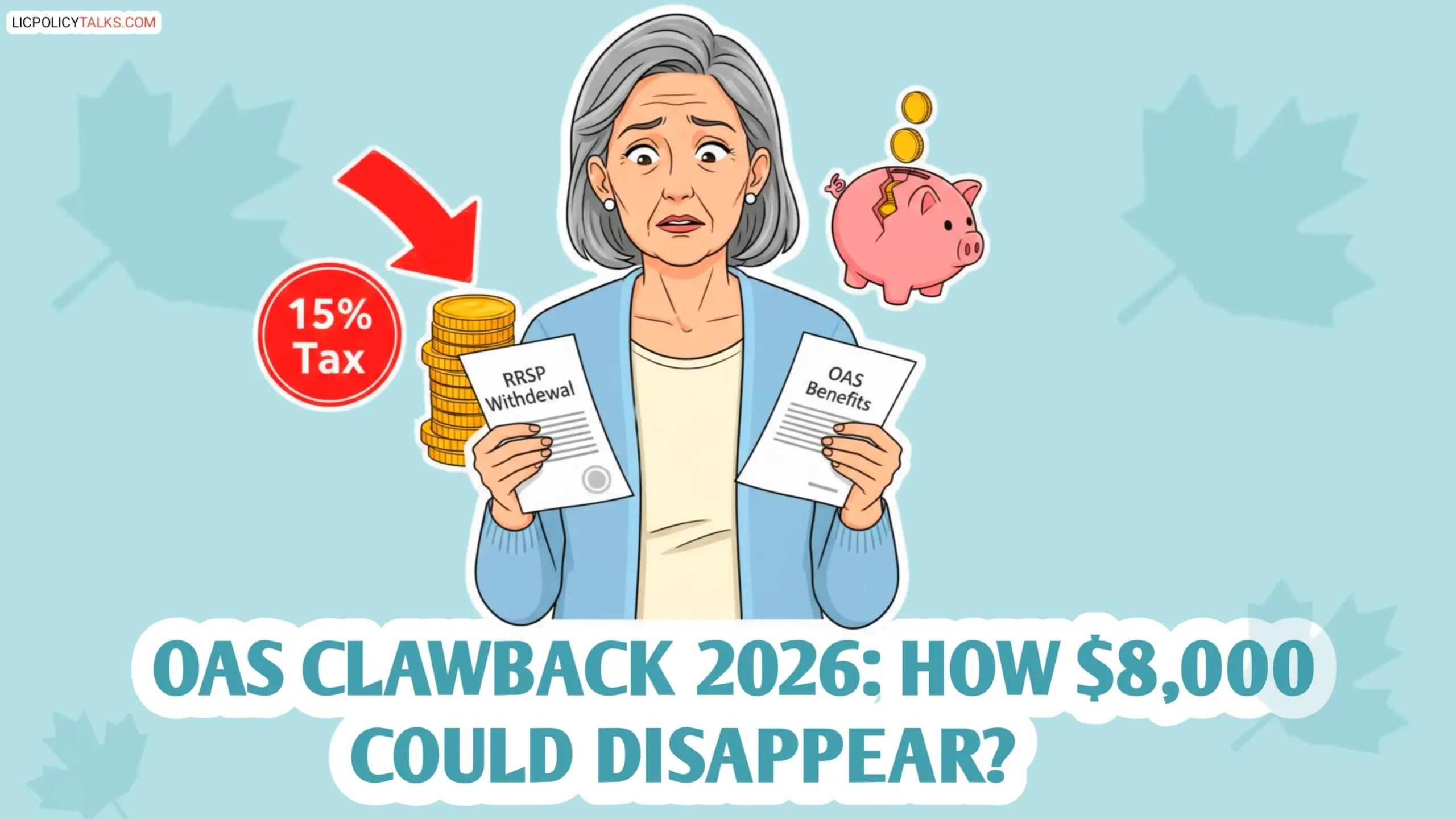
Risk: RRSP withdrawal income adds to net income on your tax return. If your total income exceeds $90,997 (2026 threshold), OAS begins to be clawed back at 15 cents per dollar. Withdrawing $10,000 extra from REER could cost you $1,500 in OAS.
Bitter truth: Many retirees don’t realize RRSP withdrawals count as income and push them into clawback territory. Using TFSA (CELI) for extra needs avoids this trap entirely. The French term for OAS clawback is ‘récupération de la SV’.
Action: Use the OAS clawback calculator on the CRA website before making large withdrawals. Plan to stay under the threshold where possible. If you need more, consider splitting income with a spouse or delaying OAS to age 70 for higher payments. Read our detailed guide on OAS clawback 2026.