
Quick Highlights – User Impact Alerts
- If you turn 71 this year, you must convert your RRSP by December 31 or face tax penalties.
- Did you know? Large RRSP withdrawals can trigger OAS clawback – check the 2026 thresholds.
- Use the RRSP withdrawal tax calculator to estimate your bill before withdrawing.
- Every month you wait past age 71, you lose the ability to contribute to your RRSP—and you may face a bigger tax bill.
- The CRA does not send reminders—your institution will, but penalties are your responsibility.
The first major financial development this morning for Canadian retirees is the mandatory RRSP conversion rule that affects everyone turning 71 in 2026. According to CRA guidelines, by December 31 of the year you turn 71, you must convert your Registered Retirement Savings Plan (RRSP) into a Registered Retirement Income Fund (RRIF) or purchase an annuity. If you miss this deadline, the CRA deems your entire RRSP to be cashed out, adding the full value to your taxable income in one year. This can push you into a higher tax bracket and trigger unexpected costs. Self-employed retirees need to act now to avoid costly mistakes. This guide explains the rules, tax impacts, OAS risks, and smart strategies to minimize taxes and protect retirement income.
Understanding the rules of rrsp withdrawal is crucial to avoid unexpected tax bills and penalties. Whether you are withdrawing now or planning for conversion, knowing the age limits, withholding taxes, and minimum withdrawal requirements can save you thousands of dollars.
RRSP Withdrawal Rules at Age 71 – Mandatory Conversion and Minimum Withdrawals
By law, you must convert your RRSP to a RRIF or annuity by December 31 of the year you turn 71. This is a key part of rrsp withdrawal rules at age 71. Once converted, you must start taking minimum withdrawals each year based on CRA factors. Withdrawing more than the minimum is optional but will increase your taxes.
Mandatory Conversion: RRSP to RRIF or Annuity
According to the Canada Revenue Agency, you must convert your RRSP into a RRIF by the end of the year you turn 71. If you fail to do so, the CRA treats your RRSP as if you withdrew the entire amount, adding it to your income and taxing it fully. You can also choose to withdraw the entire RRSP in cash before conversion, but that triggers full tax in that year. Contact your financial institution at least 60 days before your birthday to set up the RRIF. Most self-employed retirees miss this deadline because they assume their bank will notify them—bank reminders are often sent only 30 days before, which may not be enough time to complete paperwork.
This is where most people quietly lose money without realizing it. Withdrawing the entire RRSP in cash seems simple, but it can bump you into the highest tax bracket in a single year. For a self-employed retiree with a $300,000 RRSP, a full cash withdrawal could result in over $100,000 in taxes alone. Always consider converting to a RRIF first to spread out the tax burden.

RRIF Minimum Withdrawal Amounts (2026 Factors)
Once your RRSP is converted to a RRIF, you must withdraw a minimum amount each year. The minimum is based on your age and the value of your RRIF at the start of the year. The CRA publishes factors for each age. For example, at age 71, the factor is 5.00%. If you have a $400,000 RRIF, your minimum withdrawal is $20,000. If you have a younger spouse, you can use their age for lower minimums, reducing taxable income. Withdrawing more than the minimum is optional but increases your taxes. The rrsp withdrawal age affects these factors—the older you are, the higher the percentage.
| Age | Minimum Withdrawal Factor (%) |
|---|---|
| 71 | 5.00 |
| 72 | 5.15 |
| 73 | 5.33 |
| 74 | 5.50 |
| 75 | 5.68 |
| 76 | 5.86 |
| 77 | 6.06 |
| 78 | 6.27 |
| 79 | 6.49 |
| 80 | 6.72 |
For a self-employed retiree with a $500,000 RRIF at age 71, the minimum withdrawal is $25,000. Add that to CPP and OAS of $50,000, and your total income becomes $75,000—before any extra withdrawal. Many people forget that using a younger spouse’s age for withdrawals only works if the spouse is the beneficiary—otherwise it is not allowed.
Can You Withdraw from RRSP Before 71?
You can withdraw money from your RRSP at any age, but the amount is added to your income and taxed according to your marginal rate. Banks like RBC allow rrsp withdrawal online, making it convenient. Exceptions like the Home Buyers’ Plan (HBP) and Lifelong Learning Plan (LLP) allow tax-free withdrawals if repaid on schedule. However, a common misunderstanding is that early withdrawals are penalty-free—they are not. The withholding tax is just a prepayment, and your true tax bill is determined at filing.
Tax Impact of RRSP Withdrawals After 71 – How to Use the RRSP Withdrawal Tax Calculator
All withdrawals from your RRSP or RRIF are added to your taxable income. Using an rrsp withdrawal tax calculator can help estimate how much tax you will owe. The main rrsp benefits come from tax-deferred growth, but the tax on withdrawal can be significant if not planned. The CRA’s calculator and bank tools (like RBC, Wealthsimple) allow you to input your expected income, withdrawal amount, province, and age to get an estimate.
How Withdrawals Are Taxed
RRSP withdrawal is treated as regular income, so every dollar you withdraw pushes you up the progressive tax scale. For example, if your income is $60,000 and you withdraw $30,000, the combined $90,000 might move you from the 20.5% bracket to the 26% bracket. You might think you are in the 20.5% bracket, but adding $30,000 can push part of your income into the 26% bracket—you will pay more on the last dollars than the first. The table below shows the 2026 federal tax brackets.
| 2026 Taxable Income | Federal Tax Rate |
|---|---|
| Up to $55,867 | 15% |
| $55,868 to $111,733 | 20.5% |
| $111,734 to $173,205 | 26% |
| $173,206 to $246,752 | 29% |
| Over $246,752 | 33% |
If you withdraw $10,000 in a year when your income is $100,000, you will lose nearly 30% to taxes. Waiting until a lower-income year could save you thousands. The withhold tax at source (10% up to $5,000, 20% on $5,001–$15,000, and 30% over $15,000) is just a deposit. Many overpay and wait until tax time for a refund—that is free money for the government.
Using the RRSP Withdrawal Tax Calculator
Online calculators from Wealthsimple, RBC, or CRA help estimate tax owing. Step-by-step: input expected income, withdrawal amount, province, age. The calculator shows the estimated tax and net amount. Use the calculator before year-end to plan your withdrawal amount. Most people only use the calculator once. But if your self-employment income varies, you should run a few scenarios—a $10,000 difference in income can change your marginal rate. The CRA’s calculator is official, but bank calculators often include provincial rates too—use both to cross-check.
Strategies to Reduce Tax on RRSP Withdrawals
- Income splitting with spouse – if spouse is in lower bracket, transfer funds via spousal RRSP. However, this only works if contributions were made in prior years—it is not a last-minute fix.
- Withdraw only the minimum from RRIF – taking more than required increases taxes unnecessarily.
- Use TFSA for growth to reduce future RRSP withdrawals. Once RRSP is converted to RRIF, you must withdraw minimums. Any excess cash can be contributed to TFSA (if room available). This shields future growth from tax. Benefit: TFSA withdrawals do not affect OAS or GIS.
- Time withdrawals when other income is low (e.g., delay CPP/OAS to age 70). Delaying CPP/OAS to age 70 boosts your payments by 36%, but the trade-off is you will deplete your RRIF faster—run the numbers.
Income splitting via spousal RRSP only works if contributions were made in prior years—it is not a last-minute fix. Using TFSA to shelter growth after RRSP conversion sounds great, but you need contribution room. Many self-employed retirees max out TFSA long ago.
OAS Clawback Risk – How RRSP Withdrawals Can Reduce Your Benefits
Large RRSP withdrawals can reduce your Old Age Security (OAS) benefits through a recovery tax (clawback). In 2026, the OAS clawback threshold is approximately $91,000 for those age 65–74 and $94,000 for age 75+. High income reduces rrsp eligibility for full OAS. The clawback rate is 15% per dollar above the threshold—that is like an additional 15% tax on RRSP withdrawals for higher-income retirees.
2026 OAS Clawback Thresholds
| Net Income Range | OAS Clawback Amount |
|---|---|
| Under $91,000 | None |
| $91,000 to $151,000 | 15% of income above $91,000 |
| Over $151,000 | Full OAS clawed back |
According to CRA indexing projections, the 2026 OAS clawback threshold is approximately $91,000 for those age 65–74 and $94,000 for age 75+. Many retirees do not realize OAS clawback is not a separate tax—it is recovered through your income tax return. You will not see a bill, you will just get less OAS. If you turn 71 in the middle of 2026, you could trigger clawback for the first time—check your 2026 projected income now.
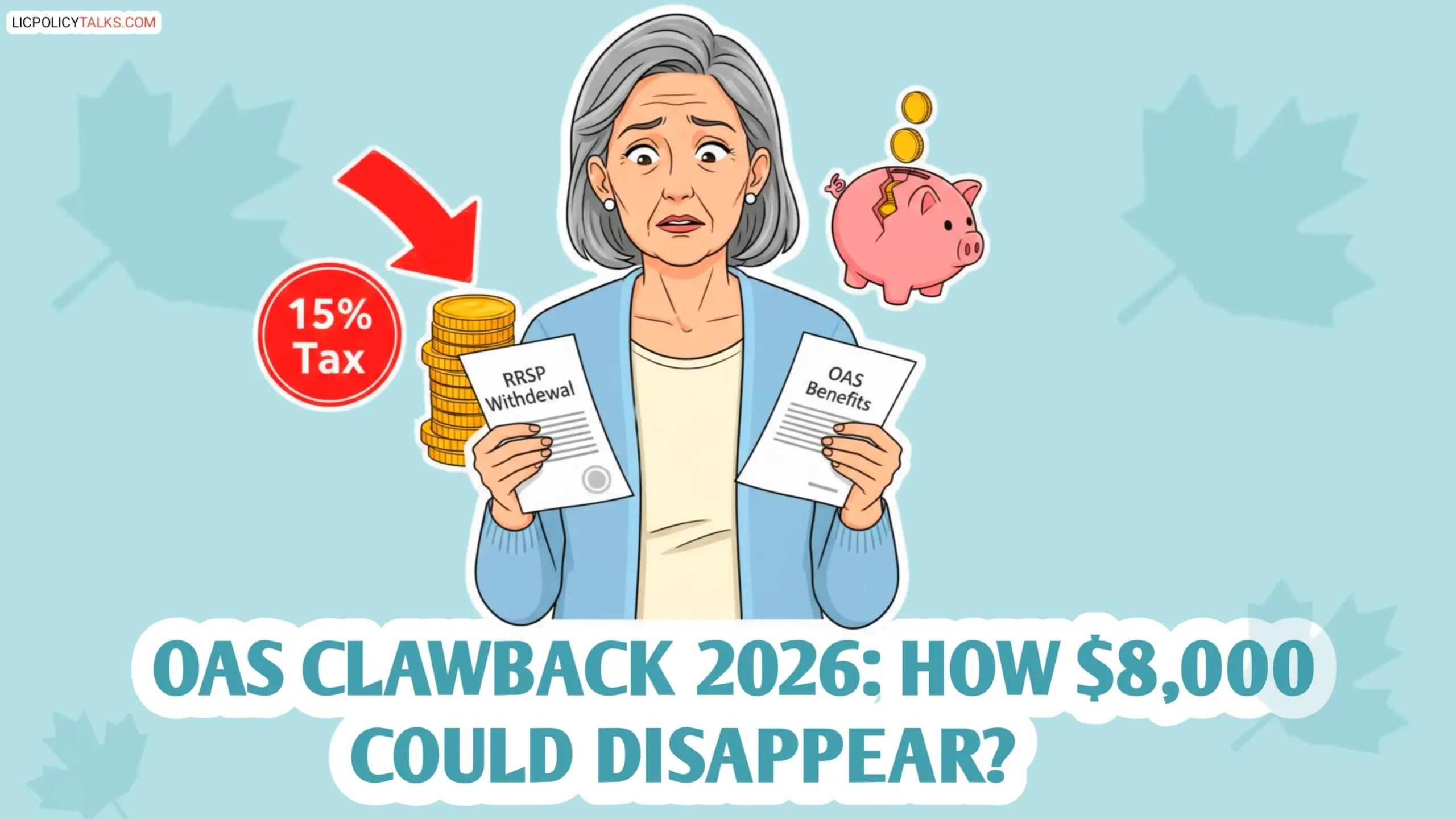
How RFSP Withdrawals Trigger the Clawback
RRIF minimum withdrawals are included in net income. High RRIF balances can cause unplanned clawback. Example: $500k RRIF at age 71 requires ~$25,000 minimum withdrawal. Add that to CPP/OAS of $50,000 = $75,000 – still below threshold, but if you withdraw more, you risk clawback. A common mistake is thinking only large RRIF triggers clawback. Even minimum withdrawals from a modest RRIF combined with CPP/OAS can push you over. Calculate your total projected income before making extra withdrawals. You may think you are safe at $75,000, but if you have rental income, pension, or investment income, it all adds up—clawback sneaks up on people.
Action Plan to Protect Your OAS
- Keep RRIF withdrawals at minimum if other income is high.
- Use TFSA withdrawals (tax-free) for extra cash.
- Consider deferring CPP/OAS to age 70 to reduce current income.
- Consult a tax professional.
If your income is close to the threshold, avoid voluntary RRIF withdrawals. A self-employed retiree with a variable income might have one year where profit is low—that is the year to make extra RRIF withdrawals, not when income is high. Consulting a tax professional costs money, but the OAS clawback error can cost you thousands annually—it is often worth the fee.
RRSP Withdrawal Benefits and Eligibility at Different Ages
Understanding rrsp benefits (tax-deferred growth) and rrsp eligibility (contribution room based on earned income) helps you plan withdrawals at any age. The key age points are 65 and 71. At 65, you can still contribute and withdraw without mandatory conversion. At 71, you must convert. This section also explains how to withdraw online using RBC as an example.
RRSP Withdrawal at Age 65 vs 71
At age 65, you can still contribute to your RRSP (until 71) and withdraw without mandatory conversion. This gives you flexibility to strategically withdraw before the forced RRIF conversion. The rrsp withdrawal age affects your tax planning—if you wait until 71, you lose control. At 65, you might want to start withdrawing in low-income years to keep tax rates low. For example, withdrawing $10,000 at 65 when your income is low might cost 15% tax, while the same $10,000 forced at 71 could cost 30%. Waiting until 71 to start withdrawals means you have no choice—the government forces you. Starting earlier gives you control.
How to Withdraw from RRSP Online (RBC Example)
Most banks allow rrsp withdrawal online. Using RBC as an example: log into online banking, select RRSP account, choose withdrawal amount, confirm. Tax withholding happens automatically. Most banks like TD, BMO, Scotiabank have similar processes. Before hitting confirm, check if your bank shows the estimated tax withheld. If not, call them—some online systems do not show it clearly. Withholding tax rates are set by CRA: 10% up to $5,000, 20% on $5,001–$15,000, and 30% over $15,000 (in most provinces). Quebec has different rates. Online withdrawals are convenient, but they do not allow you to adjust withholding. If you want to pay extra tax now to avoid a surprise, you need to make a separate payment.
RRSP Eligibility – Who Can Contribute and Withdraw?
Anyone with earned income under 71 can contribute to an RRSP. Self-employed individuals use net business income to calculate contribution room. Spousal RRSP rules allow income splitting. You can also withdraw through the Home Buyers’ Plan. If your net self-employment income is $60,000, your RRSP contribution room for the next year is 18% of that, or $10,800. Many self-employed people think they can contribute all their earnings—they cannot. Only earned income up to the annual limit ($32,490 for 2026) qualifies.
Expert Strategies for Self-Employed Retirees – Minimize Taxes and Maximize Income
Self-employed retirees have unique opportunities to manage RRSP withdrawals. Here are advanced strategies to reduce tax and increase retirement income.
Coordinate RRSP Withdrawals with CPP and OAS Timing
Delaying CPP/OAS to age 70 increases payments but allows you to withdraw from RRSP/RRIF earlier at lower tax rates. Scenario: if you have no other income at 71, taking RRIF minimum plus some extra before CPP starts can keep you in lower bracket. Use the rrsp withdrawal tax calculator to test different timing scenarios. Delaying CPP/OAS to age 70 gives you a guaranteed 36% increase in benefits. But if you have a large RRIF, delaying CPP/OAS can backfire because you will be forced to withdraw more from RRIF, pushing you into a higher bracket than if you had taken CPP earlier. Using a calculator to compare ‘take CPP at 65 vs 70’ with your RRIF withdrawals can show whether you will save $5,000 or lose $10,000 over 10 years.
Use TFSA to Shelter Growth After RRSP Conversion
Once RRSP is converted to RRIF, you must withdraw minimums. Any excess cash can be contributed to TFSA (if room available). This shields future growth from tax. Benefit: TFSA withdrawals do not affect OAS or GIS. Self-employed retirees often have higher contribution room due to business income, so they should maximize TFSA first before taking extra RRIF withdrawals. Many retirees withdraw the RRIF minimum and then leave the cash in a savings account earning low interest. Instead, they should use it to maximize TFSA contributions if room exists. TFSA growth is tax-free forever, while RRIF growth is eventually taxed at your marginal rate. Shifting funds to TFSA is a net positive if you have contribution room. Self-employed retirees often forget they have unused TFSA room from years of low contribution—check your CRA account before dismissing this strategy.
Contrarian Insight – The ‘Safety’ of RRSP Minimum Withdrawals Is Overrated
Most advisors tell you to take only the RRIF minimum to avoid taxes. But for self-employed retirees with variable income, taking slightly more in low-income years can actually reduce lifetime taxes by preventing a bracket spike later. The real risk is not the tax today – it is the forced withdrawal in a high-income year. After analyzing many self-employed retirement plans, I have seen that rigid minimum-only withdrawals often lead to higher taxes later—precisely because income jumps unexpectedly. If you have a low-income year (say $30,000), withdrawing extra from RRIF up to the next bracket ceiling (around $55,000) pays only 20.5% tax. If you leave that money in the RRIF and it grows, you might withdraw it later at 30% tax when income is higher. Most advisors recommend minimum withdrawals because it is safe and simple. But ‘safe’ does not mean optimal—especially when your income varies.
Bottom Line
RRSP withdrawal after age 71 requires careful planning to avoid high taxes, OAS clawback, and missed deadlines. Use the rrsp withdrawal tax calculator to estimate your tax bill, and consider strategies like income splitting, TFSA sheltering, and timing withdrawals in low-income years. The next 24 hours are critical—check your RRSP balance and set up a meeting with your financial institution to discuss conversion. What looks small today can become a significant loss in 6 months. Act now to protect your retirement income.
FAQs: Frequently Asked Questions
Q: What is the RRSP withdrawal age limit in Canada?
Q: How much tax do I pay on RRSP withdrawal after 71?
Q: What is the RRIF minimum withdrawal at age 71?
Q: How does RRSP withdrawal affect OAS benefits?
Q: Is there an RRSP withdrawal tax calculator for 2026?
Important Disclaimer
This article provides general educational information about RRSP withdrawals and retirement planning in Canada. It does not constitute personalized financial, tax, or legal advice. Tax laws and thresholds can change. Always consult a qualified financial advisor or tax professional before making withdrawal decisions. Investment and tax decisions involve risk. The information is based on 2026 rules as of May 2026.