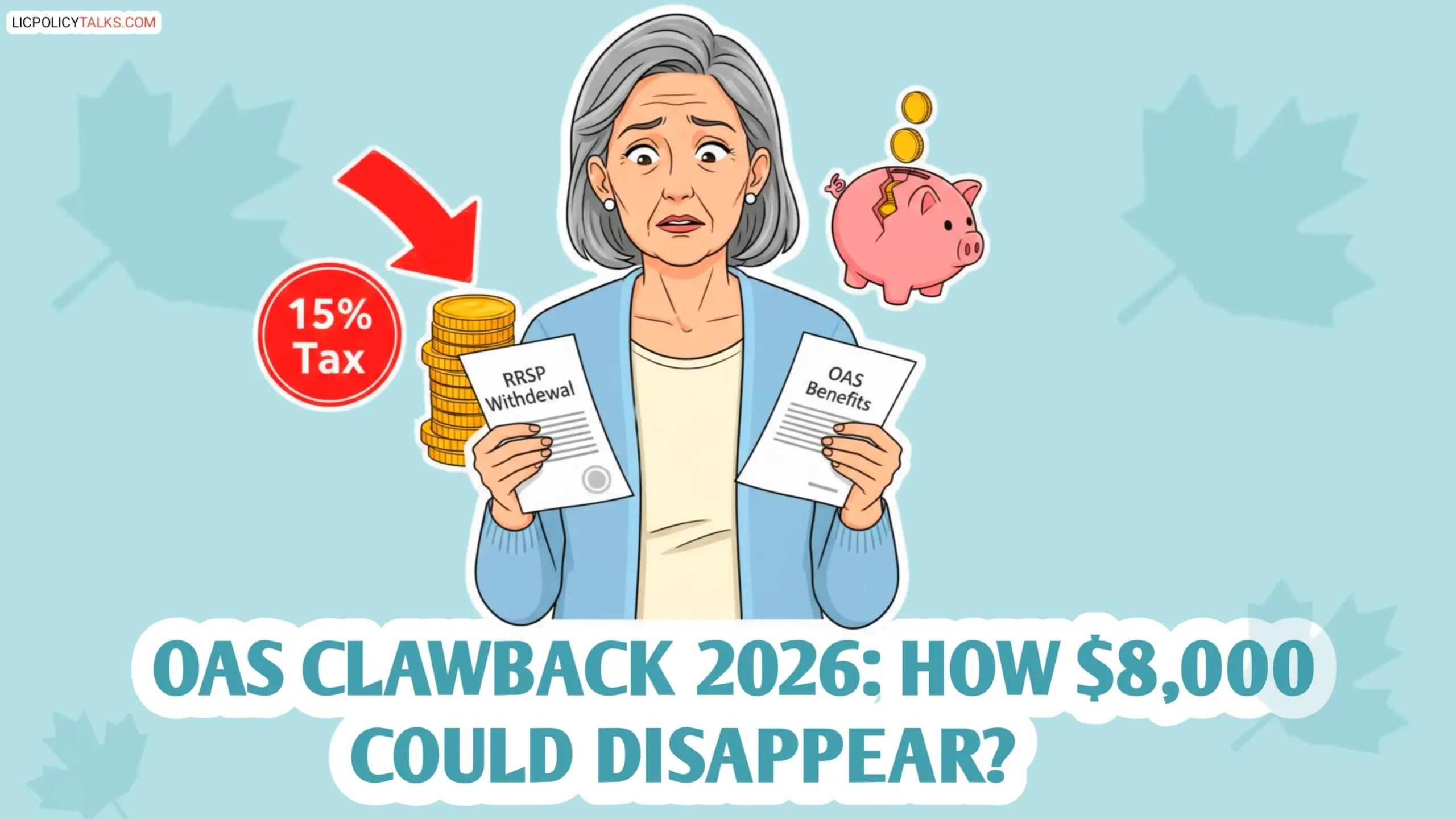
The magic number for the 2026 tax year is $95,323. That is the CRA’s OAS clawback threshold, and it is turning routine RRSP withdrawals into permanent retirement income traps for thousands of Canadian retirees this year. The risk is not just the withholding tax your bank takes off the top — the real damage comes from the hidden 15% OAS recovery tax and the permanent loss of your contribution room.
The RRSP full form is Registered Retirement Savings Plan. It is Canada’s most powerful tax-deferred savings tool — but only if you understand the withdrawal rules before you touch the money. This guide walks through the five most expensive mistakes Canadians make when pulling cash out of an RRSP in 2026, and exactly how to avoid each one.
- OAS clawback threshold for 2026: $95,323.
- OAS recovery tax: 15% on every dollar above the line.
- RRSP withholding tax: 10%–30% depending on the amount.
- TFSA cumulative contribution room: $109,000.
- Age 71 RRSP-to-RRIF conversion deadline: December 31, 2026.
- Withdrawn RRSP room is lost forever — it never comes back.
2026 RRSP Reality Check: The $95,323 OAS Line That Turns Withdrawals Into a Tax Trap
Here is the hard truth about retirement income in Canada: your company pension, CPP, OAS, and RRSP withdrawals all count toward your net world income. The CRA uses that total to decide whether your Old Age Security gets clawed back. The magic number for the 2026 tax year is $95,323. If your net world income crosses that line, the CRA applies a 15% recovery tax on every extra dollar.
According to a recent TFSA investing tactics analysis by Andrew Walker at The Motley Fool, a person with net world income of $105,323 in 2026 would see their total OAS reduced by $1,500 for the July 2027 to June 2028 payment period. A single, well-intentioned RRSP withdrawal can silently push you over the line and trigger that loss.
- Threshold: $95,323
- Tax: 15% per $1 above the threshold
- Example: $105,323 income → $1,500 recovered
Who This Hits in 2026: Your Pension + RRSP Income Is the Trigger
If you have a company pension and a moderately sized RRSP, you are living on the edge of this threshold without feeling rich. Imagine a retiree with a $60,000 company pension who takes a $40,000 RRSP withdrawal in a single year. That is $100,000 in net world income — already over the $95,323 line. The withdrawal itself pushed them into clawback territory.
An $8,000 RRSP withdrawal can silently cost $1,200 in lost OAS benefits — a 15% penalty on money you may not even need to spend. The withdrawal strategy itself becomes the risk, not the market.
| 2026 Net World Income | OAS Clawback |
|---|---|
| $70,000 | $0 (Safe) |
| $95,323 | $0 (At the line) |
| $100,323 | $750 recovered |
| $105,323 | $1,500 recovered |
| $115,323 | $3,000 recovered |
Mistake #1: Believing the 10% Withholding Tax Is Your Entire Tax Bill
When you make a lump-sum RRSP withdrawal, your bank is legally required to withhold a percentage of the money and send it to the CRA. Most Canadians assume that 10% or 30% is the final tax bill. It is not. Withholding tax is just a pre-payment, like a deposit, toward your actual tax bill at filing time.
Here is what CRA requires your financial institution to withhold in 2026:
| Withdrawal Amount | Outside Quebec | Quebec |
|---|---|---|
| Up to $5,000 | 10% | 15% |
| $5,001–$15,000 | 20% | 25% |
| $15,000+ | 30% | 35% |
The real problem appears when your RRSP withdrawal gets added to your other income. Combined federal and provincial marginal tax rates in Canada can exceed 53% for high earners. That means the 30% withheld at the bank is nowhere near the final tax owed.
The $20,000 Lump-Sum Shock: Withholding vs. Final Tax in 2026
Let us walk through a concrete Ontario example so you can see the gap clearly. Assume you withdraw $20,000 from your RRSP in 2026 and your marginal tax rate is 43%.
The bank withholds 30% of the $20,000, which is $6,000, and sends it to the CRA. But when you file your taxes, the real tax on that $20,000 at a 43% marginal rate is $8,600. That means you still owe an extra $2,600 at tax time.
That $2,600 gap is roughly two months of groceries for a senior — money you need to set aside before the withdrawal, not discover at tax time. You have two options: ask your financial institution to withhold extra tax now, or delay the withdrawal to a low-income year. Choose the one that matches your cash-flow reality.
Mistake #2: Ignoring the 15% OAS Clawback That Turns RRSP Income Into Hidden Tax
For high-income seniors, the combination of 30% withholding, 15% OAS clawback, and provincial tax can create an effective loss of more than 50% on every RRSP withdrawal. This is the hidden tax that no one warns you about. When your net world income crosses $95,323, the CRA claws back your OAS at a rate of 15% per dollar. And because an RRSP withdrawal is fully taxable, it is often the single factor that pushes a retiree over the threshold.
Consider the alternative: moving income-generating investments into a TFSA keeps them out of the net world income calculation entirely. That single move can preserve thousands of dollars in OAS benefits.
The TFSA $109,000 Escape Hatch: How Wealthy Canadians Protect OAS in 2026
Since 2009, the TFSA cumulative maximum contribution room has grown to $109,000. The 2026 rule of thumb is simple: hold GICs, bonds, and dividend payers in your TFSA first; keep your RRSP for later years or lower-income years. TFSA withdrawals are not counted as income for OAS purposes, so using TFSA savings to fund retirement keeps you below the $95,323 line without sacrificing access to your money.
There is a painful irony at the heart of Canadian retirement planning. The RRSP tax deduction you enjoyed in your 50s becomes the OAS clawback you pay in your 70s. Moving income-producing assets out of the RRSP and into a TFSA in stages across two or three calendar years is the smartest way to avoid this trap.
Mistake #3: Missing the Age 71 RRSP-to-RRIF Conversion Deadline
If you turn 71 in 2026, the CRA requires you to convert your RRSP into a Registered Retirement Income Fund (RRIF) by December 31, 2026. Missing this deadline is not a small administrative slip — the CRA may treat your entire RRSP balance as if it were fully withdrawn in a single year. That means the full value of your account gets added to your taxable income at once, creating a massive tax bill that could reach into the hundreds of thousands of dollars.
Schedule the RRIF conversion with your financial institution before the deadline and plan your minimum withdrawals carefully.
RRIF Minimums in 2026: The CRA Slow-Pay Plan You Must Understand
After 71, the CRA forces a small, taxable payout from your RRIF each year, and the percentage grows with age. These are the 2026 minimum withdrawal rates:
| Age | Minimum Withdrawal Rate |
|---|---|
| 71 | 5.00% |
| 72 | 5.26% |
| 73 | 5.56% |
| 74 | 5.88% |
| 75 | 6.25% |
Here is what the table means for a real balance: a 75-year-old with $300,000 in a RRIF must withdraw at least $18,750 in 2026. That forced income could push you closer to the $95,323 OAS threshold. Calculate your required minimum in January, and only make optional withdrawals later in the year after checking your total income against the OAS line.

Mistake #4: Assuming Withdrawn RRSP Room Comes Back Next Year
Unlike a TFSA, every RRSP dollar you withdraw is gone forever. $20,000 withdrawn = $20,000 of deduction room permanently lost. This is the most misunderstood rule in Canadian retirement planning. Many Canadians treat their RRSP as an emergency fund, making withdrawals and expecting to re-contribute later. The CRA does not allow this. The contribution room is permanently consumed, silently destroying your future tax-planning power.
- Withdrawn RRSP contribution room is lost permanently.
- You cannot re-contribute the withdrawn amount unless you use specific CRA programs.
- Using your RRSP as an emergency fund sacrifices decades of tax-deferred growth.
The Only Exceptions: HBP and LLP Repayment Rules
There are exactly two exceptions where contribution room can be restored: the Home Buyers’ Plan (HBP) and the Lifelong Learning Plan (LLP). If you used the HBP, the $60,000 you withdrew is not free money — it has a 15-year repayment clock. A $30,000 HBP withdrawal means about $2,000 in repayments each year, or roughly $167 per month. Miss a repayment, and CRA adds that amount to your taxable income that year.
The LLP allows you to withdraw up to $10,000 per year (to a maximum of $20,000) to fund full-time training or education, with a 10-year repayment schedule. These are the only doors where RRSP contribution room can come back into play, and only if you strictly follow the CRA repayment schedule. This is also where rrsp eligibility for re-contributions gets confusing — eligibility to withdraw is always there, but eligible re-contribution space is not.
Mistake #5: Draining Your RRSP Before Your TFSA — The $109,000 Sequencing Error
The 2026 rule of thumb for retirement drawdowns is simple: withdraw from taxable accounts first, TFSA second, and RRSP last — unless you are in a low-income year. TFSA withdrawals do not create taxable income or trigger OAS clawbacks. By withdrawing from your RRSP first, you are voluntarily generating taxable income, crossing the $95,323 threshold sooner, and permanently destroying your contribution room.
According to recent top TSX dividend stock analysis, dividend-paying stocks like Enbridge belong in a TFSA to protect future OAS and avoid RRSP withholding tax.
Enbridge Down 13%: Should This Dividend Stock Live in Your RRSP or TFSA in 2026?
Enbridge’s Enbridge share price has dropped 13%, but the bigger question for Canadian retirees is where that dividend lives. The same $10,000 investment can produce very different after-tax retirement income depending on the account type. Canadian dividends in a TFSA are 100% tax-free. In an RRSP, they are taxed at your full marginal rate upon withdrawal. In a taxable account, you get the dividend tax credit, but no shelter.
| Account Type | Tax on Withdrawal | OAS Impact | Best For |
|---|---|---|---|
| TFSA | Tax-free | None | Dividend income in retirement |
| RRSP | Full marginal rate | Counts as income | Deferring tax to lower-income years |
| Taxable | Dividend tax credit | Counts as income | Canadian dividend stocks with credits |
Here is the contrarian truth: when you talk about rrsp price, the real price is paid at withdrawal, not at purchase. The account location can matter more than the stock pick. An RRSP still makes sense for someone who expects a lower tax bracket in retirement — the key is to compare the future tax cost, not just the current tax deduction.
Bonus Analyst Move: Use SEC EDGAR Filings to Vet Dividend Payers Inside Your RRSP
Before buying a US dividend stock inside your RRSP, open the latest 10-K on SEC EDGAR filings. The RGS filing (June 30, 2026) reveals share dilution and EPS trends that headlines miss. Most people skip this and only find out about dilution after the dividend is cut. You do not need to become a securities analyst — fifteen minutes on EDGAR is enough to avoid the most obvious dividend traps.
RRSP Withdrawal FAQ: Eligibility, Calculator, REER, Login & More (2026)
Here are the most common questions we receive about RRSP withdrawal planning for 2026.
Who Is Eligible to Withdraw From an RRSP in 2026?
Yes, you can withdraw from an RRSP at any age — the real question is what it costs you. Every withdrawal is taxable income. If you withdraw from a former employer plan, CRA issues a T4RSP slip; if you are a non-resident, it is an NR4. Withdraw $10,000 at age 45 and you lose $10,000 of lifetime contribution room permanently.
How Do I Calculate the Real Tax on an RRSP Withdrawal? (2026 Calculator Guide)
Do not just look at the 10–30% withholding rate. A rrsp calculator should follow this loop: (1) add the withdrawal to your current income, (2) find your combined federal and provincial marginal rate, (3) calculate the tax, and (4) subtract withholding already paid. A $10,000 withdrawal in a 43% marginal bracket creates about $4,300 of tax; if only $2,000 was withheld, the gap is $2,300 on your return.
What Is RRSP in French? (REER Explained)
In French, RRSP is REER — Régime enregistré d’épargne-retraite. Same account, same rules, different acronym. If you file taxes in French, look for REER on your slips. One Quebec-specific difference: withholding rates are 15%, 25%, and 35%, which are higher than the rest of Canada. Calling it REER does not change the withdrawal tax or OAS impact.
How to Check Your RRSP Balance and Contribution Limit Online (rrsp login Guide)
Log in to CRA My Account, select RRSP, and check available deduction room. Your bank shows the balance; CRA shows the true contribution limit. This is your real rrsp login checkpoint before any 2026 withdrawal. Doing this today takes five minutes and can save you from losing contribution room permanently.
FAQs: Frequently Asked Questions
Q: What should a Canadian saver do before making an RRSP withdrawal in 2026?
Q: Who will be affected by the OAS clawback if they withdraw from RRSP this year?
Q: What is the real risk of withdrawing from an RRSP — withholding tax, OAS clawback, or permanent contribution room loss?
Q: What is the immediate step to avoid RRSP tax mistakes this year?
Q: What should be done in the next 24 hours: run an rrsp calculator, check rrsp eligibility, verify CRA login, and review the 2026 OAS threshold?
Your 24-Hour RRSP Action Plan for 2026: 5 Moves Before You Withdraw
Convert these five mistakes into a practical checklist you can execute today. Do not wait until the December 31 deadline approaches.
- Pull your real numbers. Log in to CRA My Account and confirm your current RRSP balance and available deduction room.
- Run an rrsp calculator on the exact amount you plan to withdraw in 2026 and note the final marginal tax.
- Check the 2026 OAS threshold ($95,323) against your total projected income, including pension and CPP.
- Prefer TFSA funds first. Withdraw from taxable and TFSA accounts before touching your RRSP.
- If you are turning 71, schedule the RRIF conversion before December 31, 2026.
This article is general financial education — not personalized tax, legal, or investment advice. RRSP, TFSA, and OAS rules are set by the Canada Revenue Agency and can change; always verify against current CRA guidelines for 2026. Withdrawing from an RRSP involves tax consequences; your situation depends on your province, marginal tax rate, and retirement income plan. Market and investment decisions carry risk. Consult a licensed Canadian financial advisor or tax professional before acting.