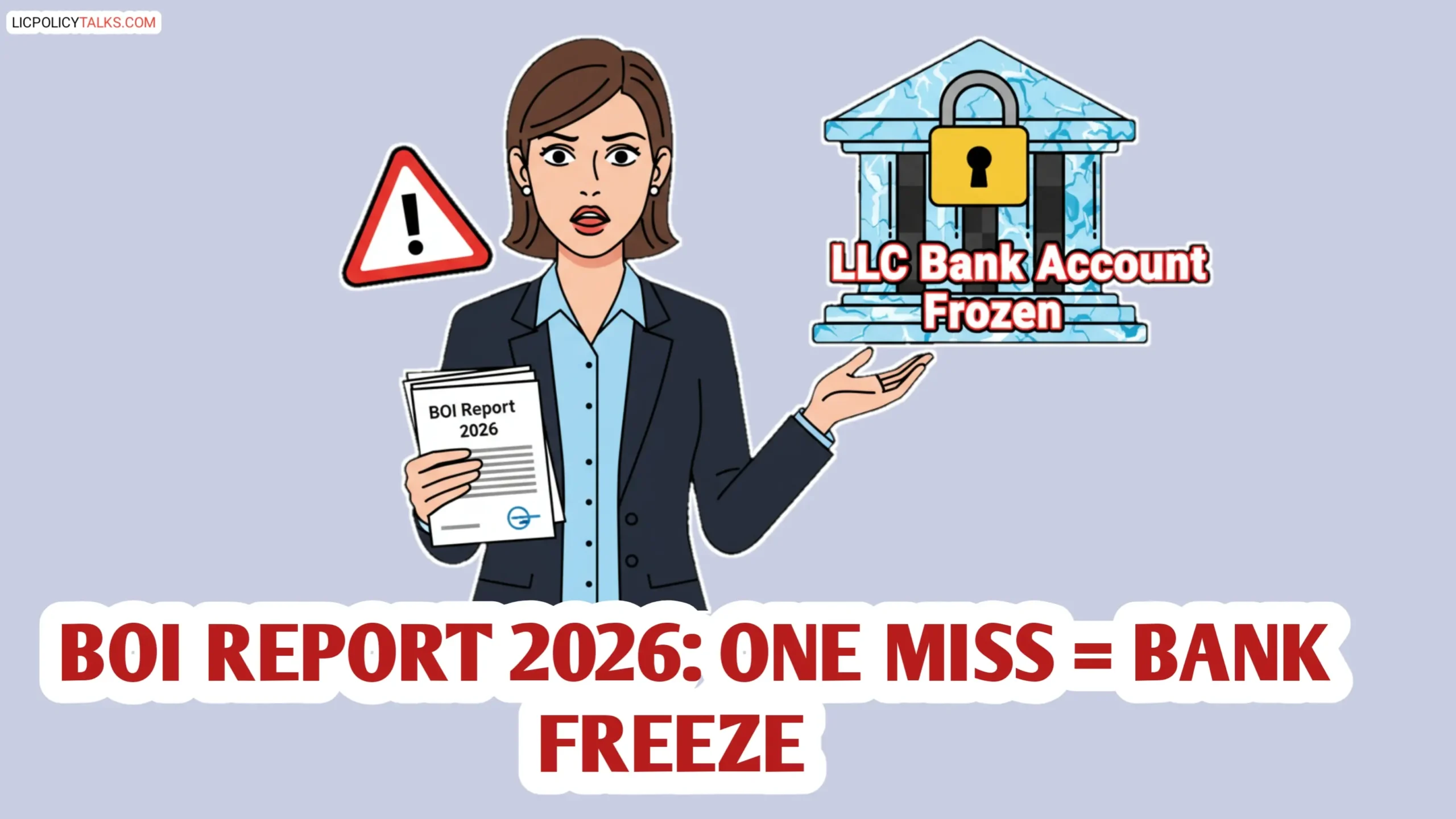
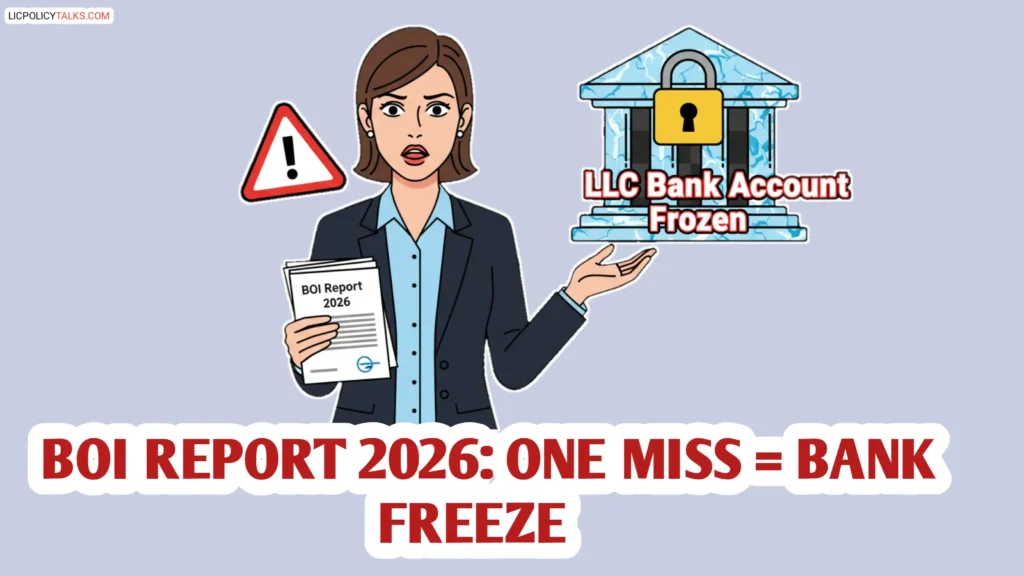
हाय दोस्तों! Picture this: it’s a regular Tuesday. You go to pay a supplier or transfer your own salary, and your bank app shows a chilling error. “Transaction Declined.” You call your bank, only to be told your business account is frozen. No warning. No explanation. Your company’s cash flow—its very lifeline—has just been shut off. This isn’t a plot from a thriller movie; it’s a very real risk if your LLC misses a new, mandatory government filing called the BOI Report. This guide cuts through the confusion. We’ll explain what the BOI report is, why the 2026 deadline matters more than you think, and exactly how to protect your business from a devastating bank account freeze.
Forget thinking of this as just another piece of LLC compliance paperwork. The Beneficial Ownership Information report, required by the Corporate Transparency Act, is a critical shield for your business. Failing to file it correctly can trigger a chain reaction that ends with your business finances locked down. Let’s break down how to stay safe.
The BOI Report Time Bomb: More Than Just Paperwork for Your LLC
Let’s return to that frozen account scenario. The trigger? Failing to file a simple report. The BOI Report isn’t a suggestion; it’s a federal mandate under the Corporate Transparency Act (CTA). As of now, a major legal hurdle has been cleared: the Eleventh Circuit Court of Appeals has ruled the CTA constitutional, reinforcing the government’s authority to collect this information. You can read more about that ruling here.
The crucial point is this: while enforcement of penalties is currently paused to give businesses time to learn the rules, the requirement to file is absolutely still the law. This isn’t a cancellation; it’s a grace period. The agency in charge, the Financial Crimes Enforcement Network (FinCEN), is using this time for education. But once the pause lifts, the consequences for non-compliance will be severe and swift. This article will walk you through what the report is, who needs to file, the precise risk of a bank account freeze, and a clear action plan to get it done right.
BOI and CTA Decoded: Why the Government Wants to Know Your LLC’s Owners
So, what exactly are we talking about? A Beneficial Owner is the real, live human who ultimately owns or controls a company. It’s not the name on the paperwork or your lawyer; it’s the person who calls the shots or enjoys the profits. The Corporate Transparency Act was created for one big reason: to fight illegal activity like money laundering and terrorist financing by pulling back the curtain on anonymous shell companies.
The BOI Report is how that happens. It’s a confidential filing you submit to FinCEN’s secure database, listing your company’s beneficial owners and the “company applicants” who formed it. Think of it as your LLC’s official birth certificate, but one that only specific, authorized government agencies and financial institutions can see to prevent fraud. It is not public information. The goal is to create a trusted directory of who really owns what, making the entire financial system safer. Staying compliant with this new rule is essential for every business owner.
This shift towards transparency is part of a global trend, where governments are collaborating to close loopholes used for tax evasion and illicit finance. Understanding these broader rules can help you navigate the changing landscape of business ownership.

The 2026 Countdown: Deadlines, the Court Ruling, and the Enforcement Pause
Who Must File? (The 23-Entity Rule)
The rule is broad. If you created your LLC, corporation, or similar entity by filing documents with a secretary of state (or similar office), you are likely required to file. This also includes foreign companies registered to do business in the U.S. We’re talking about the vast majority of small business reporting entities here.
The Critical Exemptions: Is Your LLC Off the Hook?
There are 23 types of exempt entities, but they are narrowly defined. Key exemptions include large operating companies (20+ full-time U.S. employees, more than $5 million in revenue, and a physical office), publicly traded companies, banks, and certain heavily regulated entities. For most small LLCs and solo entrepreneurs, these exemptions do not apply. You should assume you need to file unless you are certain you meet an exemption.
The timeline has been confusing. The original BOI filing deadline for existing companies (created before 2024) was January 1, 2025. That was extended, and then a federal court ruling created uncertainty. However, the Eleventh Circuit has since affirmed the law’s constitutionality (see ruling), ending the major legal challenge.
Right now, we are in an “enforcement pause.” FinCEN has temporarily halted penalties (FinCEN Temporarily Pauses Enforcement and Treasury Department Suspends Enforcement) to focus on education. This is critical: the legal requirement to file has NOT gone away. The safe advice is to target early 2026 as your effective deadline for existing entities. For new companies created in 2024 or later, the deadline is 90 days after formation. Don’t wait for the last minute.
| Entity Type | Likely Needs to File? | Key Notes/Clarification |
|---|---|---|
| Single-Member LLC | Yes | You are the beneficial owner. Exemptions are very rare for small LLCs. |
| Multi-Member LLC | Yes | All members with >25% ownership or substantial control must be reported. |
| S-Corporation | Yes | Tax classification doesn’t matter. It’s a corporation filed with the state. |
| Large Operating Company | No (Exempt) | Must have 20+ full-time US employees, >$5M revenue, and a physical office. |
| Publicly Traded Company | No (Exempt) | Already subject to extensive SEC reporting requirements. |
The Domino Effect: From a Missed Form to a Frozen Bank Account
So, what happens if you ignore the BOI filing deadline? It’s a designed chain reaction. First, your entity is flagged as non-compliant in FinCEN’s system. This information can then be shared with financial institutions through secure government channels. Banks have their own strict legal obligations to combat money laundering.
When a bank sees your LLC is on the non-compliant list, its anti-money laundering (AML) protocols may legally require it to restrict or even cease doing business with you. This isn’t a vague threat; it’s the specific enforcement mechanism of the CTA. The result? Frozen accounts or rejected transactions. Your business operations grind to a halt instantly. Beyond this operational death blow, willful failures to file can also lead to civil penalties of $500 per day and even criminal penalties including jail time. The enforcement pause delays this chain, but when it ends, the dominoes will fall quickly for those who aren’t ready. Staying compliant is your only shield.
This kind of sudden, severe financial enforcement isn’t unique. Governments worldwide are getting more aggressive in using financial controls to achieve policy goals, often with little warning to the individuals affected.

Your Action Plan: A Step-by-Step Guide to Filing the BOI Report Correctly
Step 1: Identify Your Beneficial Owners (The Control Test)
This is the most important step. A Beneficial Owner is any individual who, directly or indirectly: (1) owns 25% or more of the company, OR (2) exercises substantial control. Substantial control includes senior officers (CEO, President), anyone with authority to appoint/remove such officers, or anyone who directs, determines, or has substantial influence over important business decisions. Don’t list your lawyer or a nominee; list the real person behind the company.
Step 2: Gather the Required Information
For each Beneficial Owner and company applicant, you will need their: full legal name, date of birth, current residential or business address, and a unique identifying number from an acceptable document (like a driver’s license or passport). You will also need an image of that document. For the company itself, you need its legal name, trade names (DBAs), address, jurisdiction of formation, and Taxpayer Identification Number (TIN).
Step 3: File Electronically via FinCEN’s Portal
You must file online through the official FinCEN BOI E-Filing website. The process is designed to be straightforward. A critical warning: there is NO FEE to file your BOI report directly with FinCEN. Be extremely wary of third-party services charging hundreds of dollars for this free government form. Some legitimate services can help for a reasonable fee if you need assistance, but you can absolutely do it yourself for free. Once filed, remember the 30-day rule: you must update your report within 30 days of any change in your beneficial ownership information.
Don’t Get Tripped Up: Common BOI Filing Mistakes and How to Avoid Them
Let’s preempt the common errors so you can file with confidence:
- Mistake 1: Assuming you’re exempt without verifying. Avoid This: Unless you clearly meet one of the 23 exemptions (like being a large operating company), assume you must file.
- Mistake 2: Misidentifying the beneficial owner. Avoid This: The beneficial owner is the real human with control or >25% ownership, not your attorney, CPA, or a corporate nominee.
- Mistake 3: Forgetting to update the report. Avoid This: Set a reminder. If an owner sells their stake, an address changes, or a passport is renewed, you have 30 days to update FinCEN.
- Mistake 4: Using a scammy third-party service. Avoid This: Use the official FinCEN portal. If you hire help, research the company thoroughly and understand that the government filing itself is free.
- Mistake 5: Procrastinating because of the “enforcement pause.” Avoid This: This pause is a gift of time to prepare. Use it. When enforcement resumes, there will be a rush and no more excuses.
FAQs: ‘bank account freeze’
Q: What is the exact BOI report deadline for my LLC formed in 2020?
Q: Can my personal bank account be frozen, or just my business account?
Q: I own multiple LLCs. Do I need to file for each one?
Q: What if my beneficial owners are foreign nationals?
Q: Where can I get official help if I’m confused?
Conclusion: Compliance is Your LLC’s Best Shield
Let’s recap. The BOI Report is a new, mandatory reality for millions of LLCs and corporations. It’s not optional. The risk of ignoring it is severe, with a bank account freeze being the most immediate and devastating operational threat. While the current enforcement pause offers a window, it’s not an exemption.
Use this time wisely. Don’t wait for the panic when enforcement resumes. Mark your calendar for the first quarter of 2026 as your filing target. Gather your owner information, understand the simple steps, and file. This one act of compliance is a powerful shield, protecting your business’s most vital asset: its ability to operate and access its own money. Take control, file correctly, and sleep easy knowing your company’s finances are secure.