
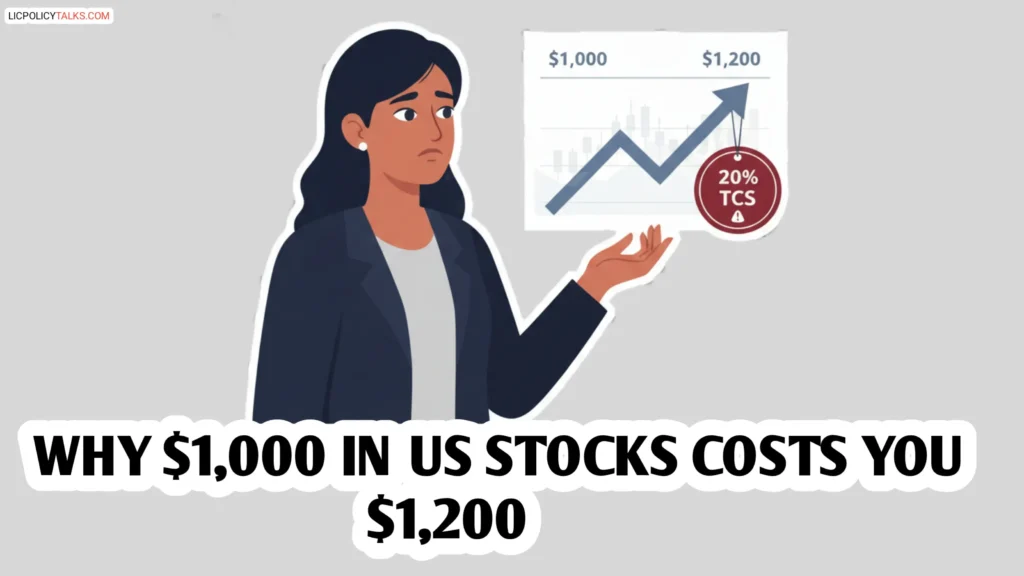
हाय दोस्तों! Picture this: You’ve done your research, chosen the perfect US ETF, and excitedly go to transfer ₹83,000 (about $1,000) to your international brokerage. But your bank or platform stops you cold. They demand an extra 20%. Your heart sinks. Why on earth does investing $1,000 abroad suddenly require $1,200 upfront? That shocking moment is the brutal reality of the post-Budget 2025 landscape for Indian investors. Let’s break down this cash flow nightmare, demystify the refund maze, and find ways to protect your hard-earned money.
Welcome to the TCS Trap 2026—a cleverly disguised liquidity crunch that acts as a massive, interest-free loan to the government, silently eroding your potential returns. This isn’t just dry tax talk; it’s about the real money leaving your account today.
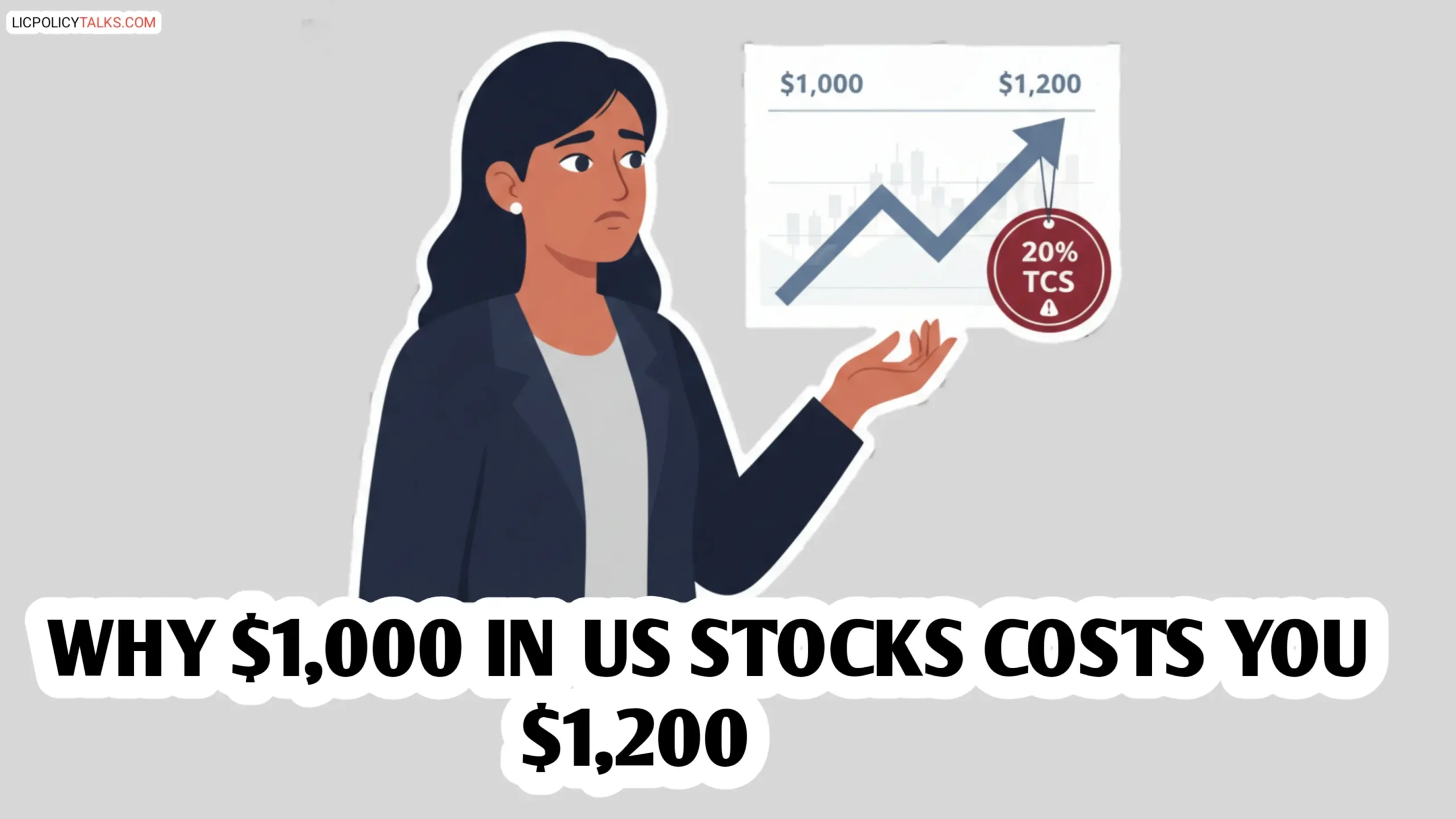
That Sinking Feeling: When Your $1,000 Investment Needs $1,200
Imagine the scenario clearly. You’re all set to buy $1,000 of a Vanguard ETF. You authorize the transfer. Instead of a smooth transaction, you get a notification or your bank blocks the remittance, stating you need to provide an additional 20% for the “Tax Collected at Source” or TCS. Your planned $1,000 investment now has an instant 20% markup. This isn’t a brokerage fee or a bad exchange rate. This is a mandatory, upfront collection by the government on your overseas investment under the Liberalised Remittance Scheme (LRS).
This upfront hit is the core of the TCS Trap 2026. While it’s technically a *credit* you can claim later, the immediate financial impact is severe. For the better part of a year or more, a significant chunk of your investment capital is locked away with the tax department, not working for you in the market. This article will dissect this trap, explain what changed in Budget 2025, walk you through the arduous refund process, and arm you with strategies to navigate this new cost of global investing.
TCS Decoded: Not a Tax, But a Temporary (Forced) Loan to the Government
Let’s get the basics straight. Tax Collected at Source (TCS) is exactly what it sounds like: a tax collected right at the source of a transaction. When you send money abroad for investments (or other purposes like travel), the authorized dealer (your bank or financial platform) acts as a collector for the government. They withhold a specified percentage of your remittance and pay it directly to the Income Tax Department on your behalf.
Here’s the critical nuance everyone misses: This is a prepaid tax credit, not an extra penalty. You can claim this amount as a credit against your final income tax liability when you file your Income Tax Return (ITR). The trap is that you are out of pocket right now. You need 20% more cash today to complete a transaction for which you’ll only get a credit much later. This scheme is linked to the Liberalised Remittance Scheme (LRS), which allows Indian residents to send up to $250,000 overseas per financial year for permissible transactions, including investing in foreign stocks.
While TCS applies to other LRS purposes like overseas travel and education, the rate and impact are most punitive for investors. The government uses this mechanism to track large foreign currency outflows and ensure tax compliance. As per recent updates, the threshold for triggering a higher TCS rate has been revised upward from the previous Rs 7 lakh limit TCS on foreign remittance limit hiked from Rs 7 lakh….
The Nuts and Bolts of the 20% Trap: A $1,200 Price Tag for a $1,000 Asset
Let’s make the math undeniable. Suppose you want to invest $1,000 in a US-listed ETF like the S&P 500 Index fund. Here’s what happens:
Step 1: Your intended remittance amount is $1,000.
Step 2: Your bank calculates the 20% TCS on foreign remittance: 20% of $1,000 = $200.
Step 3: The total amount debited from your Indian bank account: $1,000 (investment) + $200 (TCS) = $1,200.
Feel that? Psychologically, you set out to deploy $1,000. Financially, you must part with $1,200. The $200 doesn’t buy you any additional shares; it simply sits with the tax department as a credit against future liability. Effective immediate cost: You pay $1,200 to own $1,000 worth of assets. This 20% instant markup is the heart of the liquidity trap, turning every investment decision into a significantly larger cash flow exercise.

Budget 2025 Changes: What Actually Changed (And What Didn’t)
You might have heard about “TCS relief” in the Budget 2025 news. It’s crucial to separate the headline from the harsh reality for investors. Yes, there were changes, but the core trap remains firmly in place.
Change 1: The Threshold Hike: The government increased the threshold limit for the higher TCS rate from ₹7 lakh to a new, higher limit (as reported). For the occasional small remitter, this is a relief. However, for a serious investor building a global portfolio, aiming for $10,000 or more annually, this revised threshold is crossed almost instantly, bringing the full 20% rate into play.
Change 2: Education Loan Relief: In a positive move, the Finance Minister proposed the removal of TCS on foreign education loans financed by banks. This shows the government is willing to tweak the rules for specific categories FM proposes increase in threshold limit… TCS on foreign education loans removed. Unfortunately, the investment category received no such kindness.
The Unchanged Core: The 20% Rate: This is the kicker. Despite widespread pre-budget speculation and hope that the high 20% rate for investments and tour packages would be reduced to 5%, it remained untouched TCS on sending money abroad is 20% in many cases…. For the US stock investor, the fundamental math of the trap—needing 20% extra cash upfront—is completely unchanged post-Budget 2025.
| Purpose of Remittance | TCS Rate | Threshold (Per FY) | Notes |
|---|---|---|---|
| Medical Treatment / Education (financed by loan) | 0.5% | Over Rs. 7 Lakh | Budget 2025 removed TCS on education loans. |
| For Overseas Travel / Other Purposes (Incl. Investments) | 20% | Over Rs. [New Limit] | The ‘Trap’ for Investors. No loan required for this rate. |
| Any Purpose | 5% | Up to Rs. [New Limit] | Applies if total remittances stay under the threshold. |
The Refund Mirage: Why ‘You’ll Get It Back’ is Only Half the Story
This is where the “it’s just a credit” argument falls apart. The TCS refund process is where the “trap” fully manifests. Let’s walk through the ordeal. First, you must obtain a TCS certificate (Form 27D) from your bank, which can take weeks or even months after the transaction. Without this document, you cannot proceed.
Next, you file your Income Tax Return (ITR) and claim the TCS credit against your total tax liability. If the TCS you paid is more than your final tax owed, you become eligible for a refund. Sounds straightforward, right? Here’s the reality: your money is locked up for an extended period. The timeline from the date of remittance to finally receiving a refund in your bank account can easily span 8 to 16 months.
During all these months, that $200 from our example isn’t invested alongside your $1,000. It’s not earning interest for you in a savings account. It is, in effect, an interest-free loan to the government. Think of the opportunity cost. If that $200 could have been invested and earned even a conservative 8% return during that period, that’s growth you’ve permanently missed out on.
It’s also a strict compliance necessity. You must accurately declare this income and the TCS paid when filing returns. As highlighted in recent advisories, remitting large amounts abroad requires you to pay TCS and declare income accurately to avoid penalties Remitting large amount abroad? Pay TCS, declare income accurately.
Visualizing the Drag: How the TCS Trap Eats Into Your Potential Returns
The real damage of the TCS Trap isn’t just the paperwork headache; it’s the silent, long-term erosion of your portfolio’s compounding potential. Let’s call this the “TCS Drag.”
Consider two investors, Anya and Bala. Each plans to invest $10,000 per year in US stocks for 5 years. Anya gets caught in the TCS Trap. For her to deploy $10,000, she needs $12,000 in cash upfront. If we account for the 20% that’s perpetually locked up in the refund cycle, her effective annual deployment is only around $8,333. Bala, through smart planning (or using a different route), manages to deploy the full $10,000 each year. Assuming a conservative 8% annual return, let’s see the difference after 5 years.
Portfolio Value After 5 Years: With vs. Without TCS Drag
Assuming $10,000 intended investment per year, 8% annual return. The ‘With TCS’ scenario effectively deploys ~20% less capital annually due to locked funds.
The difference of ~$13,900 represents the opportunity cost of the trapped capital over 5 years.
Smart Investor’s Playbook: Navigating and Mitigating the TCS Trap
Now that we see the problem clearly, let’s talk solutions. You can’t change the law, but you can strategize around it. Here’s your playbook.
Strategy 1: Perfect Your Tax Timing. If you must pay the TCS, plan large remittances early in the financial year (April-May). This starts the clock on your “interest-free loan” earlier, potentially allowing you to claim the credit and get a refund by the time you file your ITR in July, shortening the overall lock-in period.
Strategy 2: Maximize the Threshold. The TCS rate is lower (5%) for total LRS remittances under the revised threshold. If you are investing with your spouse or family, consider splitting the annual investment amount across individual LRS limits to stay under the threshold for each person and avail the lower 5% rate. Know the rules and document the purpose clearly.
Strategy 3: Explore TCS-Free Avenues (with caution). Look at indirect routes. Indian mutual funds that offer overseas exposure (Feeder Funds or Fund of Funds) do not attract LRS TCS. The pros: convenience, no upfront 20% hit. The cons: typically higher expense ratios and a limited choice of underlying funds.
Strategy 4: Meticulous Record-Keeping. This is non-negotiable. Save every bank statement, SWIFT confirmation, and especially the TCS certificate (Form 27D). Create a dedicated folder for these documents. This will make your foreign investment tax India filing smooth and prevent delays in claiming your credit.
Strategy 5: Consider the Big Picture. For some investors, especially those building large, long-term global portfolios, the 20% hit may be an unavoidable cost of doing business for the benefit of direct access to specific US stocks or ETFs. The key is to be aware of this cost, factor it into your cash flow planning, and not be surprised by it.
TCS Trap 2026: Your Final Checklist Before You Hit ‘Send’
Before you authorize any overseas investment remittance, run through this quick checklist:
1. Calculate the Real Cost: Always multiply your intended investment amount by 1.2 to know the total cash that will leave your Indian bank account.
2. Check the Latest Threshold: Verify the current LRS TCS threshold with your bank for the applicable financial year.
3. Secure Your Form 27D: Proactively follow up with your bank to get this TCS certificate; don’t wait for them to send it.
4. Plan Your Tax Filing: Factor this TCS credit into your annual tax liability calculations well in advance.
5. Evaluate Alternatives: Honestly weigh the pros and cons of direct investment (with the TCS hit) against Indian feeder funds based on your investment goals and cost tolerance.
Knowledge of the TCS Trap 2026 is the first and most powerful step to minimizing its bite on your financial future.
FAQs: ‘foreign investment tax India’
Q: Is the 20% TCS on US stock investments an extra tax I’m paying?
Q: If I’m a salaried employee with TDS deducted, do I still need to pay this TCS?
Q: Can I avoid TCS completely by using my international credit card?
Q: How long does it typically take to get my TCS refund after filing my ITR?
Q: Has the 20% TCS rate always been there for investments?
The Bottom Line: See the Trap to Escape Its Bite
The core insight is simple but powerful: the TCS Trap 2026 is a severe liquidity constraint cleverly disguised as a minor tax technicality. It forces you to overfund your investments by 20%, turning a portion of your capital into a non-interest-bearing deposit with the government for up to a year or more.
To protect your wealth, remember the key takeaways: the instant 20% cash requirement, the lengthy and friction-filled refund process, and the silent but quantifiable drag it places on your long-term compounding. Armed with this knowledge, you can now plan your foreign investments with clear eyes, manage your cash flows effectively, and make informed choices between direct and indirect routes. As global investing becomes mainstream for Indians, mastering these cross-border financial nuances isn’t optional—it’s essential for protecting your hard-earned capital from hidden traps.