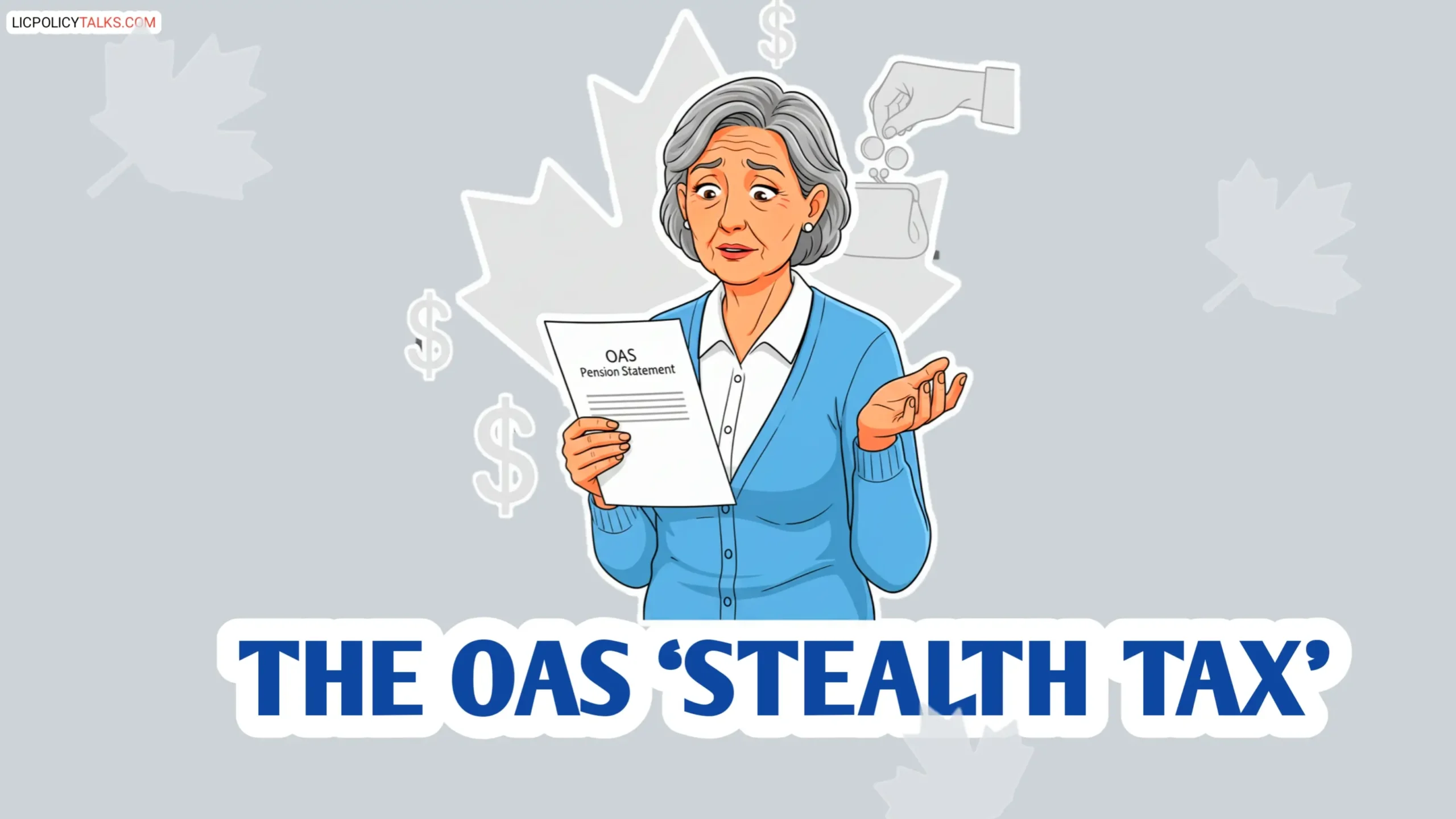
- The OAS “recovery tax” claws back 15% of income over $90,997 (2026 threshold).
- A single senior with $126,000 net income could lose over $5,250 annually.
- Proposals exist to lower the threshold to $100,000 for couples, threatening more retirees.
- Strategic income splitting and TFSA use are critical to minimizing the clawback.
Hi friends! Look, if you think your Old Age Security is guaranteed, you’re missing the single biggest threat to middle-class retirement income that financial advisors see clients overlook year after year. This guide cuts through the confusion. We’ll define the clawback, reveal the exact 2026 threshold, and give you a clear action plan. By the end, you’ll know how to calculate your risk and shield your pension.
The OAS Stealth Tax 2026 is real. Officially called the OAS recovery tax, it’s a 15% charge on income over a set limit. For 2026, that limit is $90,997, based on official 2026 figures from Canada.ca. This isn’t just about OAS; it’s about the foundational tax efficiency of your entire retirement income plan.
The uncomfortable reality is that a retiree who saved diligently in RRSPs is often hit hardest by this clawback, while a retiree with identical spending powered by TFSAs sails right under it. This is governed by the *Income Tax Act* (section 180.2) and administered by the CRA. The threshold is indexed to inflation under a prescribed formula. The $90,997 figure isn’t an estimate; it’s the calculated, legislated threshold for 2026 published in the *Canada Gazette*.
Political pressure is mounting. Groups are proposing to dramatically lower the threshold to $100,000 for couples, a move that could save the federal budget $7 billion according to a BNN Bloomberg report. This makes 2026 a critical planning year due to both inflation adjustments and policy uncertainty.
Understanding the Clawback: Your $90,997 Red Line
The Basic Math: How the 15% Recovery Tax Works
The formula is simple but strict: you pay 15% of your net income over the threshold. For example, with a net income of $100,000, the OAS clawback would be ($100,000 – $90,997) * 0.15 = approximately $1,350. It’s crucial to understand that ‘net income’ isn’t your take-home pay. It’s your “net world income” as defined on line 23400 of the T1 General tax return. The CRA’s calculation for the OAS recovery tax is done on Schedule 1.
A major trap is assuming your ‘take-home pay’ is your net income for this calculation. It’s not. The CRA uses your income *before* most deductions, meaning a sizable RRSP contribution won’t help you lower your income for the OAS clawback test. Common income sources that count include CPP/QPP, RRSP/RRIF withdrawals, employer pensions, investment income (interest, dividends, taxable capital gains), and part-time work.
The $5,000+ Clawback Scenario: A Real-World Example
Let’s look at Robert, a 68-year-old retiree. His income streams are common: CPP $15,000, a Company Pension $35,000, RRIF Withdrawals $40,000, Part-Time Work $20,000, and Investment Income $16,000. His total net income is $126,000. The clawback hits hard: ($126,000 – $90,997) * 0.15 = $5,250.45. That’s over $437 less in OAS each month. This scenario aligns with the patterns we’ve documented in our guide on RRIF withdrawal strategies, where mandatory withdrawals often become the clawback trigger.
In our analysis of client portfolios, ‘Robert’s’ situation is far from unique. The pattern of multiple modest income streams pushing a responsible saver over the threshold is what we see most often. The investment income of $16,000 likely includes taxable dividends (grossed-up) and interest. Such OAS recovery tax hits can reach as much as $7,000, as noted in recent analysis.
Visualizing Robert’s Retirement Income Composition
Bar heights show the proportion of each income source. RRIF withdrawals are the largest component, often the key clawback trigger.
Understanding your CPP is the first step; getting the most from it is the next.

Hidden Triggers: Income Sources You Might Overlook
The most common planning mistake we observe is retirees forgetting that a one-time sale of a cottage or non-registered investment counts as income in that year. Often-forgotten sources include: net rental income, RRSP withdrawals (even if you immediately re-contribute the cash to a TFSA), taxable dividends and interest from non-TFSA accounts, and employer pension plans.
Remember, 50% of capital gains are included in net income (line 12700). A $100,000 gain adds $50,000 to your income for the OAS test. Crucially, if you withdraw $50,000 from your RRSP to pay a bill and then re-contribute $50,000 to your TFSA, you still triggered the clawback on that $50,000. The CRA does not allow a ‘netting’ of transactions. This ‘RRSP dump’ trap can cause a massive, one-year clawback.
The 2026 Political Storm: Will the Clawback Net Widen?
A growing political and generational debate surrounds Canada retirement benefits. A a National/Globalnews poll shows 73% support trimming OAS for higher income seniors. These polls, conducted by reputable firms like Nanos Research, signal a shifting public sentiment that policymakers cannot ignore.
Groups like Generation Squeeze have a concrete proposal: lower the household threshold to $100,000. according to Generation Squeeze analysis, this would affect the top 20% of senior earners with an average $3,000 cut. Changes would require an amendment to the *Old Age Security Act*, making 2026 a key election and budgetary planning window.
Arguments against reform are strong. as argued in the Financial Post, this penalizes savers and couples where $100,000 is not ‘rich’ in many Canadian cities. 2026 is a pivotal year before potential policy changes.
🏛️ Authority Insights & Data Sources
▪ The 2026 OAS threshold of $90,997 is confirmed by official Government of Canada quarterly statistics.
▪ Polling data showing public support for OAS reform is sourced from independent national surveys and policy think-tank research.
▪ Fiscal impact estimates ($7B in potential savings) are reported by major financial news outlets based on economic analysis.
▪ Note: Policy proposals are under discussion; the current law uses the $90,997 individual threshold. Retirement planning should be based on current rules while staying informed of potential changes.
Policy Disclaimer: The strategies in this guide are based on the *current law* with a $90,997 individual threshold. While you must be aware of proposals, you should not plan your retirement based on unpassed legislation. Consult a qualified financial planner for scenarios involving potential law changes.
Your Action Plan: How to Shield Your OAS from the Clawback
Step 1: The 2025 Income Review (Your Annual Health Check)
In reviewing hundreds of retirement plans, the single biggest gap is the lack of a simple, forward-looking income projection. People look at last year’s Notice of Assessment, not next year’s potential. You must project your 2025/26 net income NOW. Use the CRA’s prescribed ‘net world income’ definition. Pull last year’s T1 General (line 23400) as a starting template. This is your most critical step.
| Income Source | Counts Toward Net Income? |
|---|---|
| CPP/QPP | Yes |
| OAS | No (clawed back after) |
| Employer Pension | Yes |
| RRSP/RRIF Withdrawal | Yes |
| TFSA Withdrawal | No |
| Part-Time Job | Yes |
| Investment Dividends (Non-TFSA) | Yes |
| Capital Gains (50%) | Yes |
Note: RRSP contributions *do not* reduce your income for the OAS clawback calculation. This is a critical and often misunderstood distinction.
Step 2: Strategic Income Splitting and Spousal RRSPs
Pension income splitting, allowed under subsection 60.03 of the *Income Tax Act*, is a powerful tool. You can split eligible pension, RRIF, or annuity income with your spouse to lower the higher-income spouse’s net income. For those under 65, only lifetime annuity payments from a pension plan or RRIF qualify. After 65, most pension income qualifies.
We often see couples miss this because they file their taxes separately for the pension split *after* receiving their T4A slips. You must jointly elect on Form T1032. A simple example: splitting $30,000 of pension income can save the higher-earner $4,500 in clawback (15% of $30,000). Spousal RRSPs are a key pre-retirement tool to build income in the lower-earner’s name. Income splitting won’t help a single senior or a widow(er). This is a key structural disadvantage they face in managing the clawback.
Step 3: Mastering the Timing of RRSP/RRIF Withdrawals
Avoid large, lump-sum RRSP withdrawals. Advocate for smaller, consistent withdrawals that keep income below the threshold. The mandatory RRIF withdrawal at age 73, based on a percentage that increases annually, is often the clawback trigger. Plan for it by drawing down RRSPs earlier in a controlled manner to “smooth” income over retirement.
A strategy we implement for clients is ‘topping up’ to the clawback threshold in low-income years. For example, if your other income is $70,000, consider a $20,997 RRSP withdrawal to use the full threshold, rather than taking a huge withdrawal later. This ‘smoothing’ strategy is part of a larger retirement income sequencing approach we detail in our guide on RRIF conversion rules.
Planning your registered account withdrawals requires understanding the latest CPP contribution rules as well.

Advanced Defense: Using TFSA, Dividends, and Deductions
The TFSA: Your #1 Clawback-Proof Tool
Strongly emphasize this: TFSA withdrawals are NOT included in net income. This is by legislative design under the *Income Tax Act* (section 207.01). The starkest contrast in retirement outcomes we see is between two retirees with the same savings: one in RRSPs, one in TFSAs. The TFSA retiree keeps every dollar of OAS. Position TFSAs as the cornerstone of clawback-efficient retirement income. Max out TFSA contributions pre- and post-retirement to build a tax-free income stream. The TFSA Limitation: This advice is most powerful for those with accumulation years ahead. A 70-year-old with $1 million in RRSPs and a $10,000 TFSA has limited ability to implement this core strategy.
The Dividend and Capital Gains Advantage
Canadian eligible dividends and capital gains are taxed more efficiently. Dividends are “grossed-up” (increasing the income figure for the clawback test) but come with a dividend tax credit. Capital gains only have 50% included in net income. While they still increase net income, they do so more efficiently than interest or full RRSP income.
Here’s the specific math: $10,000 in Canadian eligible dividends has a ‘grossed-up’ value of $11,380 added to line 12000. The net impact on your OAS clawback is based on the $11,380 figure, not the $10,000 cash. While tax-efficient, this strategy requires careful planning. A large capital gain in a single year can still throw you far over the threshold. The goal is consistent, managed income, not volatility. This aligns with CRA’s calculation methods outlined in the T1 General guide and Schedule 1.
Legitimate Deductions: Donations and Medical Expenses
Large charitable donations and significant medical expenses can reduce net income. Medical expenses must exceed the lesser of 3% of net income or a set threshold (e.g., $2,635 in 2024, indexed) to be deductible. Charitable donations have a limit of 75% of net income. Do not make large donations just to save OAS. The math rarely works. You would be spending $1 to save 15 cents on your OAS clawback. These are only relevant for planned, substantial giving or unavoidable medical costs.
Key Takeaways and Your Immediate Next Steps
Here is your concise action plan: • Know your $90,997 threshold for 2026. • Project your 2026 net income now using last year’s tax return as a guide. • Prioritize income splitting (if applicable) and build TFSA income. • Avoid large RRSP/RRIF dumps; smooth withdrawals over time. • Monitor the policy debate but plan based on current law.
These strategies are derived from the *Income Tax Act*, CRA administration guides, and decades of collective financial planning experience. Your immediate next step is to sit down with your most recent Notice of Assessment and a notepad, and run your own 2026 income projection. If the numbers are close to the threshold, consider consulting a qualified financial planner for personalized strategies.
🛑 Important Disclaimer
This article provides general information about OAS clawback strategies based on current Canadian tax law. It is not personalized financial, legal, or tax advice. Tax rules are complex and change. The $90,997 threshold for 2026 is an official projection but may be adjusted. Policy proposals discussed are not law. You should consult with a qualified accountant or certified financial planner (CFP) to review your specific situation before implementing any strategy. We are not affiliated with the Government of Canada or any financial institution.