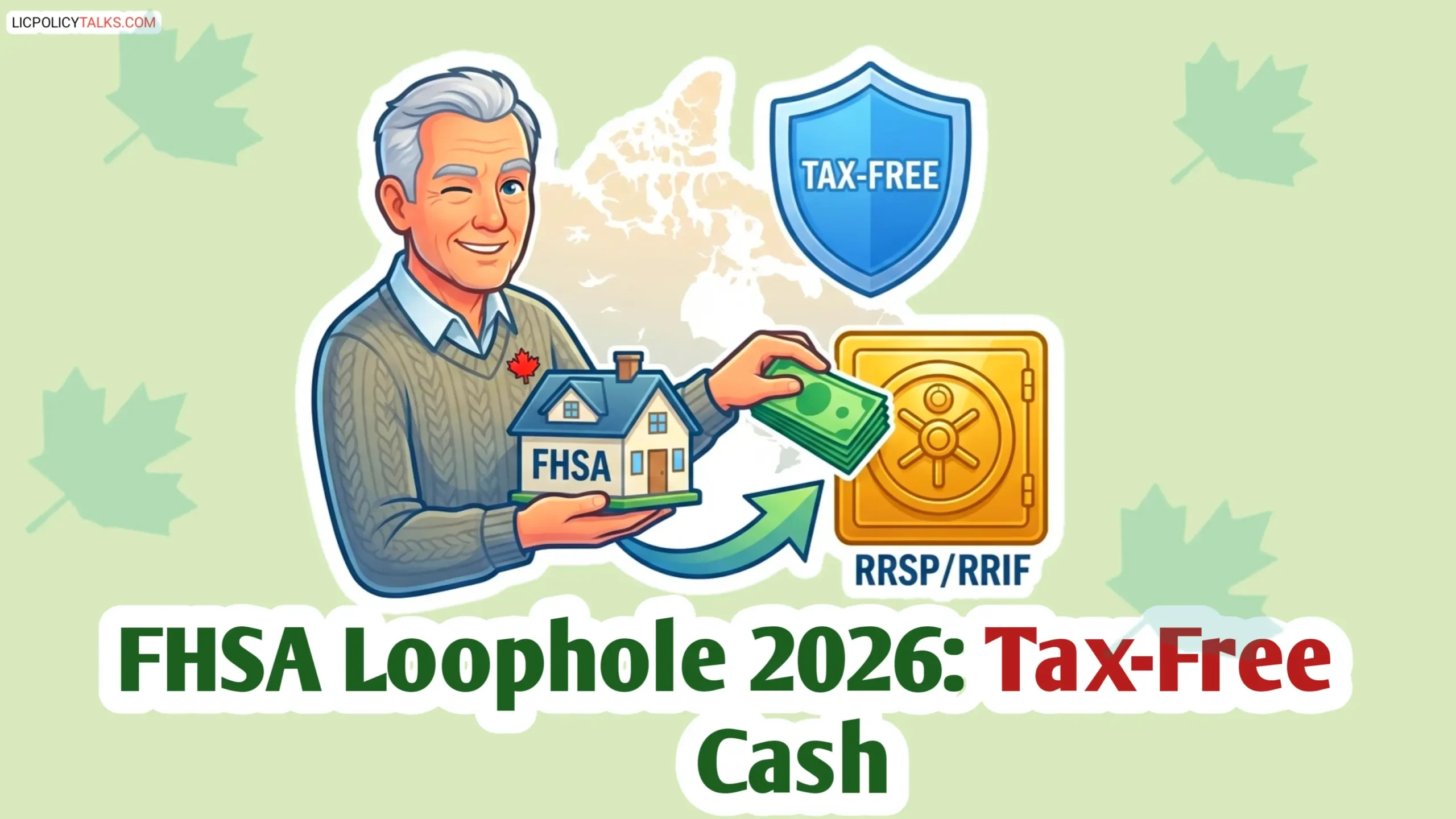
The Ultimate FHSA Loophole Guide 2026: How Canadian Retirees Are Sheltering Tax-Free Cash (Legally)

Updated on: April 9, 2026 4:51 PM
Follow Us:
The Ultimate FHSA Loophole Guide 2026: How Canadian Retirees Are Sheltering Tax-Free Cash (Legally)
Follow
Share
Socials
Add us on 
⚡ Quick Highlights
  • The FHSA ‘loophole’ lets Canadian retirees shelter up to $40,000 for completely tax-free growth and withdrawals, even if they never buy a home.
  • For 2026, the annual contribution limit is $8,000, with a lifetime maximum of $40,000. Unused room from 2025 can be carried forward.
  • It’s a legal tax strategy, not evasion. Funds can be transferred to an RRSP if not used for a home purchase, preserving tax sheltering.
  • Eligible retirees are those who haven’t owned a home in the last 4 calendar years and are under age 71.
  • Combining FHSA with RRSP Home Buyers’ Plan can unlock over $100,000 in tax-advantaged funds for a couple.

Hi friends! Let’s talk about a powerful retirement tool hiding in plain sight. Most Canadian retirees overlook the First Home Savings Account because of its name, missing out on a CRA-approved tax shelter. This isn’t about buying a house. It’s about using the rules to build tax-free cash flow for your golden years. The core issue? A misconception that costs thousands in lost savings. If you’re a retiree or near retirement, this guide will show you how to legally shelter income and grow it tax-free. The 2026 context brings specific limits and deadlines, making strategic action now more important than ever. You’ll gain clarity on a legal, low-risk strategy to enhance your retirement finances.

Table of Contents

This guide will explain the FHSA loophole for 2026, a legal strategy for Canadian retirees to shelter tax-free cash.

Unlocking the FHSA Loophole: Your Key to Tax-Free Retirement Income

The ‘FHSA loophole‘ is simply the ability to use the account for tax-sheltered growth and strategic withdrawals in retirement, regardless of whether you buy a home. It’s a legal, strategic use of the rules written by Parliament, not a shady trick. The legal basis is clear: CRA rules allow funds to be transferred to an RRSP or RRIF, or withdrawn as taxable income after 15 years. This contrasts sharply with the common misconception that the First Home Savings Account is only for active home buyers. The mechanism is grounded in the *Income Tax Act* and specifically defined in CRA’s guidance on ‘qualifying transfers.’ This isn’t a hack; it’s using the account as legislated.

What Is the FHSA Loophole and How Does It Work?

The mechanism has three clear steps: 1. Contribute (your money is tax-deductible). 2. Invest & grow (all investment gains are tax-free inside the account). 3. Withdraw in retirement (strategically tax-free or tax-deferred). You must understand the 15-year timeline and the two paths: a ‘qualified withdrawal’ for a home purchase, or a ‘non-qualified withdrawal’ for any other reason. Think of it as a hybrid RRSP/TFSA with a built-in retirement exit ramp. In reviewing financial plans, the critical error is failing to plan for the 15-year account closure rule from day one. For example, a recent analysis by financial columnist Christopher Liew highlights strategic uses of the FHSA beyond just home buying.

Why the FHSA Loophole Is a Legal Tax Strategy for Retirees

It’s crucial to distinguish between tax avoidance (legal planning) and tax evasion (illegal). This strategy is the former. The rules for FHSA benefits are found in specific sections of the Income Tax Act. The CRA’s own guidance outlines permissible transfers and withdrawals. Direct readers to the Department of Finance Canada’s original legislative framework for the FHSA, which clearly outlines the transfer and withdrawal options, proving this strategy is built into the law’s design.

Immediate Benefits: Tax-Free Growth and Withdrawals

The power of tax-free compounding inside the FHSA is significant. You get a double benefit: an RRSP-like tax deduction when you contribute, and TFSA-like tax-free withdrawal if used for a home. For a simple example: a $8,000 contribution can save you about $2,400 in tax immediately (at a 30% rate), and that money can grow tax-free for decades. This benefit is potent but capped. The $40,000 lifetime limit means it’s a powerful satellite account, not a core retirement fund. Don’t expect it to solve all your income needs.

Simple Calculated Example:
• Contribution: $8,000
• Tax Refund (30% bracket): $2,400
• Projected Value in 15 yrs (6% return): ~$19,200
• Tax-Free Withdrawal Potential: $19,200

FHSA Rules Decoded: Eligibility, Contributions, and Withdrawals

Let’s break down the FHSA rules in plain language. This is the foundation for the entire strategy. We’ll go beyond basic summaries to explain the ‘why’ behind CRA’s FHSA eligibility criteria and contribution mechanics, referencing official definitions.

FHSA Eligibility Criteria: Who Can Open an Account?

To open an FHSA, you must meet specific criteria. You must be between 18 and 71 years old. You must be a resident of Canada for tax purposes. The key rule is the first-time home buyer definition: you must not have owned a home you lived in during the current year and the preceding four full calendar years. This is KEY for retirees who sold their home years ago. Ownership includes co-ownership or a home owned by your spouse. The most common eligibility pitfall is misunderstanding ‘ownership.’ If your spouse owned a home you lived in within the last 4 years, you are likely *ineligible*, a detail many advisors gloss over.

CriteriaMust Be
Age18 to 71
ResidencyCanadian tax resident
Home Ownership HistoryHave not owned & lived in a home in the current + prior 4 calendar years
Account LimitOnly one FHSA at a time, max lifetime contributions $40,000

↔️ Scroll horizontally to view full table if needed

FHSA Contribution Limits and Deadlines for Maximum Impact

For 2026, the annual FHSA contribution limit is $8,000, with a lifetime limit of $40,000, as confirmed by a BNN Bloomberg report on 2026 tax changes. The carry-forward rule lets you bring forward unused room of up to $8,000 to the next year, but it does not accumulate beyond one year. The deadline is strict: contributions for the 2026 tax year must be made by December 31, 2026. Unlike an RRSP, there is no 60-day grace period for the prior year, a point detailed in H&R Block’s 2026 FHSA deduction guide. The $8,000 limit for 2026 isn’t arbitrary; it’s indexed to inflation and confirmed by the Canada Revenue Agency in its annual *Registered Plan Limits* bulletin.

$40,000
2027 Total
$24,000
2026 Total
$8,000
2025 Total

↔️ Visual showing cumulative lifetime contribution growth to $40,000 limit

FHSA Withdrawal Rules: Accessing Funds Without Buying a Home

A qualified withdrawal for a first home purchase is tax-free but has strict conditions, like a written agreement and a 30-day deadline from moving in. A non-qualified withdrawal for any other reason is fully taxable as income in the year you take it out. For the retirement ‘FHSA loophole‘, you have two main paths: 1. Transfer the funds to an RRSP or RRIF (tax-deferred, doesn’t use RRSP room). 2. Hold the account for 15+ years and then make taxable withdrawals strategically in low-income retirement years. You can also name a successor holder or beneficiary, a feature noted by the Innovation Federal Credit Union. The ‘non-qualified withdrawal’ path is often marketed softly. We must stress that these withdrawals are **100% taxable at your marginal rate** and could trigger OAS clawbacks.

Step-by-Step Strategy to Implement the FHSA Loophole in 2026

Let’s turn this into an actionable, numbered plan. These steps are based on observing successful implementations and common errors made at financial institutions for optimal tax efficiency.

How to Set Up and Fund Your FHSA for Optimal Tax Sheltering

First, open an account at a bank, credit union, or brokerage, comparing fees and investment options. The funding order for a retiree often means prioritizing the FHSA for the deduction before adding to an RRSP, but after maximizing your TFSA for flexibility. A key tactic is to reinvest the tax refund from your FHSA deduction back into the account or your TFSA to boost your savings. For a retiree in a 30% tax bracket, a $8,000 contribution generates a $2,400 refund. The true ‘cost’ of the contribution is only $5,600.

Timing Your FHSA Contributions and Withdrawals for Tax Efficiency

Make contributions in your highest-income years to maximize the value of the tax deduction (e.g., just before full retirement). Plan withdrawals or the RRSP transfer for your lowest-income years in retirement to minimize the tax hit. Remember, the account must be closed within 15 years of opening, so your exit strategy is crucial. In case reviews, the most optimized strategies involve making contributions in the last few working years and scheduling the RRSP transfer for ages 65-70.

Years 1-5
Accumulation & Deduction
Years 6-15
Tax-Free Growth
Year 15+
Transfer to RRIF or Strategic Taxable Withdrawals

Choosing the Best FHSA Investments for Long-Term Growth

Given the long-term, tax-free nature of the account, a moderate-to-growth portfolio of ETFs, mutual funds, or stocks may be suitable, aligned with your risk tolerance. Practice good asset location: hold investments that generate interest or high dividends inside your FHSA or TFSA first, not in taxable accounts. If your risk tolerance is very low and you’d only hold cash in the FHSA, the strategy’s benefit shrinks dramatically. The tax-free growth engine requires actual growth assets.

Real-World Examples: How Canadian Retirees Use the FHSA Loophole

Let’s look at concrete case study scenarios. These are common profiles seen in financial planning, showing both ideal and cautionary elements of generating tax-free cash flow.

Case Study: Early Retirement with FHSA Tax-Free Cash Flow

Mark is 60 and retired. He sold his home at 55 to travel, so he’s FHSA-eligible. He contributes $8,000 yearly for 5 years, maxing his $40,000 lifetime limit. He claims the deductions against his final years of employment income. At 65, he starts small, planned non-qualified withdrawals to supplement his pension, carefully keeping his total income in a low tax bracket. The hidden risk here: if market returns are poor, the taxable withdrawals are smaller, but so is the overall benefit. This strategy banks on reasonable growth.

Case Study: Supplementing CPP and OAS with FHSA Withdrawals

Susan relies mainly on CPP and OAS and needs an extra $10,000 per year. She uses her FHSA (funded earlier) for targeted, taxable withdrawals to cover specific expenses. She must calculate carefully, as these withdrawals are taxable income and could reduce her GIS benefits. This case requires precise math. Every dollar of taxable FHSA withdrawal can reduce GIS benefits by 50 cents. The net gain might be far less than expected.

Case Study: Estate Planning and Legacy Building with FHSA

Robert is 70, has ample retirement income, and doesn’t need his FHSA funds. His strategy: contribute for the tax deduction, invest for growth, and name his adult daughter as the successor holder. Upon his death, the account transfers tax-free to her, and she can use it for her own first home purchase under her limits. This leverages the specific ‘successor holder’ rules in the Income Tax Act.

Read Also
Capital Gains Inclusion 2026: How to Avoid the 66% Tax Hit on Your Cottage or Rental Property
LIC TALKS • Analysis

FHSA vs. RRSP vs. TFSA: Comparing Tax Shelters for Retirement

This is a crucial comparison for allocating limited retirement savings. In practice, retirees often ask ‘which is best?’ The expert answer is always ‘it depends on your tax rate now vs. later.’

Tax Deductions and Savings: FHSA vs. RRSP Analysis

Both FHSA and RRSP offer immediate tax deductions. The FHSA has a lower limit ($8k vs. $33,810 for the official RRSP limit for 2026). The key difference: FHSA funds can be withdrawn tax-free for a home; RRSP withdrawals are always taxable. For a retiree not buying a home, the FHSA deduction is still valuable, but the eventual withdrawal will be taxable unless transferred to an RRSP. The transfer to RRSP is a non-taxable event under the Income Tax Act. This is the linchpin that makes the ‘loophole’ work.

Withdrawal Flexibility and Tax Implications: FHSA vs. TFSA

TFSA: Contributions are not deductible, but all withdrawals are completely tax-free, anytime, for any reason. FHSA: Contributions are deductible, but non-qualified withdrawals are taxable. For a retiree, the TFSA is the ultimate flexible tax-free bucket. The FHSA is a ‘deduction-first, plan-your-exit’ bucket. If you must choose one, the TFSA’s absolute flexibility almost always wins for a retiree. The FHSA is a strategic add-on if you have extra cash.

Integrated Approach: Combining FHSA with RRSP and TFSA

The ‘Power Move’ is to use the FHSA for the deduction and tax-free growth, then transfer to an RRSP if no home purchase happens. Use your TFSA for flexible emergency and spending money in retirement. A smart prioritization order for a retiree with extra cash is: 1. FHSA (for the deduction), 2. TFSA (for flexibility), 3. RRSP (if still in a high tax bracket). This integrated approach is discussed in H&R Block’s guide on combining FHSA with the Home Buyers’ Plan.

Pros & Cons Box: The FHSA ‘Loophole’ for Retirees
Pros
  • ✓ Immediate tax refund on contributions
  • ✓ Tax-free growth inside the account
  • ✓ Legal and CRA-approved strategy
  • ✓ Estate planning flexibility via successor designation
  • ✓ Can be a backup home fund for family
Cons
  • ✗ $40,000 lifetime cap is relatively low
  • ✗ Non-qualified withdrawals are taxable
  • ✗ Account must be closed within 15 years of opening
  • ✗ Adds complexity to retirement income planning
  • ✗ Eligibility hinges on not owning a home for 4+ years

Common FHSA Loophole Mistakes and How to Avoid Them

Be aware of these pitfalls. These aren’t theoretical; they are the most frequent errors seen in client files and CRA notices.

Over-Contribution Penalties and Compliance Traps

The penalty for over-contribution is 1% per month on the excess. You must calculate your limit correctly, considering the carry-forward rule. Remember, the $8,000 carry-forward is use-it-or-lose-it; it doesn’t stack year over year. The penalty is calculated under Part X.1 of the *Income Tax Act*. The carry-forward is a *right to contribute more next year*, not an increase in your current year’s limit.

Misunderstanding FHSA Withdrawal Conditions and Timelines

A qualified withdrawal must be within 30 days of moving into the home. The 15-year closure rule is strict; plan your transfer to RRSP well before the deadline. A major mistake is making a taxable withdrawal in a high-income year, triggering a large tax bill. The 15-year rule is the single most overlooked aspect. Setting a personal calendar alert for year 14 is non-negotiable.

Investment Pitfalls Within FHSA Accounts

Being too conservative (e.g., only cash) misses the growth potential of a tax-free environment. Being too aggressive risks capital you might need. Not reviewing your investment plan annually is another common error. Individuals who cannot tolerate any investment risk should likely avoid this strategy. The primary benefit (tax-free growth) is neutered if the money isn’t invested for growth.

Advanced FHSA Strategies for Sophisticated Retirement Planning

These are niche strategies for larger estates or complex situations. The information here is educational. Implementing them requires consultation with a qualified tax advisor.

Leveraging FHSA for Estate Planning and Inheritance

Understand the difference between a ‘successor holder’ (spouse/common-law partner, continues the account) and a ‘beneficiary’ (taxable benefit, offset by contribution room). The FHSA can be a precise tool for intergenerational wealth transfer for a first home down payment. A ‘successor holder’ continues the account tax-free. A ‘beneficiary’ receives funds as a taxable benefit. This distinction is critical and legally defined.

Tax-Loss Harvesting and Asset Allocation in Your FHSA

You cannot claim capital losses inside a tax-free FHSA. Therefore, tax-loss harvesting should only be done in taxable accounts. For asset location, place high-growth, high-dividend investments in your FHSA or TFSA first. This principle is supported by CRA’s position that losses in a registered plan are not recognizable for tax purposes.

International Aspects: FHSA for Canadian Expats and Non-Residents

You must be a Canadian tax resident to contribute. If you emigrate, your existing FHSA remains open and grows tax-free, but you cannot make new contributions. It must still be closed by the 15th anniversary year. This is a firm rule. If you plan to retire abroad, the FHSA’s utility is limited.

Future-Proofing Your FHSA: Trends and Updates for 2026

Let’s look ahead. Based on observing Canadian tax policy, new programs like FHSA are typically stable for 5-7 years before governments consider tweaking limits.

Potential Legislative Changes to FHSA Rules and the Loophole

While the program is new, future governments may adjust limits. Major changes to the core mechanics are less likely soon. Stay updated via CRA and Finance Canada announcements. The single best source for real-time updates is the ‘News’ section of the Department of Finance Canada website, such as their news release on recent affordability legislation.

Long-Term Projections: FHSA in a Changing Economic Landscape

Consider how the FHSA fits with higher interest rates, inflation, and housing market shifts. Its role is as a fixed-lifetime-limit supplemental tool within a broader portfolio. In a high-inflation environment, the $40,000 lifetime limit’s real value erodes. This underscores its role as a supplemental, not primary, retirement tool.

Read Also
How to Protect Your Retirement from a 2026 Canadian Housing Market Crash
LIC TALKS • Analysis

Adapting Your FHSA Strategy for Future Tax Laws

Conduct an annual review of your strategy with a financial advisor. Be prepared to execute a transfer to an RRSP if changes in your personal tax situation make the ‘loophole’ path less favorable. This guide is an independent educational analysis. Your personal financial decisions should be made in consultation with a qualified professional.

🏛️ Authority Insights & Data Sources

📚 Authority Insights & Data Sources

This analysis is built on the following authoritative sources:

  • Canada Revenue Agency (CRA) & Department of Finance Canada – FHSA legislative framework and official rules.
  • BNN Bloomberg / Christopher Liew – 2026 contribution limits and RRSP/TFSA comparisons.
  • H&R Block Canada – Strategic use, combination with Home Buyers’ Plan.
  • Innovation Federal Credit Union – Product features, successor holder rules.

This information is for educational purposes. For personal advice, consult a qualified tax or financial advisor.

FHSA Loophole 2026: Your Questions Answered

These are the most common questions we receive from retirees in consultations and reader emails.

1. I’m 68 and retired. I sold my house 10 years ago to downsize to a rental. Can I use the FHSA loophole?

Answer: Yes, very likely. If you haven’t owned a home you lived in since 2022 (4-year rule), you are eligible. You can open an FHSA, contribute, claim the deduction against any income (even pension/RRIF income), and let it grow tax-free. Key is proving non-ownership for tax years 2022-2025. Keep records of your rental agreements and the sale documents from 10 years ago in case the CRA requests verification.

2. What happens if I contribute $8,000 but then my income is very low that year? Should I still take the deduction?

Answer: You can defer claiming the deduction. Unlike RRSP, FHSA deductions can be carried forward indefinitely. Claim it in a future year when your tax rate is higher for more benefit. This deduction carry-forward is specified in subsection 146.6(5) of the *Income Tax Act*. It’s a powerful planning tool often missed.

3. Is the FHSA loophole risky? Could the CRA come after me?

Answer: No, if followed correctly. The ‘loophole’ is simply using the account as permitted by law—for retirement savings via transfer or taxable withdrawal. The risk lies in breaking rules (over-contributing, missing deadlines), not in the strategy itself. The CRA’s job is to enforce the law as written. This strategy follows the letter of the law.

4. How does the FHSA interact with the Home Buyers’ Plan (HBP)? Can I use both?

Answer: Yes, they can be used together for a home purchase, creating a powerful combo. For retirees using the ‘loophole’, the HBP is less relevant unless helping a child buy a home. We see advanced retirees use this combination to gift a tax-efficient down payment assist to a child by coordinating within the family.

5. What’s the single biggest mistake retirees make with FHSA?

Answer: Not opening one due to the name ‘First Home’ and thinking it’s only for young buyers. Missing out on years of tax-free growth and a deduction because of this misconception is the top error. In our analysis, this behavioral mistake costs eligible retirees thousands in lost tax savings and compounding.

FAQs: ‘retirement planning’

Q: I sold my home years ago. Am I eligible for the FHSA loophole?
A: Yes, if you haven’t owned and lived in a home in the current year and the past four calendar years. Many downsizing retirees qualify.
Q: What is the FHSA contribution limit for 2026?
A: The annual limit is $8,000, with a $40,000 lifetime maximum. Unused room from 2025 can be carried forward to 2026.
Q: Is using the FHSA as a retirement account actually legal?
A: Absolutely. It’s legal tax planning using the CRA’s own rules for transfers to RRSPs or taxable withdrawals after 15 years.
Q: Should I prioritize my FHSA or my TFSA?
A: For most retirees, the TFSA’s total flexibility wins. Use the FHSA as a strategic add-on if you want the tax deduction.
Q: What’s the biggest risk with the FHSA loophole strategy?
A: Forgetting the 15-year closure rule or making a taxable withdrawal in a high-income year, leading to a large tax bill.

How useful was this post?

Click on a star to rate it!

Average rating 0 / 5. Vote count: 0

No votes so far! Be the first to rate this post.

Author Avatar

Sanya Deshmukh

Global Correspondent • Cross-Border Finance • International Policy

Sanya Deshmukh leads the Global Desk at Policy Pulse. She covers macroeconomic shifts across the USA, UK, Canada, and Germany—translating global policy changes, central bank decisions, and cross-border taxation into clear and practical insights. Her writing helps readers understand how world events and global markets shape their personal financial decisions.

Leave a Comment

Reviews
×