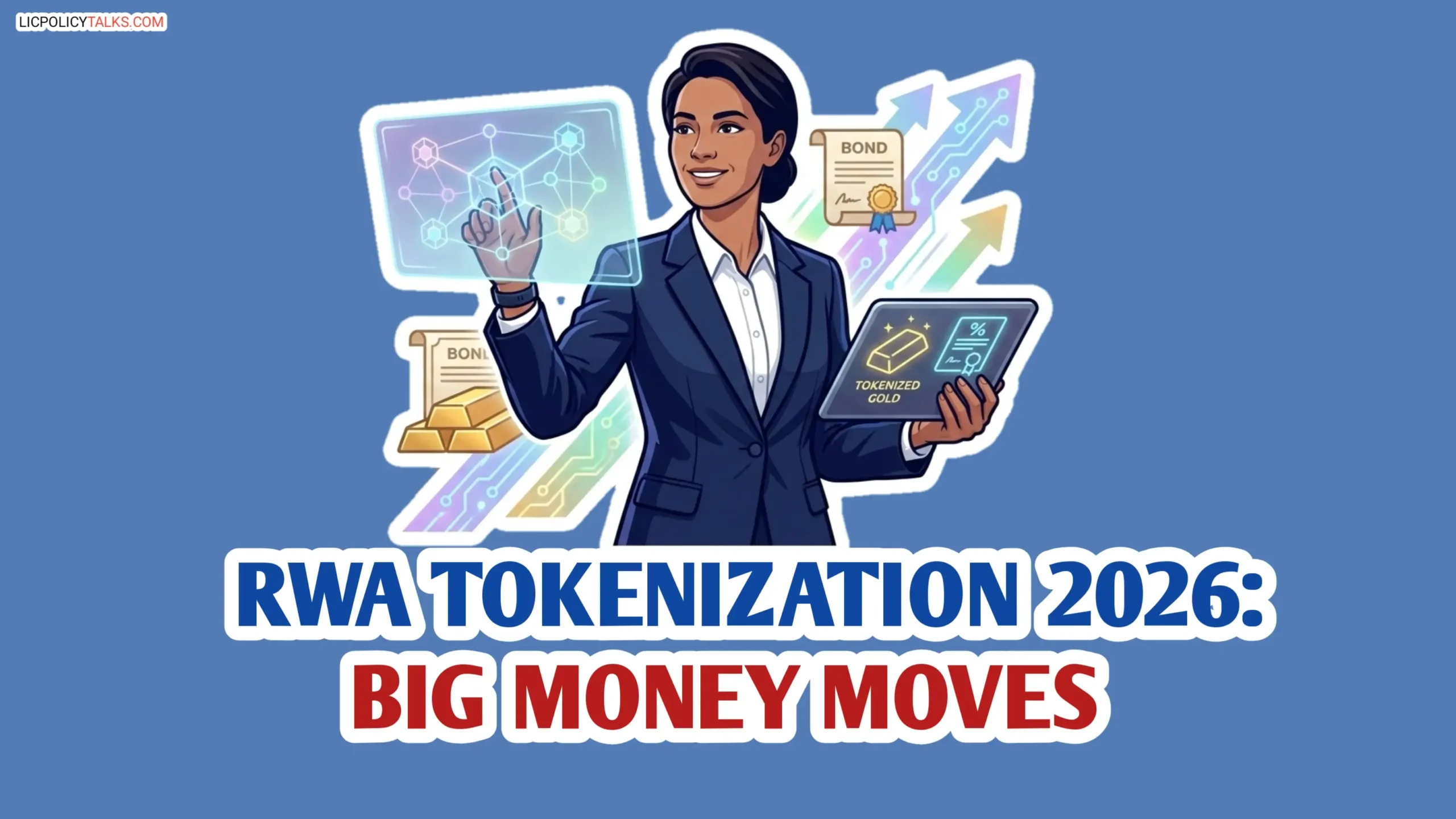
Hi friends! Let’s talk about a quiet revolution happening in the world of high finance. BlackRock didn’t just dip a toe; they plunged $2.3 billion into blockchain-based Treasury bonds. JPMorgan is running live settlements. This isn’t an experiment anymore.
This is the core shift: the fusion of traditional finance assets like gold and bonds with blockchain’s 24/7, fractional ownership model. Why is this happening *now*, and what does it mean for investors and the future of finance? The RWA tokenization market surged to a staggering $21 billion in January 2026, marking 260% year-over-year growth, signaling this move has serious momentum.
- The RWA tokenization market surged to $21 billion in Jan 2026, up 260% year-over-year.
- BlackRock’s BUIDL fund holds over $2.3 billion in tokenized U.S. Treasury bonds on Ethereum.
- Tokenized gold trading volume hit $178 billion in 2025, dominated by PAXG and XAUT.
- Major banks like JPMorgan are live with blockchain networks for institutional settlement.
- Analysts project the tokenized asset market could reach $16 trillion by 2030.
Why RWA Tokenization is the #1 Institutional Crypto Trend for 2026
The move is driven by key factors: new regulatory clarity (like US stablecoin laws), proven technology that can now scale, and a global hunt for yield in a digital age. Institutions are not chasing memecoins; they are building the next layer of efficient markets.
The Simple Breakdown: What Real World Asset (RWA) Tokenization Actually Means
It’s simpler than it sounds. Imagine taking a physical or paper asset, like a gold bar or a bond certificate, and legally tying it to a digital token on a blockchain. It’s like digitizing a property deed. The token isn’t just a digital picture; it’s a programmable representation of your ownership rights to that underlying asset.
From BlackRock to Banks: The Data Proving This Isn’t Just Hype
The numbers tell the real story. The total market for Real World Asset Tokenization hit $21 billion in January 2026, a 260% year-over-year surge according to Fibo Crypto’s report. BlackRock’s BUIDL fund, a tokenized U.S. Treasury fund, now holds over $2.3 billion, as noted in TradersUnion analysis. Meanwhile, Commodara’s market analysis highlights JPMorgan’s Canton Network going live for private blockchain settlements between institutions.
🏛️ Authority Insights & Data Sources
▪ Market size figures ($21B, $33B) and growth rates are sourced from aggregated on-chain data providers like RWA.xyz and institutional reports from Fibo Crypto and Commodara.
▪ BlackRock BUIDL fund details and AUM are based on official fund disclosures and blockchain analytics, reported by TradersUnion and ARKM Research.
▪ Regulatory context and warnings reference public statements and analyses from the International Monetary Fund (IMF) and financial news coverage from Cryptorank.
▪ Competitive landscape and project-specific data are drawn from platform documentation (MetaMask Institutional) and market analysis reports.
▪ Note: This analysis integrates the latest available data as of early 2026. The RWA tokenization sector is evolving rapidly; investors should verify details directly from official sources before making financial decisions.
The Core Benefits Driving Adoption: Liquidity, Efficiency, and Transparency
The appeal is clear. Blockchain finance enables 24/7 trading versus traditional market hours, boosting liquidity. Smart contracts automate coupon payments and settlements, slashing costs and errors for unmatched efficiency. Finally, every transaction and ownership record is immutable and visible on-chain, creating a new standard for transparency.
How Tokenized Gold and Bonds Work: A Technical Deep Dive for Investors
Understanding the hype is one thing. Knowing how it actually works is what separates observers from participants.
Blockchain Gold: From Vault to Digital Token (A Step-by-Step Flow)
Gold tokenization follows a secure chain. First, audited bullion sits in a secure vault like Brink’s. A regulated issuer, like Paxos for PAXG, mints digital tokens 1:1 against that gold. These tokens are then traded on exchanges. Holders can usually redeem tokens for physical gold. Commodara’s finding shows PAXG and its competitor XAUT control about 95% of the blockchain gold market.
Tokenized Bonds Explained: Automating Coupons and Settlements on the Blockchain
Here, a bond’s terms are encoded into a smart contract. Interest is paid automatically to token holders’ wallets, and settlement is instant (T+0). Look at BlackRock’s BUIDL or Franklin Templeton’s BENJI as real examples—these tokenized money market funds offer yields around 3.5-4.5% APY. This is securities tokenization in action.
The Critical Role of Oracles and Legal Frameworks in Securing RWAs
Oracles like Chainlink act as bridges, feeding off-chain data (audit reports, net asset value) onto the blockchain to prove the asset backing. The legal framework is the true spine. The token is a legal claim. The issuer’s structure and jurisdiction determine your real protection if something goes wrong.
Key Players and Current Market Landscape: Who’s Leading the Charge?
The field splits into two camps: TradFi Titans and Native Crypto Platforms.
BlackRock’s Blockchain Strategy: Analyzing BUIDL and Future RWA Moves
BlackRock’s BUIDL fund is a strategic beachhead. It holds short-term U.S. Treasuries and repos, offering institutions a blockchain-based cash management tool. Its rapid growth to over $2.3B signals strong demand. Their BlackRock blockchain roadmap likely points toward tokenizing private equity or real estate funds next.
Major Banks vs. Native Crypto Platforms: A Competitive Analysis
JPMorgan focuses on private, permissioned blockchains like Canton for interbank efficiency. In contrast, native platforms like Ondo Finance use public blockchains for broader accessibility. The Depository Trust & Clearing Corporation (DTCC) is also exploring tokenizing U.S. Treasuries, signaling wide institutional interest.

The Most Promising Tokenized Gold and Bond Projects to Watch
Key projects include PAX Gold (PAXG) for its deep liquidity, Ondo Finance’s OUSG for easy Treasury exposure, and Maple Finance for private credit. To understand the market landscape, here’s how different digital assets categories stack up:
| Category | Market Size (Apr 2026) | Typical Yield | Liquidity |
|---|---|---|---|
| US Treasuries | ~$12.98B | ~3–5% | High |
| Private Credit | ~$6B (Distributed) | ~8–15% | Low |
| Commodities (e.g., Gold) | ~$7.37B | Price Appreciation | Medium |
| Real Estate | Low hundreds of millions | ~4–10% (Rental) | Low |
Practical Steps: How to Invest in and Interact with Tokenized Real World Assets
Alright, you’re convinced. How do you actually get exposure?
Choosing the Right Platform: Custody, Compliance, and Access Considerations
Your decision rests on four pillars. First, Regulation: Is the issuer regulated (e.g., by the SEC or FINMA)? Second, Custody: Who holds the underlying asset, and is it legally separate from the issuer’s balance sheet? Third, Access: Does the platform require KYC, and is it available in your country? Fourth, Liquidity: What are the trading volume and redemption terms?
A Real-World Example: Purchasing and Managing a Tokenized Treasury Bond
You could sign up on a compliant platform, purchase a token like OUSG (which represents shares in a Treasury fund), and store it in a self-custody wallet. The yield typically accrues automatically, either by increasing your token balance or through a rebasing mechanism.
Understanding the Tax and Regulatory Reporting Implications
This is crucial. Tax treatment varies but often treats these tokens as property, similar to crypto. Interest income is usually taxable when accrued. You must track your cost basis for capital gains. Always consult a tax professional familiar with digital assets.

Critical Risks and Common Mistakes to Avoid with RWA Tokenization
The promise is huge, but the pitfalls are real and can wipe you out. Understanding RWA Tokenization means understanding its dangers.
Counterparty and Smart Contract Risk: What “Backed by Real Assets” Really Means
Your token is only as good as the legal promise behind it. If the custodian fails or the asset isn’t properly segregated, you hold a worthless digital claim. Smart contract bugs are a secondary layer of risk. You must audit the issuer’s legal structure as diligently as you would its code.
Regulatory Gray Areas and Jurisdictional Pitfalls
A token legally issued in Singapore might be considered an unregistered security in the U.S. Regulatory actions can freeze assets. The IMF report covered by Cryptorank warns that tokenization is outpacing regulators, creating potential financial stability risks.
The Liquidity Illusion: Not All Tokenized Assets Are Created Equal
Just because a token trades 24/7 doesn’t mean you can exit a large position. Deep order books are not guaranteed. Contrast highly liquid tokens like PAXG with niche real estate tokens, which may have very low liquidity, as shown in the market table above.
The 2026 Outlook and Beyond: Predictions for the Future of Digital Assets
So where does this all lead in the next 2-5 years?
The Path to Mainstream Adoption: Interoperability and Regulatory Clarity
The keys are seamless blockchain interoperability and clearer global rules. Initiatives like the UK’s FCA sandbox and the EU’s DLT pilot regime are early steps. The growth potential, as shown below, is monumental.
Beyond Gold and Bonds: The Next Wave of Tokenizable Assets (Real Estate, Private Credit)
The logic expands to commercial real estate for fractional ownership and private credit for higher yield. ARKM’s research even highlights tokenized private equity for assets like SpaceX.
Long-Term Impact: How RWA Tokenization Could Reshape Global Finance
The vision is a unified, 24/7 global market with fewer intermediaries, lower costs, and greater inclusion. This is a multi-decade transition. The grand scale is captured by the Boston Consulting Group forecast of a $16 trillion tokenized asset market by 2030. BlackRock’s initial bet is just the opening move in this vast reshaping of blockchain finance.