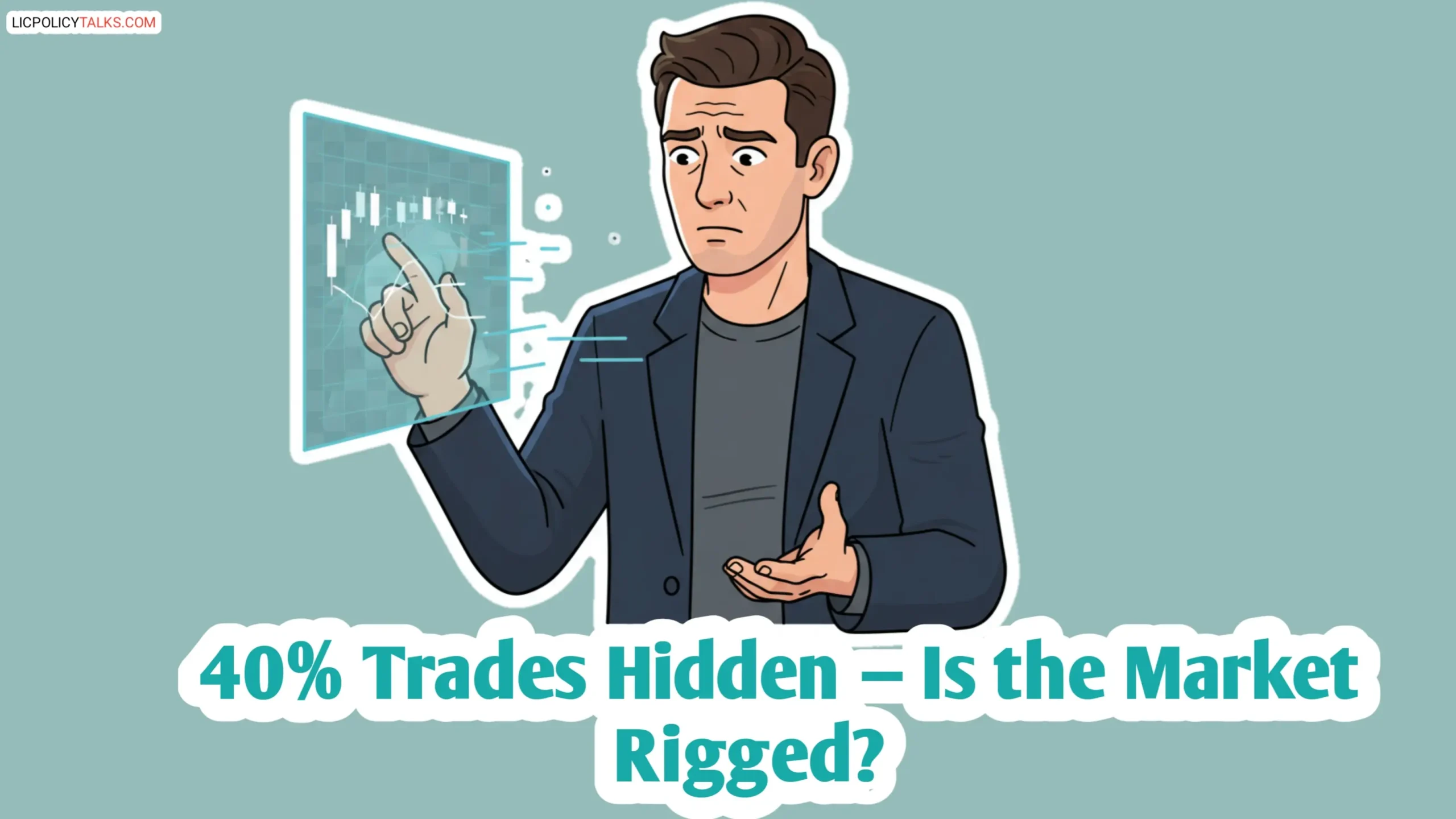
- Approximately 40% of U.S. stock trading volume now occurs in hidden, off-exchange dark pools.
- The 2026 ‘crisis’ stems from severe liquidity fragmentation, eroding price discovery for all investors.
- Retail investors face increased volatility, slippage, and skewed market access due to hidden trades.
- SEC enforcement in 2026 is shifting focus to market integrity and qualitative penalties over pure metrics.
- Protect your portfolio by understanding dark pool exposure and using limit orders on lit exchanges.
Hi friends! Look, if you think you’re seeing the real stock market on your brokerage app, think again. A massive part of the action is invisible. This hidden activity is creating a dark pool liquidity crisis that directly threatens the fairness of the market and the value of your investments. Understanding this isn’t about Wall Street jargon—it’s about protecting your financial security from a system that’s becoming less transparent by the day.
The core issue is stark: about 40% of all U.S. stock trades are executed away from public view. What does this mean for the average investor’s money and market fairness? In 2026, new regulatory shifts and enforcement priorities are bringing this hidden crisis to a head, forcing us to ask hard questions about where our money really goes.
This article cuts through the complexity. We’ll break down the immediate dangers to your portfolio, explain the mechanics of hidden trading, and give you clear strategies to defend your investments. By the end, you’ll see the market in a new light and know exactly how to navigate its hidden corners.
Immediate Implications: How the Dark Pool Liquidity Crisis Threatens Your Investments
Let’s talk direct impact. The dark pool liquidity crisis creates a two-tier market. One tier exists for institutions with access to hidden liquidity, and another, more volatile tier exists for everyone else. This hidden activity distorts stock prices and can lead to unexpected volatility spikes, especially during major news events, catching retail investors off guard. The most critical risk is the erosion of trust in the very price you see on your screen, which can lead to consistently poorer investment outcomes.
The Shocking Reality: 40% of Stock Trades Are Hidden from Public View
Let’s unpack that 40% figure. It represents trillions of dollars in annual trading volume that never shows up on a public ticker. These trades happen in private forums called dark pools and Alternative Trading Systems (ATS). This is a far cry from the transparent, central exchange model—like the NYSE—that most people picture. The data, sourced from FINRA TRF reports and industry analyses, paints a clear picture of a market operating largely in the shadows.
↔️ Slide horizontally to see more
U.S. Equity Trading Volume Distribution (2026)
(Lit Markets)
Direct Impact on Your Portfolio Value and Financial Security
The consequences are concrete. First, you face poorer trade execution, known as slippage—the difference between your expected price and the actual fill. Second, you operate with a false sense of liquidity; the market seems deep, but a huge portion is inaccessible. Third, this fragmentation heightens crash risk when hidden liquidity suddenly vanishes.
The core problem is price discovery. How can the “true” price of a stock be found if 40% of the trades setting that price are invisible? It’s like buying a house where 40% of the comparable sales are secret. You have incomplete, and likely inaccurate, information.
This system disproportionately harms retail investors. You lack the direct access and sophisticated tools that institutions use to navigate dark pools. You’re left trading in the thinner, more volatile public market, bearing the brunt of the instability caused by hidden liquidity fragmentation.

Key Data and Latest Updates: Regulatory Moves in 2026
The regulatory landscape is shifting in response. At the SEC Speaks 2026 conference, enforcement leaders shifted focus to qualitative assessments of market integrity and investor protection under Chairman Atkins. While core enforcement areas remain market manipulation and fraud harming investors, the emphasis is now on outcomes, not just rule-breaking.
Further, the SEC’s first-quarter 2026 priorities for public companies included heightened scrutiny on market structure and trading practices. This signals closer oversight of off-exchange venues and is a clear move to address the transparency gaps at the heart of the dark pool liquidity crisis.
🏛️ Authority Insights & Data Sources
▪ SEC Enforcement Priorities: Analysis of the SEC Speaks 2026 conference indicates a shift under Chairman Atkins towards qualitative enforcement focused on market integrity and investor protection, with core targets including market manipulation.
▪ 2026 Regulatory Landscape: Recent updates from the SEC, CFTC, and international bodies like CIRO highlight intensified scrutiny on manipulative trading practices (spoofing, layering) across all venues, including electronic and off-exchange platforms.
▪ Legislative Activity: 2026 has seen proposed bills in the U.S. Congress, such as the Prediction Markets Security and Integrity Act, aimed at curbing abuse in non-transparent trading venues, signaling political attention on opacity risks.
▪ Market Data: The ~40% off-exchange trading volume figure is widely cited in financial industry reports (e.g., from FINRA, Rosenblatt Securities) and is consistent with periodic public data releases on trade reporting facilities (TRFs).
▪ Note: This analysis integrates publicly available regulatory announcements, enforcement speeches, and market data. It is for informational purposes and does not constitute financial or legal advice.
What Is Dark Pool Trading? Decoding the Hidden Market Ecosystem
Now that we see the impact, let’s decode the mechanics. Dark pool trading originated to solve a big problem for institutions: moving massive blocks of shares without moving the market price against them. They are legal, regulated as Alternative Trading Systems (ATS), but intentionally opaque to the public. Their core function is to provide anonymity and minimize market impact for large trades, but this very feature undermines public market transparency.
Defining Dark Pools and Alternative Trading Systems (ATS)
Formally, a dark pool is a private forum for trading securities that is not accessible to the investing public. They are registered with the SEC as an ATS but operate under different, less stringent reporting rules than public exchanges like the NYSE or Nasdaq.
Major operators include bank-owned pools (like Goldman Sachs’ Sigma X) and independent ATS. While they provide a necessary service for large institutional trading, their growth has fundamentally changed the structure of the equity market, pulling a critical mass of activity away from public view.
The Role of Institutional Trading in Off-Exchange Platforms
Hedge funds, mutual funds, and pension funds use dark pools primarily to minimize market impact and potentially lower transaction costs. The typical order is a large block trade that, if placed on a public exchange, would signal their intention and likely worsen the execution price.
This contrasts sharply with retail order flow, which is mostly executed on “lit” exchanges. This divergence in access and venue creates the two-tier market system, where institutions can operate in a separate, hidden layer of liquidity.
Benefits vs. Risks: Why Dark Pools Exist and Their Controversies
There are legitimate benefits. For the large institutions using them, dark pools offer potential price improvement and reduced market impact, which can lower costs for the end investor (like a pension fund beneficiary).
However, the risks are significant. The lack of transparency is the primary issue. It can hide conflicts of interest, such as a broker trading against a client’s order, and it causes severe liquidity fragmentation. The core controversy is this: do the private benefits to a few large players outweigh the public harm to overall market quality and fairness for all investors?
Root Causes of the 2026 Liquidity Crisis: Why Dark Pools Are Failing
The system is reaching a crisis point in 2026 not because dark pools are new, but because their scale has tipped the balance. The original utility has been overshadowed by systemic risks that now threaten market stability. The crisis is a direct result of technology and regulation failing to keep pace with the explosion in off-exchange trading volume.
Liquidity Fragmentation: How Hidden Trades Drain Public Market Stability
Liquidity fragmentation occurs when buy and sell orders are split across dozens of public and private venues. No single place has deep, reliable liquidity. The consequence is that the public “lit” market becomes thinner, more volatile, and less representative of true supply and demand.
Think of it like draining water from a main reservoir into hundreds of small, hidden ponds. The reservoir (the public market) appears shallower and more susceptible to ripples, while the real volume is scattered and unseen. This makes the market less efficient and more dangerous for everyone.
Regulatory Gaps and the Rise of Unmonitored Trading Activities
Regulation has lagged. Rules for ATS are less stringent than for national exchanges, creating gaps. A key challenge is monitoring for manipulative practices like spoofing or layering within the opaque environment of a dark pool.
This concern is global. In March 2026, CIRO clarified that manipulative practices like spoofing and layering are prohibited in all venues, manual or electronic, highlighting that regulators worldwide are struggling with the same issue. The SEC faces similar ongoing challenges in ensuring market manipulation does not thrive in the dark.
Technological Shifts Accelerating the Dark Pool Trading Boom
Technology fuels the boom. High-frequency trading (HFT) algorithms constantly seek any edge, including accessing hidden liquidity. Furthermore, analysis suggests that after regulators cracked down post-2008, dark pools persisted. Now, technological evolution is pushing more activity on-chain. As noted in a recent analysis, regulators cracked down on dark pools but they persisted, and now technological evolution is pushing more activity on-chain, creating new generations of opaque trading venues that continue the cycle.
Retail Investor Impact: How Hidden Trades Skew Your Market Access
This brings the focus squarely back to you, the individual investor. The retail investor impact is not theoretical; it’s measurable in dollars and cents. Your market access is skewed by a system you cannot see or directly participate in. Your most significant disadvantage is trading based on incomplete and often stale price information, which systematically erodes your portfolio’s value over time.
Eroding Price Discovery: When You Can’t See True Stock Prices
Let’s deep dive into price discovery. The National Best Bid and Offer (NBBO) you see may not reflect true supply and demand if 40% of trading is hidden. For example, a stock might be aggressively bought in dark pools, absorbing sell pressure, while the public tape shows a flat or stagnant price.
The result? You buy at what you think is the fair market price, but it’s an outdated or inaccurate signal. You’re essentially trading in the dark, despite being on a “lit” exchange, because the true market is happening elsewhere.
Increased Volatility and Slippage in Everyday Trades
Slippage is the difference between your expected execution price and the actual fill. Fragmented liquidity directly increases this risk. When a large hidden order in a dark pool is finally filled, it can suddenly exhaust that pocket of liquidity, causing the public price to jump or drop unexpectedly just as your order hits the market.
This also contributes to “flash” volatility events. The public market, drained of depth by hidden stock trades, can swing wildly on relatively small public orders because the stabilizing depth of hidden orders isn’t visible or reliably accessible.
Comparative Analysis: Dark Pools vs. Public Exchanges for Individual Investors
To see the stark differences in how these venues affect you, let’s break it down side-by-side.
Dark Pools vs. Public Exchanges: The Retail Investor Perspective
↔️ Slide horizontally to see the full comparison
| Feature | Dark Pools/ATS | Public (Lit) Exchanges |
|---|---|---|
| Transparency | Hidden | Public |
| Order Types | Large Blocks | All Sizes |
| Price Improvement | Possible | Transparent |
| Impact on Price Discovery | Negative | Positive |
| Retail Access | No Direct Access | Full Access |
SEC Regulations and Market Transparency: Can Oversight Curb the Crisis?
Given these risks, what are regulators doing? The SEC regulations framework exists, but its effectiveness in ensuring true stock market transparency is being tested like never before. The question is whether oversight can adapt quickly enough to curb the crisis. The SEC’s 2026 shift to qualitative enforcement is a recognition that old metrics are insufficient to protect market integrity in today’s fragmented environment.
Current SEC Rules Governing Dark Pool Trading and ATS Operations
Key existing regulations include Regulation ATS, which sets the framework for these platforms, and requirements for Form ATS filings. There are also post-trade transparency rules, where trades are reported to a Trade Reporting Facility (TRF), albeit often with a delay.
Rules like the Order Protection Rule (Rule 611) are meant to ensure investors get the best publicly displayed price, but they have limits when so much trading is hidden. The framework acknowledges dark pools but struggles to fully integrate them into a transparent market structure.
Proposed 2026 Reforms and Enforcement Actions to Boost Transparency
2026 is seeing legislative momentum. Proposed bills like the Prediction Markets Security and Integrity Act of 2026 aim to prohibit manipulation in new markets, reflecting a mindset that could extend to dark pools. The SEC’s own updated enforcement manual standardizes procedures to better police these complex areas.
Ongoing debates focus on increasing real-time or near-real-time reporting for large ATS trades and lowering the volume thresholds that trigger public disclosure. The goal is to shine more light into the dark corners without destroying their utility for legitimate large trades.
The Transparency Debate: Balancing Innovation with Investor Protection
The debate is a tough balancing act. Complete, real-time transparency could eliminate the beneficial aspects of block trading, raising costs for everyone. However, too much opacity clearly harms market integrity and investor trust.
Potential middle-ground solutions include delayed transparency (e.g., reporting large trades at the end of the day) or smarter size thresholds. The SEC’s 2026 qualitative focus suggests a move towards judging outcomes for investors, not just checking compliance boxes, which may lead to more nuanced regulation.
Protective Strategies: How to Safeguard Your Money from Dark Pool Risks
You are not powerless. While you can’t change the market structure overnight, you can take proactive steps to shield your portfolio. The key is awareness and defensive positioning. The single most powerful action you can take is to use limit orders religiously, as they define your maximum price and prevent unpleasant surprises from hidden liquidity gaps.
Due Diligence Steps to Identify Dark Pool Exposure in Your Holdings
Start by checking your broker’s disclosures on order routing. By law, they must provide quarterly reports detailing where they sent your orders. Many retail brokers route orders to wholesale market makers who frequently trade in dark pools. Look for funds or ETFs that explicitly state they avoid dark pools or use direct exchange listings for execution.
For the curious, tools like the SEC’s Market Structure data and FINRA’s Transparency reports offer a macro view of where trading occurs. Knowing the scale of the issue for your specific stocks can inform your strategy.
Portfolio Adjustments: Asset Allocation to Mitigate Liquidity Fragmentation
Adjust your portfolio for resilience. Focus on highly liquid, large-cap stocks where dark pool volume, while present, is a smaller percentage of the massive total trading volume. These stocks have deeper public markets that are harder to distort.
Be cautious with overtrading in illiquid small-cap stocks. Here, hidden trading can dominate the limited volume, leading to extreme price distortions and higher volatility. Your due diligence is even more critical in this space.
Tools and Resources for Monitoring Market Transparency and Avoiding Manipulation
Utilize the resources available. Your brokerage order execution reports are the first line of insight. For broader market surveillance, follow FINRA’s TRF data dashboards. You can also search SEC EDGAR for specific ATS forms (Form ATS-N) to see how individual dark pools are structured. Finally, stay informed on SEC enforcement action announcements—they are a clear signal of where regulators see the biggest risks and abuses.
The Future of Off-Exchange Trading: Predictions and Proactive Steps Post-2026
Looking ahead, the tension between hidden and public trading will define the market’s evolution. The future of off-exchange trading will be shaped by regulatory pressure, technological innovation, and perhaps a catalytic market event. Investors must prepare for a future where transparency is a premium feature, not a market guarantee, and adapt their strategies accordingly.
Long-Term Implications for Stock Market Efficiency and Fairness
Dark pools won’t disappear, but they will likely face incremental regulation to improve post-trade transparency and oversight. The danger is that without meaningful reform, the ongoing liquidity fragmentation could precipitate a major market disruption that forces drastic change.
On the technological frontier, innovations like blockchain are being explored to create new forms of transparent private markets (a concept touched on in our interlinked article on tokenization). This could eventually provide the benefits of block trading with the auditability public markets lack.
Actionable Steps for Investors to Stay Ahead of Regulatory Changes
Your action plan is straightforward. First, always use limit orders. Second, review your broker’s order routing practices annually. Third, make it a habit to stay educated on SEC rule proposals and enforcement actions. Being aware of the regulatory winds is 80% of the battle in protecting your interests.
Final Takeaways: Ensuring Your Investments Thrive Amid Transparency Shifts
Concisely restating the core message: The stock market is far less transparent than you think, and this opacity costs you money through worse execution and distorted prices. The dark pool liquidity crisis is a real, ongoing drain on market quality.
End on a note of cautious empowerment. You cannot control the dark pools, but you can control your response. By understanding these hidden mechanisms, demanding transparency from your brokers, and employing defensive trading tactics, you can make smarter, more resilient investment decisions. Your awareness is your first and best line of defense.